
mRNA Therapeutics Market Overview Analysis By Fortune Business Insights
Market Size & Growth Outlook
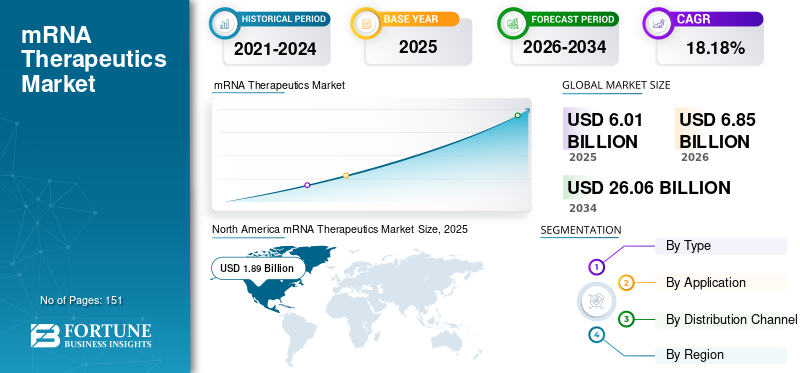
According to Fortune Business Insights: The global mRNA therapeutics market was valued at USD 6.01 billion in 2025 and is projected to grow from USD 6.85 billion in 2026 to USD 26.06 billion by 2034, exhibiting a CAGR of 18.18% during the forecast period. North America dominated the market with a 31.47% share in 2025, valued at USD 1.89 billion — driven by substantial research funding, federal initiatives, a high volume of clinical trials, and the presence of industry-leading companies including Moderna Inc. and Pfizer Inc.
mRNA therapeutics represent a transformative class of biomedical products that use messenger ribonucleic acid to instruct the body's cells to produce specific proteins — triggering immune responses or correcting protein deficiencies associated with disease. The COVID-19 pandemic was a pivotal inflection point for the market, demonstrating mRNA technology's speed, efficacy, and adaptability at global scale and fundamentally accelerating investment, regulatory experience, and public awareness across the broader mRNA therapeutic landscape.
Get a Sample Research PDF: https://www.fortunebusinessinsights.com/enquiry/request-sample-pdf/113411
Market Trends
Growing Adoption of mRNA Technology Across Therapeutic Areas: The defining trend shaping the global mRNA therapeutics market is the expanding application of mRNA technology beyond COVID-19 vaccines into infectious diseases, oncology, rare genetic disorders, and personalized medicine. Pharmaceutical companies have significantly shifted their R&D focus toward mRNA-based drug development, recognizing the technology's potential for personalized cancer treatments tailored to individual genetic profiles and its versatility across diverse disease targets. As of September 2022, approximately 40% of all mRNA-based clinical trials globally were in Phase I — reflecting the depth of early-stage innovation and the growing pipeline breadth across therapeutic areas. In September 2023, Moderna expanded its mRNA research across rare diseases, respiratory conditions, and oncology — signaling the company's strategic pivot from pandemic-era vaccine revenue toward a diversified therapeutic portfolio. The increasing number of clinical trials worldwide is reinforcing the market's structural growth trajectory across both prophylactic and therapeutic applications.
Market Drivers
Compelling Advantages of mRNA Therapeutics Over Conventional Approaches: The primary growth driver is the broad portfolio of advantages offered by mRNA therapeutic products compared to conventional vaccine and drug development platforms. Key advantages include high potency, superior safety profiles, faster development timelines, adaptability to emerging pathogen strains and individual genetic profiles, and fewer side effects relative to traditional biological therapies. mRNA vaccines have demonstrated the ability to generate strong protective immune responses while avoiding integration into host DNA — a significant safety advantage relative to viral vector platforms. These attributes are compelling a growing number of pharmaceutical and biotech companies to invest in mRNA platform development across vaccines, protein replacement therapies, and oncology applications. The COVID-19 vaccines developed by Moderna and BioNTech/Pfizer validated the clinical and commercial viability of mRNA technology at unprecedented scale — establishing a regulatory and manufacturing foundation that is accelerating subsequent pipeline development.
Market Restraints
Cold Chain Logistics and Storage Stability Challenges: The primary market restraint is the significant logistical complexity associated with the storage and distribution of mRNA-based therapeutics. Current mRNA vaccines and therapeutics require ultra-cold storage — often at temperatures as low as minus 70 degrees Celsius — creating substantial infrastructure requirements that limit accessibility in resource-constrained health systems and developing nations. Maintaining cold chain integrity across global distribution networks is technically demanding and costly, restricting the equitable global deployment of mRNA vaccines and constraining adoption in markets lacking specialized cold storage and logistics infrastructure. Scaling production while simultaneously ensuring consistent quality and managing cold chain requirements remains a significant operational and commercial hurdle.
Market Challenges & Opportunities
High Manufacturing Costs Constraining Scalability: A major market challenge is the high manufacturing cost of mRNA products. Large-scale production requires multiple purification steps — processes that are labor-intensive, time-consuming, and sensitive to yield variability — resulting in elevated unit costs that affect pricing, reimbursement, and global accessibility. Navigating diverse and evolving regulatory frameworks across global markets, alongside the ongoing need to build and sustain public trust in mRNA technologies, represents a further commercial and strategic challenge.
Drug Delivery Technology Advancements Creating Significant Opportunities: The most compelling market opportunity lies in the rapid advancement of mRNA delivery technologies — particularly lipid nanoparticles (LNPs), polymeric nanoparticles, and cationic nanoparticles — which are improving mRNA stability, cellular uptake efficiency, and tissue-specific targeting. These innovations are enabling the development of more effective and accessible mRNA therapeutics with enhanced tolerability and lower required doses. The first mRNA drug is expected to be launched in 2027, with the mRNA drugs/medications market estimated to reach USD 2 billion by 2032 at a CAGR of 118.7% — representing one of the most explosive growth trajectories across biopharma. In July 2024, Harvard Medical School researchers developed technologies to make mRNA vaccines more potent and longer-lasting with reduced side effects and smaller doses, exemplifying the research breakthroughs propelling next-generation product development.
Segmentation Analysis
By Type: Prophylactic (vaccines) dominates with a projected 100% market share in 2026 — reflecting the current regulatory landscape in which SpikeVax, Comirnaty, and mRESVIA are the only approved mRNA therapeutics currently on the market, all falling within the vaccine category. Non-COVID-19 vaccines — including candidates targeting influenza, malaria, and Mpox — are expected to contribute increasingly to segment growth. In February 2023, Moderna announced positive Phase 3 results for mRNA-1010, its seasonal influenza vaccine candidate. The drugs/medications segment is projected to grow at a remarkable CAGR — driven by expanding oncology and rare genetic disorder pipelines — with the first mRNA drug expected to reach the market in 2027.
By Application: Infectious diseases leads with 100% market share in 2026, as COVID-19 and RSV represent the only approved mRNA therapeutic applications as of January 2025. Oncology is expected to grow at a significant rate in the near future — with BioNTech initiating global trials in August 2024 for BNT116, an mRNA vaccine candidate for non-small cell lung cancer — alongside a broad and active pipeline of cancer immunotherapy candidates across multiple tumor types. In November 2023, Sanofi and Griffith University opened a new mRNA research site to advance oncology and infectious disease R&D.
By Distribution Channel: Hospital and retail pharmacies dominate with a 63.62% projected share in 2026, driven by the specialized healthcare professional administration requirements of mRNA vaccines and the established institutional procurement frameworks that support approved product distribution. Drug stores and retail pharmacies are expected to grow considerably as government initiatives expand mRNA vaccine availability and public immunization program reach.
Regional Outlook
North America leads with USD 1.89 billion in 2025 (31.47% share), projected to reach USD 2.28 billion in 2026. The U.S. market — projected to reach USD 2.16 billion by 2026 — benefits from substantial R&D investment, a favorable regulatory environment, and strong federal support. In January 2025, the U.S. Department of Health and Human Services provided USD 590 million in funding to Moderna to advance mRNA-based pandemic influenza vaccine development and expand U.S. mRNA platform capabilities. In May 2024, Moderna received FDA approval for mRESVIA — the first mRNA RSV vaccine — underscoring North America's leadership in regulatory approvals.
Asia Pacific generated USD 2.40 billion in 2025 (39.95% global share) — the largest regional market — projected to reach USD 2.67 billion in 2026 and expected to grow at the fastest regional CAGR during the forecast period. Rising R&D investment in China — the region's largest contributor at USD 0.58 billion in 2026 — alongside Japan (USD 0.63 billion in 2026) and India (USD 0.27 billion in 2026), and expanding mRNA applications in oncology and rare genetic disorders, are primary growth catalysts. In March 2023, China approved its first domestically produced mRNA COVID-19 vaccine. In July 2023, Moderna signed a USD 1 billion agreement with Chinese authorities for mRNA research, development, and manufacturing.
Europe contributed USD 1.26 billion in 2025 (20.87% share), projected to reach USD 1.39 billion in 2026. Germany leads the regional market at USD 0.37 billion by 2026, while the U.K. is projected to reach USD 0.15 billion. In August 2024, Moderna received European Commission approval for mRESVIA — expanding the vaccine's reach across the EU. Government initiatives, a strong pipeline of candidates under development, and active company investment sustain regional growth momentum.
Rest of the World accounted for USD 0.46 billion in 2025 (7.7% share), projected to reach USD 0.50 billion in 2026, with improving healthcare infrastructure expected to support sustainable longer-term market development across Latin America and the Middle East & Africa.
Connect with Our Expert for any Queries: https://www.fortunebusinessinsights.com/enquiry/speak-to-analyst/113411
Competitive Landscape
The global mRNA therapeutics market is highly competitive and characterized by the presence of both established pharmaceutical giants and innovative biotech firms. Moderna Inc. (U.S.), BioNTech (Germany), and Pfizer Inc. (U.S.) collectively held a dominant global market share in 2024, driven by their approved product portfolios, extensive clinical pipelines, and continued leadership in mRNA platform innovation. Other key players include CureVac SE (Germany), GSK plc (U.K.), Sanofi (France), Omega Therapeutics (U.S.), Strand Therapeutics (U.S.), and Immunomic Therapeutics (U.S.) — all pursuing strategic partnerships, pipeline investments, and innovative therapeutic development.
Key recent developments include the U.S. FDA's August 2024 emergency use authorization for updated mRNA COVID-19 vaccines (2024–2025 formula); BioNTech's August 2024 initiation of global trials for BNT116 for non-small cell lung cancer; Moderna's May 2024 FDA approval of mRESVIA for RSV; Harvard Medical School's July 2024 breakthrough in potency-enhancing mRNA vaccine technologies; Moderna's September 2023 Phase 3 positive results for mRNA-1010 influenza vaccine; and HHS's January 2025 USD 590 million funding commitment to Moderna for pandemic influenza mRNA vaccine development.
What Everyone Should Know About Japan’s Market - mRNA Therapeutics Market Insights