
Mobile Artificial Intelligence Market Overview Analysis By Fortune Business Insights Analysis
Market Size & Future Outlook
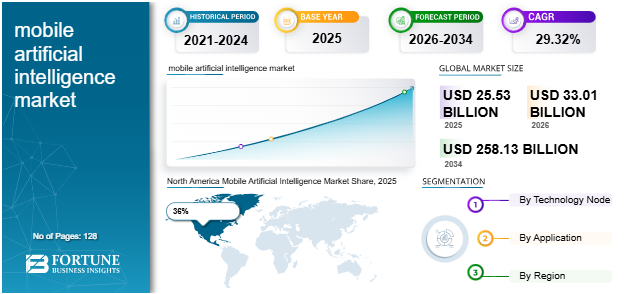
According to Fortune Business Insights: The global mobile artificial intelligence (AI) market was valued at approximately USD 25.53 billion in 2025 and is projected to grow from about USD 33.01 billion in 2026 to approximately USD 258.13 billion by 2034, exhibiting a CAGR of about 29.3% during the forecast period. North America led the market with approximately a 36% share, followed by Asia Pacific at about 32% and Europe at about 28%.
Market Overview
Mobile AI refers to the AI chips, processors, and software that enable intelligent capabilities directly on mobile and edge devices, including smartphones, tablets, wearables, vehicles, cameras, drones, and robots. By running AI models locally rather than relying solely on the cloud, mobile AI delivers faster responses, stronger data privacy, and functionality even without a network connection. The technology underpins features such as voice assistants, computational photography, predictive text, and context-aware applications.
Get a Sample Research PDF: https://www.fortunebusinessinsights.com/enquiry/request-sample-pdf/111573
Market Drivers
The primary driver is rising demand for on-device AI that runs locally, offering lower latency, improved privacy, and offline capability. Consumer appetite for smarter phones, tablets, and wearables is expanding the installed base of AI-capable devices, while edge AI adoption in healthcare, automotive, and industrial settings is broadening demand beyond consumer electronics.
Market Restraints
High research, development, and manufacturing costs for AI processors and software are a significant restraint. Higher power consumption from AI workloads affects battery life and thermal management, constraining device design. Budget limitations also make it difficult for smaller manufacturers and startups to compete with established chipmakers.
Market Opportunities
AI-powered applications such as adaptive user interfaces, predictive text, and photo enhancement are creating new value for consumers and developers. Enterprise use cases in analytics, mobile healthcare, AR/VR, and industrial automation offer additional growth. The rollout of 5G networks supports low-latency edge processing, strengthening the case for distributed, device-level intelligence.
Market Challenges
A key challenge is ensuring AI hardware and software work consistently across a wide variety of chip architectures, operating systems, and device configurations. Fragmented ecosystems and frequent operating system updates complicate long-term compatibility and raise development and maintenance costs for vendors and app makers.
Market Trends
Adoption of neural processing units (NPUs), AI accelerators, and optimized AI chipsets for on-device tasks is accelerating. AI assistants, smart camera features, and context-aware apps are becoming standard in premium and mid-range devices. AI is also being used to enhance AR, VR, and gaming experiences, while cloud-edge hybrid architectures are emerging to balance on-device performance with cloud-scale intelligence.
Segmentation Analysis
By Technology Node: The 20–28nm node holds approximately 30% of the market, followed by 10nm at about 25% and 7nm at about 20%. Other nodes, including 12nm and 14nm, account for roughly 25%.
By Application: Smartphones lead with approximately 35% share, reflecting the central role of handsets in mobile AI adoption. Automotive follows at about 15%, while cameras and AR/VR each hold roughly 12%. Drones account for about 10%, robotics about 8%, and other devices such as smart boards and PCs about 8%.
Regional Analysis
North America leads with approximately 36% share, driven by high smartphone penetration, semiconductor industry strength, and the United States' leadership in AI chips and devices.
Asia Pacific holds about 32%, supported by strong consumer electronics manufacturing, semiconductor development, and 5G deployment. China is a major contributor at roughly 15% of the global market, and Japan is also prominent.
Europe accounts for about 28%, with Germany contributing roughly 12% of global share and the U.K. around 8%, supported by industrial adoption and established data-privacy frameworks.
Rest of the World represents a smaller share, estimated at around 5%, with growth tied to expanding mobile connectivity and device adoption.
Competitive Landscape & Key Developments
The market is led by Qualcomm with approximately an 18% share, followed by Nvidia at about 16%. Other key players include Intel, IBM, Microsoft, Apple, Huawei (HiSilicon), Google, MediaTek, Samsung, Graphcore, and Cambricon.
Notable developments between 2023 and 2025 include new AI mobile processors and NPUs from Qualcomm, Apple, and Huawei; AI-accelerated mobile GPUs from Nvidia; and expanded on-device machine learning frameworks from Google.
Connect with Our Expert for any Queries: https://www.fortunebusinessinsights.com/enquiry/speak-to-analyst/111573
Outlook Summary
The global mobile AI market is on an exceptional growth path through 2034, driven by demand for on-device intelligence, expanding AI-capable device categories, and advances in NPUs and edge-optimized chipsets. While high development costs, power constraints, and ecosystem fragmentation remain challenges, 5G, cloud-edge hybrid architectures, and rising enterprise adoption are expected to sustain rapid expansion across all major regions.
Uncover Japan’s Market Trends - Explore the Latest Mobile Artificial Intelligence Market Insights