
Medical Display Market Overview Analysis By Fortune Business Insights Analysis
Market Summary
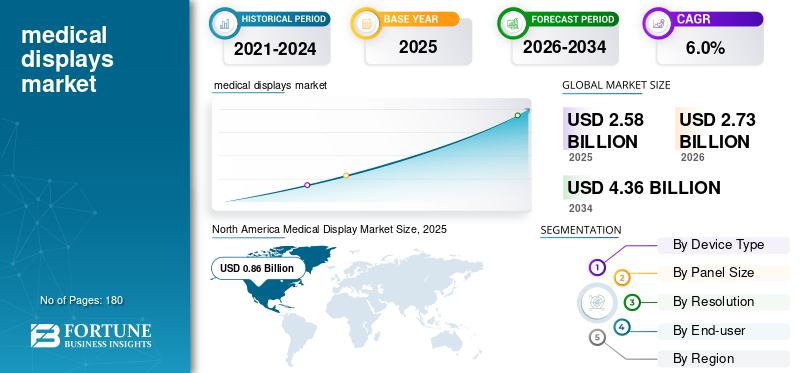
According to Fortune Business Insights: The global medical display market was valued at USD 2.58 billion in 2025 and is projected to grow from USD 2.73 billion in 2026 to USD 4.36 billion by 2034, exhibiting a CAGR of 6.0% during the forecast period. Medical displays are DICOM-compliant monitors used across diagnostic imaging, surgical visualization, and clinical workflow applications, spanning modalities such as MRI, mammography, CT, ultrasound, and endoscopy. Growth is being driven by the rising use of advanced imaging technologies and the ongoing shift from outdated, non-compliant screens to calibrated LED and OLED displays. North America led the market with a 33.33% share in 2025.
Key Market Trends
Manufacturers are increasingly emphasizing higher resolution, wider panels, breast imaging optimization, multiview viewing, and AI-enabled surgical visualization in new product launches. Displays are also being positioned as part of broader clinical workflows, with growing integration into PACS and image management systems as well as future-ready operating room environments designed around connected, high-performance visualization tools.
Get a Sample Research PDF: https://www.fortunebusinessinsights.com/enquiry/request-sample-pdf/115608
Key Market Drivers
Growing use of advanced imaging modalities, including MRI, mammography, CT, ultrasound, and endoscopy, is driving demand for DICOM-compliant, high-resolution displays capable of supporting precise diagnostic work. Rising imaging volumes reinforce this trend, with roughly 6.4 million publicly funded CT scans performed in fiscal 2022-2023, equivalent to 160.2 per 1,000 people, up 9.0% from 2015. Hospitals are also actively upgrading from outdated CCFL and non-compliant screens to DICOM-calibrated LED or OLED displays, further supporting replacement demand across healthcare systems.
Market Restraints
The high cost of medical-grade displays, combined with ongoing calibration and maintenance expenses, limits adoption, particularly among smaller hospitals and diagnostic centers with constrained capital budgets. Pricing reinforces this restraint at the high end of the market, with Carrot Medical's full large-display systems, launched in December 2024, priced between USD 100,000 and 200,000 per turnkey installation.
Market Opportunities
The expansion of telemedicine, digital pathology, and AI-powered diagnostic imaging is creating demand for high-resolution, color-accurate, remotely accessible displays, including OLED, 4K/8K, and cloud-enabled monitors. These technologies are opening new use cases for medical displays beyond traditional hospital radiology departments, extending into remote diagnostic and consultation settings. Rapid changes in panel technology, interfaces, and clinical applications can shorten product relevance and increase R&D requirements, while hospitals must also ensure compatibility among displays, graphics boards, PACS viewers, and calibration software; competition from established brands and cost-focused domestic manufacturers continues to intensify across the category.
Segmentation Analysis
By device type, diagnostic displays held the largest share in 2025, while surgical displays are projected to grow at a faster 6.5% CAGR as operating room visualization needs expand. By panel size, the 23-26 inch segment led with an estimated 45.1% share in 2026, while displays up to 22 inches are projected to grow at a 5.0% CAGR. By resolution, the 2.1-4MP segment held the largest share, projected at 36.2% in 2026, while the 4.1-8MP segment is projected to grow faster at a 6.6% CAGR as higher-resolution imaging becomes more standard. By end-user, hospitals and ambulatory surgical centers (ASCs) led the market, projected at 59.9% in 2026, while diagnostic imaging centers are projected to grow at a 6.4% CAGR.
Connect with Our Expert for any Queries: https://www.fortunebusinessinsights.com/enquiry/speak-to-analyst/115608
Regional Outlook
North America led the market at USD 0.82 billion in 2024, growing to USD 0.86 billion in 2025, with the U.S. projected at USD 0.78 billion by 2026, representing roughly 28.5% of the global market. Europe is projected at USD 0.77 billion by 2026, growing at a 5.4% rate and led by Germany (USD 0.17 billion by 2026, about 6.2% of global share), the U.K. (USD 0.15 billion by 2026, about 5.4%), and France. Asia Pacific ranked as the second-largest regional market, projected at approximately USD 0.61 billion by 2026, led by China (approximately USD 0.22 billion, about 7.9%), Japan (approximately USD 0.17 billion, about 6.2%), and India (approximately USD 0.10 billion, about 3.7%). Latin America is projected at approximately USD 0.26 billion by 2026 with moderate growth, while the GCC region is projected at approximately USD 0.08 billion by 2026, about 2.8% of the global total.
Competitive Landscape
Barco, EIZO Inc., and Sony held the largest market shares in 2025, alongside other key players including Siemens Healthineers, BenQ Medical, LG Electronics, NEC, Advantech, Double Black Imaging, and TRU-Vu Monitors. In September 2025, LG launched the 31.5-inch 4K surgical monitor 32HS710S, and in August 2025, Sony launched the LMD-43M1MD, a 43-inch 4K Mini LED surgical monitor. In October 2024, Barco launched its Coronis OneLook breast radiology display solution, and in August 2024, EIZO launched the RadiForce RX670, a 30-inch 6MP radiology and teleradiology monitor. In May 2024, Barco unveiled its AI-powered DL Precise tool alongside new Nio and Eonis 8MP displays. In April 2024, LG introduced the 21HQ613D 5MP diagnostic monitor, which received FDA clearance in the U.S., and EIZO launched the CuratOR LX2420-T, a 23.8-inch touch monitor designed for operating rooms and interventional radiology.
What’s Driving Japan’s Market? Discover the Latest Medical Display Market Insights