
Infection Surveillance Solutions Market Overview Analysis By Fortune Business Insights Analysis
Market Size & Future Outlook
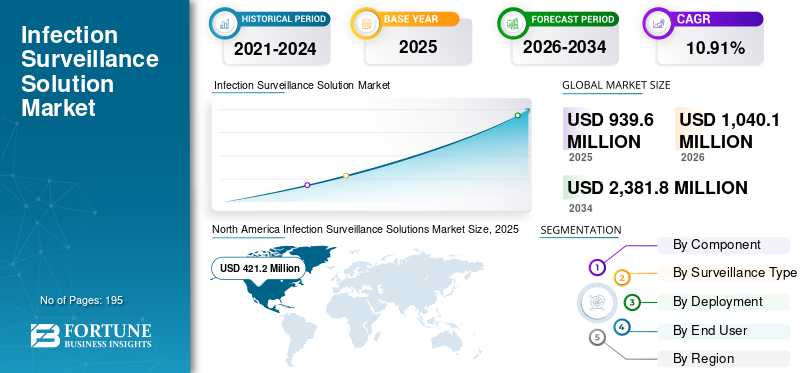
According to Fortune Business Insights: The global infection surveillance solutions market was valued at USD 939.6 million in 2025 and is projected to grow from USD 1,040.1 million in 2026 to USD 2,381.8 million by 2034, exhibiting a CAGR of 10.91% during the forecast period. North America dominated the market with a 44.82% share in 2025, valued at USD 421.2 million. The report covers a study period of 2021–2034, with 2025 as the base year and a forecast horizon running through 2034.
Market Overview
Infection surveillance solutions comprise software and service platforms deployed by healthcare facilities to continuously monitor, detect, and manage healthcare-associated infections (HAIs), antimicrobial resistance (AMR), and outbreak events. These solutions integrate with clinical workflows and electronic health record systems to provide real-time visibility into infection patterns, enabling hospitals and health systems to intervene earlier, strengthen compliance with infection control protocols, and reduce the clinical and financial burden associated with preventable infections.
Get a Sample Research PDF: https://www.fortunebusinessinsights.com/enquiry/request-sample-pdf/112694
Market Drivers
The primary growth driver is the rising prevalence of healthcare-associated infections globally. According to the European Centre for Disease Prevention and Control (ECDC), more than 3.5 million HAI cases occur annually across the EU/EEA alone, underscoring the scale of the clinical challenge facing health systems. This persistent and growing infection burden is compelling hospitals and healthcare networks to invest in dedicated surveillance infrastructure capable of identifying outbreaks earlier, tracking resistant pathogens, and supporting compliance with increasingly stringent infection control mandates imposed by national health authorities and accreditation bodies.
Market Restraints
The primary restraint facing the market is the high cost of implementation combined with limited IT resources at many healthcare facilities. Deploying comprehensive infection surveillance platforms requires significant upfront investment in software licensing, staff training, and systems integration — a burden that falls disproportionately on smaller hospitals, rural facilities, and resource-constrained healthcare networks. This cost and capacity gap continues to slow broader market penetration, particularly outside large acute care hospital systems with dedicated IT infrastructure.
Market Opportunities
A significant opportunity lies in the growing global focus on antimicrobial resistance (AMR) monitoring, including the integration of AMR tracking directly within HAI surveillance platforms. The World Health Organization's September 2025 launch of its updated Global Antimicrobial Resistance and Use Surveillance System (GLASS) dashboard reflects the accelerating institutional priority being placed on AMR data visibility worldwide. Vendors that can deliver unified platforms addressing both HAI and AMR surveillance in a single workflow are well positioned to capture this expanding demand.
Market Challenges
A key challenge is the complexity of integrating infection surveillance platforms with existing electronic health record (EHR) systems. Healthcare facilities often operate EHR systems with varied data formats and architectures, requiring ongoing interface development and maintenance to ensure surveillance platforms can reliably ingest and analyze clinical data in real time. This integration burden can extend implementation timelines and raise total cost of ownership for healthcare providers.
Market Trends
A defining trend is the increasing adoption of AI and machine learning to automate HAI case-finding and enable predictive outbreak prioritization. Rather than relying solely on manual chart review by infection preventionists, AI-powered tools can continuously scan clinical data streams to flag probable infection cases and prioritize them by risk and urgency. The University of Pittsburgh's EDS-HAT (Enhanced Detection System for Healthcare-Associated Transmission) tool, highlighted in April 2025, exemplifies this shift toward algorithmic, data-driven infection surveillance that reduces the manual burden on clinical teams while improving detection speed and accuracy.
Segmentation Analysis
By Component: Software is expected to dominate the market, driven by widespread hospital adoption of digital surveillance tools that improve operational efficiency and enable real-time infection tracking. The services segment, encompassing implementation, training, and support, is projected to grow at a CAGR of 9.88% over the forecast period as healthcare facilities seek ongoing vendor support to maximize platform value.
By Surveillance Type: HAI surveillance holds the largest share at 46.14%, reflecting its foundational role in hospital infection control programs. The AMR and stewardship segment is projected to grow at the fastest rate of 11.86% CAGR, driven by intensifying global attention to antimicrobial resistance as a public health priority. Outbreak detection & response and post-discharge surveillance round out the remaining application areas.
By Deployment: Cloud/SaaS deployment dominates with a 64.42% share, reflecting healthcare providers' preference for scalable, lower-maintenance infrastructure that supports real-time data access across care settings. On-premise deployment, while declining in relative share, is still projected to grow at a CAGR of 8.79%, driven by facilities with strict data residency or security requirements.
By End User: Acute care hospitals dominate with a 63.12% share, given their high infection risk profiles and regulatory reporting obligations. Private hospital networks are projected to grow fastest at a CAGR of 12.03%, as consolidated health systems increasingly standardize surveillance platforms across multiple facilities. Long-term care facilities and diagnostic labs represent additional, smaller end-user segments.
Regional Analysis
North America leads the global market, supported by strict infection control regulations and high healthcare IT adoption rates. The U.S. alone is projected to reach approximately USD 424.4 million in 2026, representing roughly 40.8% of the global market.
Europe is the second-largest region, projected to reach USD 274.1 million in 2026 and grow at a CAGR of 9.94%, driven by robust national infection surveillance programs and accelerating hospital digitization initiatives. Germany (approximately USD 50.3 million, 4.8% share) and the U.K. (approximately USD 40.8 million, 3.9% share) are the region's largest individual markets.
Asia Pacific ranks as the third-largest region at approximately USD 182.0 million in 2026, led by China (USD 43.7 million), Japan (USD 32.6 million), and India (USD 18.8 million), reflecting expanding hospital infrastructure investment and rising awareness of infection control standards across the region.
Latin America and Middle East & Africa are expected to register comparatively slower growth, constrained by limited healthcare IT budgets and lower overall adoption of digital surveillance infrastructure relative to more developed markets.
Competitive Landscape & Key Developments
The market is moderately consolidated, led by Premier Inc., Oracle, and BD, alongside other notable players including Wolters Kluwer N.V., Clinisys, GOJO Industries, Baxter, RLDatix, and Epic Systems. Companies are competing primarily through strategic partnerships, new product development, and continuous platform enhancement.
Notable recent developments include Inovalon's acquisition of VigiLanz in February 2024, with VigiLanz subsequently ranked first by KLAS for Infection Control & Monitoring; Wolters Kluwer's Sentri7 being named Best in KLAS for Infection Control & Monitoring in February 2025, followed by a platform update in June 2025; Ireland's eHealth Ireland announcing a national clinical surveillance IT system built on Baxter's ICNET platform in July 2025; and BD updating its HealthSight Infection Advisor with new MedMined Insights workflow and training capabilities in October 2025.
Connect with Our Expert for any Queries: https://www.fortunebusinessinsights.com/enquiry/speak-to-analyst/112694
Outlook Summary
The global infection surveillance solutions market is positioned for steady, sustained growth through 2034, driven by the persistent global burden of healthcare-associated infections, intensifying focus on antimicrobial resistance monitoring, and accelerating AI-powered automation of infection detection workflows. While implementation costs and EHR integration complexity remain structural barriers — particularly for smaller facilities — continued regulatory emphasis on infection control and the shift toward cloud-based, AI-enabled platforms are expected to sustain robust market expansion across all major regions.
Uncover Japan’s Market Trends - Explore the Latest Infection Surveillance Solutions Market Insights