
Hydrogen Market Overview Analysis By Fortune Business Insights
Market Summary
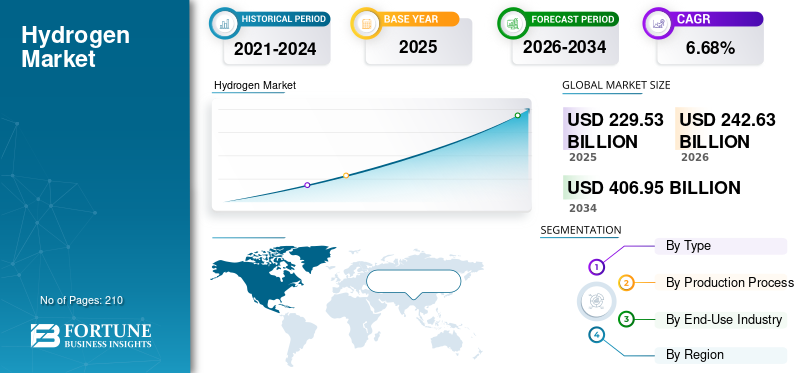
According to Fortune Business Insights: The global hydrogen market was valued at USD 229.53 billion in 2025 and is projected to grow from USD 242.63 billion in 2026 to USD 406.95 billion by 2034, at a CAGR of 6.36% during the forecast period. Hydrogen is emerging as a key pillar of the global energy transition, supporting decarbonization across hard-to-abate industrial sectors including steel, cement, refining, and chemicals, while also enabling renewable energy storage, clean power generation, and low-emission transportation. The market spans the production, storage, distribution, and end-use application of hydrogen across grey, blue, and green production routes. Asia Pacific dominated the market with a 31.45% share in 2025, valued at USD 110.46 billion.
Get a Sample Research PDF: https://www.fortunebusinessinsights.com/enquiry/request-sample-pdf/114275
Key Market Drivers
Renewable integration and energy storage are the primary market drivers. Green hydrogen enables the storage of surplus solar and wind energy — converting intermittent renewable generation into a storable, dispatchable energy carrier that can be deployed for power generation, industrial feedstocks, and transportation. This grid stabilization and decarbonization function is becoming increasingly critical as renewable penetration expands globally, reinforcing hydrogen's strategic importance to energy transition frameworks. In April 2025, the Asian Development Bank approved USD 104 million toward Georgia's Energy Storage and Green Hydrogen Development Project — establishing the country's first energy storage system and investigating green hydrogen production potential. In February 2025, Siemens, Guofu Hydrogen, and RCT GH Hydrogen signed an MOU to co-develop green hydrogen production using electrolyzers, targeting international expansion of green hydrogen technology.
The rising adoption of hydrogen in shipping and heavy-duty vehicles is a defining market trend. Unlike battery-electric solutions, hydrogen fuel cells and hydrogen-derived fuels including green ammonia and methanol offer the longer range, faster refueling, and high energy density required by maritime shipping and commercial road transport. In May 2024, Volvo Trucks announced development of hydrogen combustion engine trucks with road testing commencing in 2026 and commercial availability targeted for later in the decade — illustrating accelerating momentum toward hydrogen-powered heavy transport.
Market Restraints and Challenges
High production costs are the primary market restraint. Green hydrogen produced via electrolysis requires substantial renewable electricity inputs, expensive electrolyzer systems, and extensive storage and distribution infrastructure, making it significantly costlier than grey hydrogen from natural gas and less competitive with conventional fossil fuels at current scale. The energy intensity of hydrogen production, compression, and liquefaction adds further cost burden, deterring widespread industrial and utility adoption until technology scales and electrolyzer costs fall further. Green hydrogen's cost premium over grey hydrogen continues to deter near-term industrial conversion absent strong policy incentives or carbon pricing.
Market Opportunities
The shift toward hydrogen-based steelmaking represents the most significant growth opportunity. Conventional blast furnace-basic oxygen furnace steelmaking is one of the world's largest industrial CO2 sources. Direct reduced iron (DRI) processes using green hydrogen — replacing coking coal as the reductant — offer a pathway to near-zero-carbon steel production. Major steel producers in Europe, Japan, South Korea, China, and the Middle East are investing in pilot and commercial-scale hydrogen DRI facilities, supported by growing government funding and green transition policies. In August 2024, Linde Engineering signed an agreement with Shell for a 100 MW renewable hydrogen unit for the REFHYNE II project in Wesseling, Germany — designed to produce up to 44,000 kilograms per day of renewable hydrogen to decarbonize site operations at Shell Energy and Chemicals Park Rheinland.
Segmentation Analysis
By type, the grey segment dominates with a 95.25% share in 2026, reflecting the low-cost, commercially established nature of steam methane reforming without carbon capture. Grey hydrogen benefits from abundant natural gas feedstocks, proven technology, and existing infrastructure — making it by far the most cost-competitive production route. The green segment is the fastest-growing at a CAGR of 15.33%, driven by declining renewable energy costs, robust policy support globally, and large-scale project investment. In January 2025, India launched its first green hydrogen hub, with approximately USD 21.6 billion expected to flow into 20 GW of renewable energy projects producing 1,500 tonnes of green hydrogen per day alongside derivatives including green urea, green methanol, and sustainable aviation fuel.
By production process, reforming without carbon capture held an 81.00% share in 2026, driven by its lowest-cost position, commercial maturity, and reliance on established steam methane reforming infrastructure. The others segment — comprising water electrolysis and reforming with carbon capture — is the fastest-growing at a CAGR of 9.27%, supported by decarbonization objectives, government support frameworks, and the growing commercial viability of clean hydrogen pathways.
By end-use industry, refineries dominate with a 40.53% share in 2025, as the largest consumers of hydrogen globally — utilizing it in hydrocracking and desulfurization processes — and as operators with extensive grey hydrogen infrastructure already in place. In June 2025, India announced green hydrogen venture plans totaling approximately USD 23 billion, including tenders for 42,000 tonnes per year of green hydrogen production by domestic oil refineries. The methanol segment is the fastest-growing end-use at a CAGR of 7.90%, supported by rising demand for methanol both as a chemical intermediate and as a low-emission maritime and transportation fuel.
Regional Outlook
Asia Pacific led the global market at USD 110.46 billion in 2025, projected at USD 117.28 billion in 2026, driven by strong industrial demand, abundant renewable resources, and large-scale government programs supporting hydrogen adoption across steel, refining, and clean mobility. China is the region's largest market at USD 51.43 billion in 2026, supported by government decarbonization commitments, rapid electrolyzer production scale-up, industrial hydrogen demand, and expanding hydrogen fuel cell vehicle deployment. Europe is the second-largest market at USD 46.10 billion in 2025, growing at a CAGR of 7.30% — the second-highest rate globally — driven by ambitious decarbonization targets, large government investments, and coordinated industrial efforts to embed hydrogen across the energy transition. Germany leads European demand at USD 11.45 billion in 2025. North America is the third-largest market at USD 40.96 billion in 2025, with the U.S. at USD 36.10 billion in 2026, supported by favorable policy frameworks, rising industrial demand for cleaner energy, and major infrastructure investment programs. The Middle East and Africa held GCC revenues of USD 13.47 billion in 2025, leveraging world-leading solar radiation resources and feedstock advantages for green hydrogen production and export programs. Latin America contributed USD 7.35 billion in 2025, supported by exceptional renewable energy endowments — with approximately 60% of electricity generated from renewables according to the IEA — providing a strong foundation for competitive green hydrogen production.
Connect with Our Expert for any Queries: https://www.fortunebusinessinsights.com/enquiry/speak-to-analyst/114275
Competitive Landscape
The global hydrogen market is shaped by established industrial gas leaders, integrated energy majors, and specialized clean energy technology companies. Key players include Linde plc (U.K.), Air Liquide (France), Air Products and Chemicals Inc. (U.S.), Shell plc (U.K.), Aramco (Saudi Arabia), Toyota Motor Corp. (Japan), ITM Power (U.K.), Nel ASA (Norway), Technip Energies (France), Cummins Inc. (U.S.), Messer Group (Germany), Ballard Power Systems Inc. (Canada), Plug Power (U.S.), BP Plc (U.K.), and ExxonMobil (U.S.). In May 2025, Technip Energies and Graphitic Energy announced a strategic collaboration to accelerate adoption of clean hydrogen technologies. In March 2025, Nel ASA entered an EPC collaboration with Samsung E&A to deliver complete hydrogen plants using Nel electrolyzers, with Samsung E&A acquiring a 9.1% ownership stake in Nel. In March 2025, Air Products Qudra and Aramco completed the takeover of a 50% equity interest in the Blue Hydrogen Industrial Gases Company in Jubail, Saudi Arabia, enabling large-scale lower-carbon hydrogen supply to the Jubail Industrial City. In July 2024, Virya Energy, HyoffGreen, and Messer finalized the investment decision for the 25 MW Hyoffwind renewable hydrogen production facility in Zeebrugge, Belgium — targeting first production in 2026 and 25,000 tonnes of annual CO2 reduction.
What’s Driving Japan’s Market? Discover the Latest - Hydrogen Market - Insights