
Graphics Card Market Overview Analysis By Fortune Business Insights Analysis
Market Summary
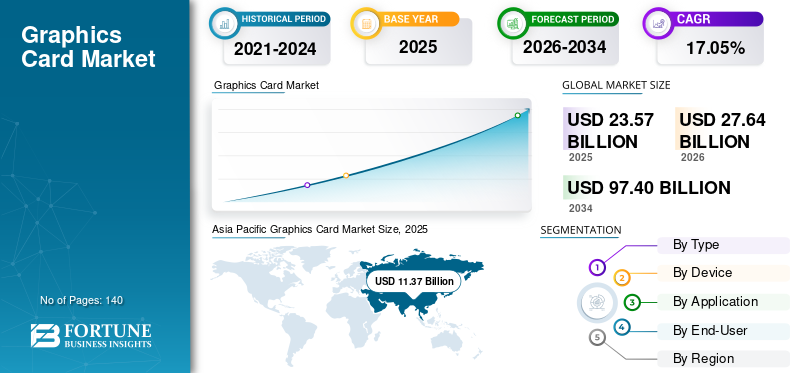
According to Fortune Business Insights: The global graphics card market was valued at USD 23.57 billion in 2025 and is projected to grow from USD 27.64 billion in 2026 to USD 97.4 billion by 2034, exhibiting a CAGR of 17.05% during the forecast period. Graphics cards have expanded well beyond their original gaming use case into AI training, high-performance computing, video rendering, and cloud data centers, with institutional buyers such as data center operators and cloud providers increasingly becoming major customers alongside traditional consumer segments. Asia Pacific led the market with a 48.22% share in 2025.
Key Market Trends
Integration of GPUs into AI infrastructure and machine learning workloads continues to accelerate, as parallel processing capabilities make graphics cards well suited to training and inference tasks. Real-time ray tracing and AI-driven features, including DLSS and frame generation, are becoming standard differentiators in consumer and professional products alike. Hyperscale cloud providers are deploying large GPU clusters to support AI and compute-intensive workloads, while manufacturers are increasingly offering specialized GPU architectures tailored separately for gaming, AI inference, and professional visualization use cases.
Get a Sample Research PDF: https://www.fortunebusinessinsights.com/enquiry/request-sample-pdf/112636
Key Market Drivers
AI and machine learning demand for parallel processing capability is a primary growth driver, as GPUs remain the preferred hardware for training and running large-scale models. Cloud computing expansion is reinforcing this trend, with providers scaling GPU infrastructure to meet enterprise demand. Gaming growth across PC, console, and mobile platforms, along with the continued rise of esports and game streaming, remains a substantial demand source, as does growth in multimedia editing and content creation. Cryptocurrency mining has also periodically served as a notable demand driver for discrete graphics cards.
Market Restraints
High power consumption and heat dissipation requirements continue to pose engineering and infrastructure challenges, particularly as GPU performance scales upward. Driver support and software/hardware compatibility issues can also complicate deployment across diverse systems. The market remains dependent on limited advanced semiconductor foundry capacity, which constrains supply during periods of high demand, while high production costs for advanced GPU architectures add further pressure. Volatility tied to cryptocurrency mining cycles has historically contributed to demand swings that complicate production planning.
Market Opportunities
Cloud gaming services, including platforms from Google, Microsoft Xbox Cloud Gaming, and Amazon Luna, represent a growing opportunity as they shift graphics processing from consumer devices to centralized data centers. Enterprise adoption of generative AI is opening substantial new demand for GPU infrastructure beyond traditional gaming and visualization markets. Edge computing with GPU-enabled systems is also emerging as an opportunity, alongside professional visualization applications in automotive, aerospace, and medical imaging.
Segmentation Analysis
By type, discrete graphics cards held a 60.5% share in 2026, while integrated graphics represent the faster-growing type as manufacturers improve integrated GPU performance. By device, servers and data centers formed the largest segment at 31.95% in 2026, while laptops posted the highest CAGR at 22.08%, with gaming consoles, desktops, and smartphones making up the remaining device categories. By application, gaming led with a 34.55% share in 2026, while cryptocurrency mining posted the highest CAGR at 21.34%, alongside education and training and multimedia editing applications. By end-user, consumer electronics led with a 27.74% share in 2026, while healthcare posted the highest CAGR at 21.73%, with industrial, media and entertainment, and IT and telecommunications rounding out the remaining end-user base.
Regional Outlook
Asia Pacific led the market with a 48.22% share in 2025 (USD 11.37 billion, projected at USD 13.33 billion in 2026), with China at USD 4.98 billion, Japan at USD 2.94 billion, and India at USD 1.65 billion in 2026. North America held a 32.90% share (USD 7.75 billion in 2025, USD 9.11 billion projected for 2026), with the U.S. at USD 7.78 billion in 2026. Europe accounted for a 12.04% share (USD 2.84 billion in 2025, USD 3.35 billion projected for 2026) and is expected to grow at the fastest rate over the forecast period, with the U.K. at USD 0.71 billion, Germany at USD 0.66 billion, and France at USD 0.34 billion in 2026. The Middle East & Africa held a 4.06% share (USD 0.96 billion in 2025, USD 1.1 billion projected for 2026), with the GCC region at USD 0.36 billion in 2025, while Latin America held a 2.77% share (USD 0.65 billion in 2025, USD 0.75 billion projected for 2026).
Connect with Our Expert for any Queries: https://www.fortunebusinessinsights.com/enquiry/speak-to-analyst/112636
Competitive Landscape
Key players include NVIDIA Corporation, AMD, ASUSTeK, MSI, GIGABYTE, EVGA, SAPPHIRE, ZOTAC, PNY Technologies, Intel, XFX, PowerColor, Innovision Multimedia, ASRock, Apple, and Galaxy Microsystems. In June 2026, NVIDIA unveiled additional GeForce RTX 50 Series models through partners at COMPUTEX 2026. In May 2026, Intel introduced Arc G-Series processors for handheld gaming systems, and AMD introduced Radeon RX 9060 XT cards built on RDNA 4 architecture with FSR 4 upscaling. In February 2025, G42 announced a strategic investment in France with DataOne, including an AI data center in Grenoble equipped with AMD GPUs. In January 2024, NVIDIA introduced GeForce RTX SUPER desktop cards alongside related generative AI tools, and in July 2023, AMD announced plans to invest approximately USD 400 million over five years in India's R&D operations.
What’s Driving Japan’s Market? Discover the Latest Graphics Card Market Insights