
Gelato Market Overview Analysis By Fortune Business Insights
Market Size & Growth Outlook
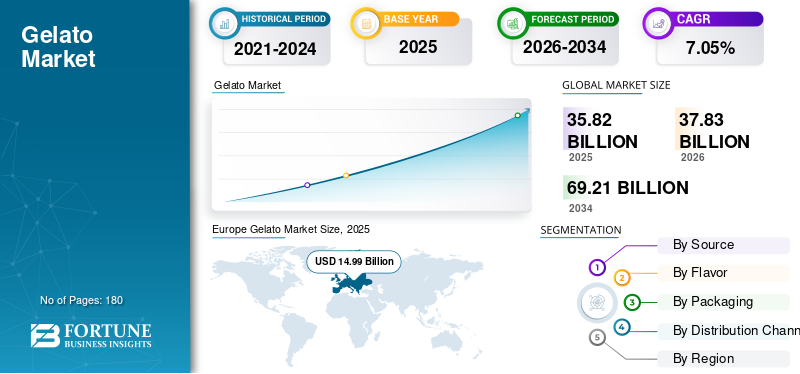
According to Fortune Business Insights: The global gelato market was valued at USD 35.82 billion in 2025 and is projected to grow from USD 37.83 billion in 2026 to USD 69.21 billion by 2034, exhibiting a CAGR of 7.05% during the forecast period. Europe dominated the market with a 39.64% share in 2025, valued at USD 14.99 billion — reflecting gelato's Italian origins, its deep cultural embeddedness across the continent, and the presence of leading manufacturers headquartered in Italy, Germany, Switzerland, the U.K., and Denmark.
Gelato is a traditional Italian frozen dessert distinguished from conventional ice cream by its lower fat and air content — resulting in a denser, smoother, and creamier texture with a more intense flavor profile. It is made primarily from milk, sugar, and natural flavoring ingredients, with a lower proportion of cream than standard ice cream. Growing awareness of gelato's relatively lower fat content compared to conventional ice cream, combined with the expanding global artisanal food trend and rising consumer demand for premium frozen desserts, is propelling the market's sustained expansion.
Get a Sample Research PDF: https://www.fortunebusinessinsights.com/enquiry/request-sample-pdf/110759
Market Trends
Increasing Artisanal Frozen Desserts Trend Reshaping Consumer Preferences: The defining trend shaping the global gelato market is the accelerating consumer shift toward artisanal frozen desserts — products made from high-quality, often locally sourced or organic and natural ingredients, with significant attention to production craft and authenticity. Consumers are increasingly willing to pay premium prices for artisanal gelato that offers a distinctive, authentic taste profile unavailable in mass-produced frozen desserts. The growing number of dedicated gelato parlors globally is both a reflection and a driver of this trend — with more than 39,000 gelato parlors operating across Italy alone by the end of 2023, according to Italian Gelato.info. In the U.K., the Ice Cream Alliance reported more than 1,000 artisanal ice cream makers operating in the country in 2025, further illustrating the sector's momentum across Europe. Social media and international travel exposure are simultaneously amplifying awareness of authentic gelato globally, drawing new consumers toward the premium artisanal category.
Market Drivers
Increasing New Product Launches Expanding Consumer Choice: The primary market driver is the continuous wave of new product launches by global and regional brands — introducing novel flavors, seasonal variants, and innovative formats that attract a broadening consumer base. Companies are actively developing exotic, fusion, and limited-edition gelato offerings to meet evolving consumer tastes, particularly among youth and millennials who seek variety and culinary exploration in their dessert choices. In April 2025, Baskin-Robbins launched a new gelato range in the Indian market targeting health-conscious consumers and younger demographics — including Chocolate & Roasted Hazelnut, Berry Me in Cheesecake, and Mango & Cream Gelato Sundaes. In January 2025, Unilever PLC launched a new range of products under its ice cream brands — Talenti, Breyers, Popsicle, Good Humor, Magnum, and Klondike — featuring bakery-inspired gelato and s'mores-themed treats, broadening its premium frozen dessert portfolio considerably.
Rising International Exposure to Premium Frozen Desserts: Growing consumer exposure to international cuisines and culinary trends through social media and travel is fueling the gelato category's global popularity. The rising demand for exotic and unique flavors is attracting adventurous consumers globally, compelling food and beverage companies to enter the gelato category. In March 2023, Next Gen Foods — an emerging plant-based food producer — acquired Mwah, a dairy-free artisanal gelato startup, to expand into the artisanal frozen desserts space and address the growing vegan and health-conscious consumer segment.
Market Restraints
Higher Prices and Strong Substitute Competition: The primary restraint is the significant price premium of gelato compared to conventional ice cream and other frozen desserts. Gelato is typically priced 2–3 times higher than conventional ice cream due to the specialized machinery required for its lower-air-content manufacturing process, the quality of ingredients used, and its positioning as an artisanal product. This pricing creates a meaningful barrier to market entry and adoption — particularly in developing markets including India, Brazil, and Southeast Asia — where consumers remain highly price-sensitive. Additionally, leading global frozen dessert brands such as Häagen-Dazs, Ben & Jerry's, and Baskin-Robbins offer premium-quality traditional ice cream at more affordable price points, creating strong competitive pressure that may slow gelato's penetration among mainstream price-conscious consumer segments.
Market Opportunities
Mergers, Acquisitions, and Geographic Expansion Reshaping the Competitive Landscape: The growing global popularity of artisanal frozen desserts is attracting significant M&A activity, as larger food companies seek to acquire established regional gelato brands and accelerate their presence in the premium frozen dessert category. In February 2024, Gelato d'Italia — an Italian gelato manufacturer — acquired Giuntoli, a maker of ice creams and ice lollies, to increase its production capacity and strengthen its position in the Italian market. Additionally, in November 2024, Gelato d'Italia introduced the Gelato d'Italia Production System (GPS) — a new manufacturing initiative combining traditional Italian gelato craftsmanship with cutting-edge automation technology — aimed at improving production efficiency and gelato quality at commercial scale.
Segmentation Analysis
By Source: Dairy dominates the market, reflecting gelato's traditional formulation using whole milk and its rich, creamy, authentic texture that remains preferred among consumers globally. Dairy-based gelato is widely available across retail and specialty store channels and is comparatively more affordable than non-dairy alternatives — reinforcing its leading position. The non-dairy segment is the fastest-growing category, driven by the accelerating global vegan trend, growing lactose-intolerance awareness, and the increasing availability of plant-based gelato formulations using coconut, almond, oat, and soy bases. Key players are actively expanding their non-dairy offerings to capture health-conscious and vegan consumer segments.
By Flavor: Vanilla leads the market with a projected 25.14% share in 2026, valued for its natural antioxidant content, classic aroma, and versatile compatibility with multiple flavor combinations and toppings — making it the most universally appealing and consistently purchased gelato flavor across demographics. The chocolate segment is the fastest-growing flavor category, supported by an International Dairy Foods Association 2024 survey that ranked chocolate-flavored ice cream and gelato as the second most popular flavor in the U.S. Growing consumer awareness of the health benefits of cocoa — combined with chocolate gelato's excellent compatibility with nuts, cookies, and brownies — is sustaining this segment's growth momentum throughout the forecast period.
By Packaging: Take-home dominates with a projected 79.43% share in 2026, driven by bulk-quantity purchasing behavior, appealing multi-serve packaging formats, and the value-for-money proposition of at-home consumption. Take-home gelato allows consumers to enjoy premium frozen desserts within family settings and social gatherings at a more economical per-serving cost. The impulse segment is the fastest-growing packaging format, reflecting rising consumer demand for convenient, single-serve, on-the-go gelato formats — particularly among millennial and younger consumers who consume premium snacks throughout the day.
By Distribution Channel: Retail channels lead the market with a projected 73.56% share in 2026, offering consumers broad brand selection, high product accessibility, and growing online retail convenience. Within retail, supermarkets and hypermarkets lead, while online retail is the fastest-growing retail sub-channel — offering a hassle-free shopping experience and increasing availability of specialty gelato brands to consumers outside major urban centers. The food service channels segment is expected to grow at the highest CAGR during the forecast period, driven by gelato's increasing penetration into hotels, cafés, restaurants, universities, and casinos. In September 2021, Perfect Day — a dairy-identical gelato brand — partnered with Villa Dolce to make its gelato products available across 2,000 U.S. food service providers, exemplifying the segment's expansion potential.
Regional Outlook
Europe leads the global market at USD 14.99 billion in 2025 (39.64% share), projected to reach USD 15.82 billion in 2026. Italy remains the spiritual and commercial heart of the global gelato industry — with over 39,000 gelato parlors and a per-capita consumption that continues to grow through the steady introduction of new flavors alongside traditional categories. Germany is projected to reach USD 3.01 billion in 2026, while the U.K. follows at USD 1.73 billion.
North America generated USD 10.26 billion in 2025 (27.12% share), projected to reach USD 10.89 billion in 2026. The U.S. — the region's dominant market projected at USD 8.56 billion in 2026 — is driven by millennial snacking culture, on-the-go impulse format adoption, and a strong premiumization trend in frozen desserts. Per the International Dairy Foods Association's 2023 survey, more than two-fifths of U.S. producers recorded a significant rise in demand for premium ice cream and gelato products.
Asia Pacific generated USD 9.00 billion in 2025 (23.78% share), projected to reach USD 9.61 billion in 2026. Rising middle-class income, rapid urbanization, and growing appreciation of Italian cuisine are driving gelato demand across China, India, and Australia. China is projected to reach USD 3.77 billion by 2026, Japan at USD 1.12 billion, and India at USD 1.04 billion — with new gelato outlet openings accelerating growth across tier-one cities.
South America contributed USD 2.26 billion in 2025 (5.98% share), projected to reach USD 2.41 billion in 2026, driven by premium artisanal dessert adoption in urban areas across Brazil, Argentina, Chile, and Peru — where millennials treat gelato as a premium indulgence for special occasions.
Middle East & Africa held USD 1.32 billion in 2025 (3.49% share), projected to reach USD 1.39 billion in 2026, with the UAE and Saudi Arabia's multicultural populations and strong tourism sectors creating sustained demand for diverse international flavors.
Connect with Our Expert for any Queries: https://www.fortunebusinessinsights.com/enquiry/speak-to-analyst/110759
Competitive Landscape
The global gelato market is fragmented, with leading international brands and regional artisanal players competing on flavor innovation, product quality, and geographic expansion. Key players include Nestle SA (Switzerland), Unilever PLC (U.K.), General Mills (U.S.), GS Gelato (U.S.), Baci Gelato (U.S.), Minus 30 (India), Gelato Factory (India), Gelato Italia Ltd. (U.K.), and Firenzes Artisanal Gelato (Italy).
Key recent developments include Sammontana Gelato's June 2025 U.S. market entry launching its premium Italian gelato range including Bindi and Sammontana Gelati all'Italiana; Nova Artisan Gelato's July 2025 expansion into Mumbai's Bandra neighborhood; Ferrero International's July 2024 launch of Nutella gelato in convenient packaging available across European supermarkets; Gelato d'Italia's November 2024 launch of the GPS production system combining artisanal craft with cutting-edge manufacturing technology; and Gelato d'Italia's February 2024 acquisition of Giuntoli to expand Italian production capacity and market reach.
What’s Driving Japan’s Market? Discover the Latest - Gelato Market Insights