
Functional Food and Beverage Market Overview Analysis By Fortune Business Insights Analysis
Market Size & Growth Outlook
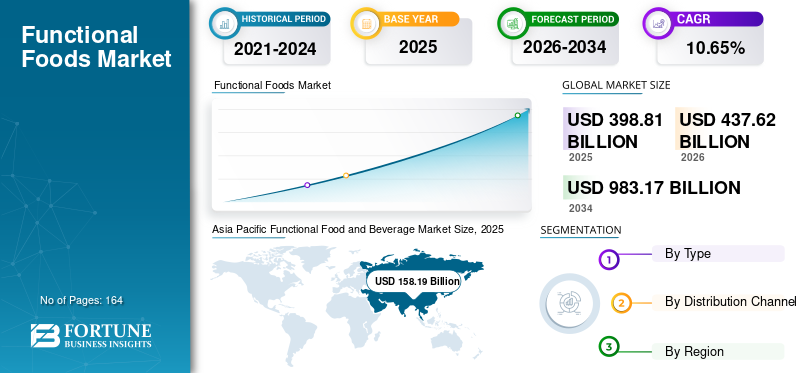
According to Fortune Business Insights: The global functional food and beverage market was valued at USD 398.81 billion in 2025 and is projected to grow from USD 437.62 billion in 2026 to USD 983.17 billion by 2034, exhibiting a CAGR of 10.65% during the forecast period. Asia Pacific dominated the market with a 39.67% share in 2025, valued at USD 158.19 billion — driven by rising health awareness, increasing discretionary incomes, and a large population transitioning from fast food-driven diets toward more nutrition-rich alternatives. The U.S. market alone is projected to reach USD 73.52 billion by 2026, reflecting the strength of North America's health-conscious consumer base.
Functional foods and beverages are products enriched with functional nutrients — including amino acids, vitamins, minerals, proteins, fatty acids, prebiotics, and probiotics — that deliver quantifiable health benefits beyond their basic nutritional value. These products target conditions such as obesity, diabetes, cardiovascular disease, and digestive disorders, and have gained significant consumer relevance as awareness of diet-related health risks intensifies globally.
Get a Sample Research PDF: https://www.fortunebusinessinsights.com/enquiry/request-sample-pdf/102269
Market Trends
Rising Consumer Spending on Healthy and Nutritious Diet Products: The defining trend reshaping the global functional food and beverage market is the accelerating consumer shift toward healthy, nutrition-rich diets — driven by evolving lifestyles, rising disposable incomes, and heightened health consciousness across developed and developing economies alike. Functional beverages designed for on-the-go consumption are particularly popular, offering enhanced nutrition without requiring dietary routine disruption. Increasing product development activity, expanding e-commerce availability, and unique promotional strategies — including personalized nutrition, digital health integration, and subscription-based product delivery — are collectively fueling market growth. The COVID-19 pandemic served as a significant demand accelerant, permanently elevating consumer awareness of immunity-supporting and wellness-aligned food and beverage products. Key manufacturers responded rapidly — with Amazon expanding its Amazon Fresh online grocery service to four additional Indian cities in November 2020, directly widening functional food access during the pandemic.
Market Drivers
Growing Consumption of Nutrient-Enriched Foods to Improve Health and Well-Being: The primary growth driver is the rising global demand for nutrient-enriched foods — compelled by hectic modern lifestyles, increased awareness of chronic disease risks, and consumer desire for convenient nutritional supplementation. According to the U.S. Department of Agriculture's Supplemental Nutrition Assistance Program, more than two-thirds of the 42 million Americans covered under SNAP prefer to eat healthier food and beverages — illustrating the scale of health-conscious consumer demand. Consumers are particularly drawn to functional products that reduce the risk of obesity, weight-related complications, diabetes, and cardiovascular disease — conditions whose prevalence is rising globally due to sedentary lifestyles and increased stress. Rising demand for hemp-infused foods and beverages, probiotics, and prebiotics is creating notable new sub-categories within the broader functional food market.
Innovation and New Product Development Accelerating Market Expansion: Increasing R&D investment and continuous product innovation are critical secondary drivers. Companies are creating functional confectioneries such as gummies and toffees targeting children, nutrition bars targeting fitness enthusiasts, and functional beverages serving consumers seeking quick and convenient nutrition. Advanced production technologies — including encapsulation technology, enzyme technology, vacuum impregnation, and edible coating technology — are enabling manufacturers to develop more effective and appealing functional products. Encapsulation in probiotics, for instance, supports ambient temperature storage and higher water activity while reducing viability loss — improving product shelf life and consumer convenience. Fonterra Co-operative Group collaborated with 7-Eleven to launch functional milk beverages Actif-Fiber and Anchor Beaute across 14,000 convenience stores in Thailand, exemplifying the market's retail innovation momentum.
Market Restraint
Off-Taste and Flavor of Functional Ingredients Hampering Consumer Acceptance: The primary market restraint is the off or bitter taste that functional ingredients — particularly botanical extracts and herbs — impart to food and beverage products when added. Taste remains the most critical purchase factor even among health-conscious consumers — meaning products that fail to deliver an acceptable sensory experience are unlikely to achieve repeat purchase. Manufacturers are employing taste and flavor modifiers, flavor masking techniques, and complementary natural fruit flavors to address this challenge. Citrus and astringent berry flavors work particularly well with antioxidant fortifications, while natural fruit flavors are increasingly preferred in functional beverages and food due to the broader consumer trend toward clean-label and plant-based ingredients.
Segmentation Analysis
By Type: Functional dairy products dominate with a projected 41.49% market share in 2026 — driven by the growing consumer focus on digestive health and the widespread adoption of probiotic and prebiotic dairy formats including yogurt, kefir, and fortified milk. The higher affordability of functional dairy relative to other functional food categories makes it particularly accessible in developing markets. In December 2020, Danone launched its Oikos Pro Line of yogurt cups and drinks enriched with essential amino acids, proteins, and minerals for muscle building and bone maintenance. The cereal and grains segment holds the second-largest position — representing one of the most effective vehicles for government-mandated food fortification programs globally, including the addition of iodine in salt, vitamin D in milk, and iron and vitamin B in flours. India's government allocated approximately USD 21.06 million under PM's Poshan Abhiyan to deliver fortified milk, oil, wheat, rice, and salt to more than 500 million beneficiaries. Functional fats and oils are growing rapidly as awareness of omega-3 fatty acids and other healthy fat variants expands among health-conscious consumers. Functional bakery products and other fortified food categories round out the segment.
By Distribution Channel: Supermarkets and hypermarkets dominate with a projected 43.83% share in 2026 — driven by their extensive product assortments, consumer trust in established retail channels, dedicated health food shelf sections, and strategic bundling and promotional pricing capabilities. These large-format retailers are also expanding into underserved locations and offering superior shelf visibility for nutritional and functional products. Convenience stores have emerged as a major distribution channel — offering both accessibility and specialized functional product ranges from diverse brands. The online retail segment is expected to grow at the fastest CAGR — driven by the e-commerce boom, attractive digital promotions, subscription-based purchasing, and manufacturers' increasing investment in digital marketing and direct-to-consumer sales strategies.
Regional Outlook
Asia Pacific leads the global market at USD 158.19 billion in 2025 (39.67% share), growing at a CAGR of 10.82% — the highest regional growth rate during the forecast period. Rising health awareness, increasing discretionary incomes, and the growing prevalence of chronic diseases related to fast food consumption are driving consumers toward nutritional and functional food alternatives. China is projected to reach USD 60.4 billion by 2026 — the largest country contributor in the region — while Japan follows at USD 45.22 billion, and India at USD 32.51 billion, reflecting its rapidly growing functional food adoption across both urban and rural populations.
North America generated USD 98.41 billion in 2025 (24.68% share), projected to reach USD 107.16 billion in 2026. A growing base of health-conscious U.S. consumers — driving heightened demand for foods rich in functional and nutritious substances — sustains the region's strong market position. The presence of major food companies including Tyson Foods, General Mills, and PepsiCo actively investing in functional food and beverage development further reinforces North America's market leadership.
Europe contributed USD 74.25 billion in 2025 (18.62% share), projected to reach USD 81.42 billion in 2026. Stable demand is supported by increased R&D investment by market players and the EU's stringent regulatory framework — which ensures only safe and high-quality functional products reach consumers, improving market confidence. The U.K. is projected to reach USD 21.35 billion by 2026, while Germany follows at USD 17.89 billion.
Latin America contributed approximately USD 55.91 billion in 2025 (14.02% share), projected to grow to USD 61.35 billion in 2026.
Middle East & Africa held USD 12.05 billion in 2025 (3.02% share), projected to reach USD 13.21 billion in 2026.
Connect with Our Expert for any Queries: https://www.fortunebusinessinsights.com/enquiry/speak-to-analyst/102269
Competitive Landscape
The global functional food and beverage market is moderately consolidated, led by Danone S.A. (France), Nestle S.A. (Switzerland), General Mills Inc. (U.S.), Glanbia Plc (Ireland), The Coca-Cola Company (U.S.), PepsiCo Inc. (U.S.), Tyson Foods Inc. (U.S.), Celsius Holding Inc. (U.S.), Arla Foods (Denmark), and Hearthside Food Solutions (U.S.). Leading players focus on R&D, strategic acquisitions, and innovation partnerships to address evolving consumer health demands.
Key recent developments include Yoplait's September 2023 launch of SKYR Energy high-protein yogurt with vitamin B6, vitamin D, and real fruit pieces; Javo Beverage's May 2023 introduction of all-natural functional energy lemonades and flavored teas; Hangobi's April 2023 launch of fortified beverages across three functional variants distributed through KeHE, UNFI Supervalu, and C&S Wholesale; Mars Inc.'s November 2020 full acquisition of KIND North America to expand its functional snack footprint; and the December 2019 merger between International Flavours and Fragrances Inc. and DuPont's nutrition and bioscience division to create high-value functional food ingredient solutions.
Explore Japan’s Market Opportunities - Latest - Functional Food and Beverage Market Insights