
Freight Trucking Market Overview Analysis By Fortune Business Insights Analysis
Market Size & Growth Outlook
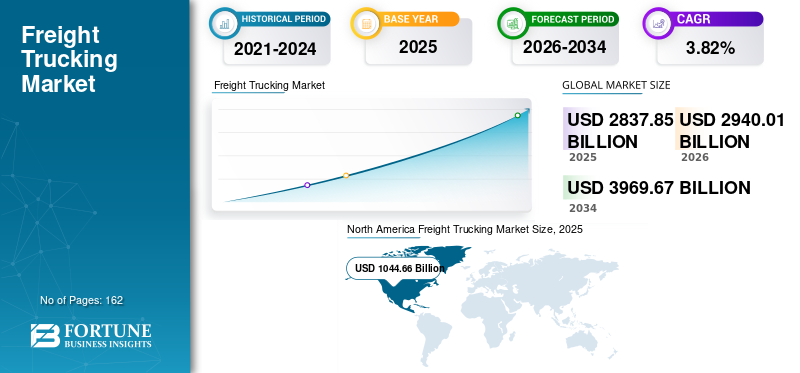
According to Fortune Business Insights: The global freight trucking market was valued at USD 2,837.85 billion in 2025 and is projected to grow from USD 2,940.01 billion in 2026 to USD 3,969.67 billion by 2034, exhibiting a CAGR of 3.82% during the forecast period. North America dominated the global market with a share of 36.81% in 2025, valued at USD 1,044.66 billion — driven by a highly integrated road transport network, strong industrial base, and rising adoption of green logistics solutions across the U.S. and Canada.
Freight trucks are large, heavy vehicles that transport goods from production and distribution points to end-user destinations — serving as essential connectors across inland waterway, maritime, air, and rail transport modes. Road freight transport is valued for its flexibility, reliability, and cost-effectiveness in transporting goods across diverse geographies and cargo types. The market's growth is underpinned by accelerating urbanization, expanding e-commerce activity, growing global trade, and the accelerating adoption of zero-emission electric trucks across developed and emerging economies.
Get a Sample Research PDF: https://www.fortunebusinessinsights.com/enquiry/request-sample-pdf/105069
Market Trends
Increasing Demand for Electrified, Energy-Efficient Trucks Driving Industry Transformation: The defining trend reshaping the global freight trucking market is the accelerating adoption of zero-emission and fuel-efficient vehicles — driven by stricter government emission standards, rising fossil fuel prices, and growing environmental consciousness among logistics operators. Freight trucking service providers are increasingly transitioning toward battery electric vehicles (BEVs) and hydrogen fuel-cell electric vehicles (FCEVs) to comply with emission mandates and reduce operational fuel costs. In July 2023, 15 leading freight service providers partnered as part of the Government of India's Zero Emission Vehicle Emerging Markets Initiative (ZEV-EMI) and Electric Freight Accelerator for Sustainable Transportation (E-FAST) initiatives — collectively initiating a coordinated electrification transition for Indian freight trucks. In August 2023, Seattle's Office of Sustainability and Environment announced a plan for local truck drivers to transition to electric trucks to improve air quality in communities adjacent to the port. In February 2023, CEMEX received an order for a fully electric, zero exhaust emission heavy-duty concrete mixer truck — illustrating how emissions regulations are compelling even construction material suppliers to transition toward electric freight vehicle fleets.
Market Driver
Upsurge in Urbanization Creating Indispensable Demand for Freight Trucking: The primary growth driver is the accelerating pace of global urbanization — which creates increasing and sustained demand for efficient goods transportation to and from expanding urban areas. As populations concentrate in cities, the need for reliable supply chains connecting industrial production sites, distribution hubs, and urban consumers intensifies significantly. According to the United Nations World Urbanization Prospects, 3.9 billion people currently live in urban areas — compared to 746 million in 1950 — and the UN projects that more than 70% of the world's population will reside in urban areas by 2050, up from 55% today. This demographic transformation is creating consistent incremental freight trucking demand across residential supply chains, commercial logistics, and industrial goods distribution. Rising e-commerce activity and expanding global trading further compound urbanization's impact — increasing shipment volumes, shortening delivery windows, and raising the operational requirements placed on freight trucking networks globally.
Market Restraint
Poor Road Infrastructure and Higher Logistics Costs Constraining Market Efficiency: The primary market restraint is the significant operational burden imposed by poor road infrastructure and elevated logistics costs. Inadequate road conditions — including potholes, congestion, and poor maintenance — increase vehicle wear and tear, elevate fuel consumption, and cause delivery schedule delays. According to the American Society of Civil Engineers (ASCE), the United States' road infrastructure received a grade of D+ in its 2021 Infrastructure Report Card. The ASCE estimated that poor road conditions cost the U.S. economy USD 170 billion annually in vehicle operating costs and congestion-related delays. Volatile fuel prices further amplify cost pressures — with U.S. diesel prices averaging USD 3.31 per gallon in December 2021, a significant increase compared to preceding years. Rising fuel, labor, and regulatory compliance costs together constrain trucking company profitability and limit competitive pricing in price-sensitive freight segments.
Segmentation Analysis
By Truck Type: The dry van segment dominates with a projected 61.65% market share in 2026 — driven by its unmatched versatility in transporting a broad range of goods including consumer products, electronics, furniture, groceries, and apparel. Dry vans are the preferred choice for most shippers and freight forwarders due to their enclosed, weatherproof design and compatibility with standard loading docks. The tanker segment is the fastest-growing truck type, expected to exhibit the highest CAGR over the forecast period — driven by expanding industrial sectors including chemicals, petroleum, pharmaceuticals, milk products, and other liquid or bulk cargo requirements. Refrigerated trucks are growing strongly, serving temperature-controlled food and pharmaceutical supply chains, while flatbed trucks serve construction, machinery, and oversized cargo transport requirements.
By End User: The agriculture segment dominates with a projected 29.20% market share in 2026 — driven by the high-volume and time-sensitive logistics requirements of fresh produce, perishable food items, and agricultural inputs. Agricultural goods require fast, reliable transportation — often with refrigeration — to preserve quality from farm to processing facility and from distribution center to retail outlet. The retail sector is the fastest-growing end-use segment — driven by rapid globalization, the expansion of international retailers into developing markets, and the rising volume of e-commerce deliveries requiring last-mile truck transport. Pharmaceuticals, electronics, petrochemicals, building materials, and automobiles all contribute significant secondary demand across diverse freight types.
Regional Outlook
North America leads the global market at USD 1,044.66 billion in 2025 (36.81% share), projected to reach USD 1,070.29 billion in 2026. The U.S. is projected to reach USD 988.25 billion — accounting for the dominant share of North American freight trucking demand through its highly integrated highway network, large industrial economy, and extensive retail and e-commerce supply chain infrastructure. Average Route Guide Depth (RGD) in North America improved by 8% in August 2023 compared to August 2022 — reflecting strengthening carrier-shipper relationships and improving freight market dynamics. In May 2022, Maersk completed the acquisition of Pilot Freight Services — a U.S.-based supply chain provider delivering cross-border solutions in Canada and Mexico — illustrating the strategic importance of North American freight network integration.
Asia Pacific is the second-largest region and fastest-growing market at USD 894.19 billion in 2025 (31.51% share), projected to reach USD 934.26 billion in 2026. Rapidly growing trade across the region — particularly between Asia and China — is accelerating market expansion. GEODIS, a global logistics leader, expanded its Road Network from Southeast Asia to China in August 2023 — providing secure, day-definite, and environmentally friendly road freight solutions connecting Singapore, Malaysia, Thailand, Vietnam, and China. Japan is projected to reach USD 297.88 billion by 2026, India at USD 224.61 billion, and China at USD 140.04 billion — with India and China representing the most dynamic growth markets through industrial expansion and urbanization-driven freight demand.
Europe contributed 18.31% of global market revenues in 2025 at USD 519.73 billion, projected to reach USD 541.56 billion in 2026. Germany leads the region at a projected USD 166.36 billion by 2026, reflecting the country's central role as a manufacturing and export logistics hub within the European supply chain. The U.K. follows at USD 81.32 billion, sustained by strong retail distribution, pharmaceutical logistics, and cross-channel trade volumes.
Rest of the World accounted for USD 379.26 billion in 2025 (13.36% share), projected to reach USD 393.90 billion in 2026 — supported by port expansion, growing e-commerce, and increasing regional trade in Latin America, the Middle East, and Africa.
Connect with Our Expert for any Queries: https://www.fortunebusinessinsights.com/enquiry/speak-to-analyst/105069
Competitive Landscape
The global freight trucking market is led by Deutsche Post AG (DHL) — an official logistics partner for Formula 1, FIFA, and Manchester United — alongside C.H. Robinson Worldwide Inc., UPS, FedEx Corporation, Kuehne+Nagel International AG, A.P. Moller Maersk, Schenker AG, Nippon Express Holdings Inc., Landstar System Holdings Inc., and DSV Solutions. DHL operates in more than 200 countries and delivers 1.818 billion parcels per year, maintaining a commanding global market position.
Key recent developments include Ryder's February 2024 acquisition of Cardinal Logistics to strengthen its dedicated contract carrier position in North America; RXO's January 2024 launch of AI-powered truck check-in technology using video analytics to streamline warehouse arrival and security processes; A.P. Moller Maersk and Kodiak Robotics' October 2023 launch of the first commercial autonomous trucking lane between Houston and Oklahoma City; UPS's September 2023 acquisition of MNX Global Logistics to expand in temperature-sensitive healthcare and radio-pharmaceutical logistics; and DSV's March 2023 acquisition of S&M Moving Systems West and Global Diversity Logistics to support semiconductor industry and cross-border Latin American operations.
Curious About Japan’s Market? Explore the Latest - Freight Trucking Market Insights