
Fraud Detection and Prevention Market Overview Analysis By Fortune Business Insights
Market Summary
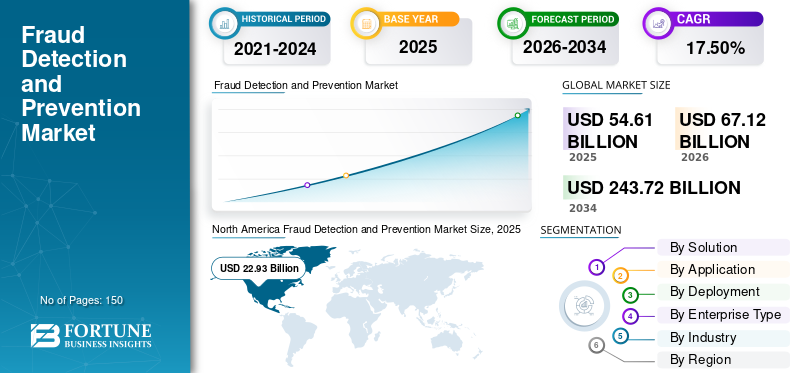
According to Fortune Business Insights: The global fraud detection and prevention (FDP) market was valued at USD 54.61 billion in 2025 and is projected to grow from USD 67.12 billion in 2026 to USD 243.72 billion by 2034, at a CAGR of 17.50% during the forecast period. Fraud detection and prevention encompasses analytics, authentication, and governance, risk and compliance (GRC) solutions deployed across industries to identify and neutralize fraudulent activity — including payment fraud, identity theft, insurance fraud, and money laundering — through the application of AI, machine learning, behavioral analytics, and multi-factor authentication technologies. Growing investment by enterprises and governments in advanced fraud solutions across BFSI, healthcare, retail, and government sectors is propelling market expansion globally. North America dominated the market with a 42.00% share in 2025, valued at USD 22.93 billion.
Get a Sample Research PDF: https://www.fortunebusinessinsights.com/enquiry/request-sample-pdf/100231
Key Market Drivers
The increasing adoption of online applications and mobile banking services is the primary market driver. According to Boston Consulting Group, approximately 70% of global resident users are digitally influenced to purchase financial products and services through mobile banking websites or e-banking applications. This rapid shift to digital financial interactions has simultaneously expanded the attack surface for fraudsters — generating fake websites, spoofed mobile applications, and phishing campaigns that mimic legitimate retail and banking platforms. The growing number of internet users, rising adoption of digital payment methods, and proliferation of e-commerce startups are further accelerating demand for robust FDP solutions across all major industries.
Cloud adoption as a technology enabler is the defining market trend. Cloud-based FDP platforms offer robust processing power, scalable storage, internet-accessible deployment, and rapid tracing of online cybercrimes — making them particularly attractive to small and mid-sized enterprises in banking and financial services that lack the capital for extensive on-premises infrastructure. Cloud also enables advanced capabilities including real-time predictive analytics, machine learning-driven customer profiling, and behavioral analytics at scale. In November 2019, ACI Worldwide collaborated with Salesforce to integrate the Salesforce Commerce Cloud with its real-time fraud prevention system, embedding predictive analytics and machine learning directly into the e-commerce payment flow — an early example of the ecosystem integration now characterizing the market.
Market Restraints and Challenges
The lack of skilled professionals and awareness across developing nations is the primary market restraint. Organizations keep critical customer records on servers that require constant protection and security updating — a task that demands specialized expertise in cybersecurity, data analytics, and fraud pattern recognition that remains scarce in emerging economies. Advanced cyberattacks and novel anonymous threats are increasingly challenging traditional FDP solutions designed for known attack vectors. Additionally, lack of awareness and acceptance of FDP solutions across Middle East and Africa, Asia Pacific, and South American markets — including Mexico, Argentina, Chile, Peru, Colombia, and the Caribbean — limits penetration in high-growth regions.
Segmentation Analysis
By solution, the authentication segment is expected to capture the largest market share. Multi-factor authentication adds critical security layers that make it exceptionally difficult for attackers to access confidential data — Microsoft has specified that multi-factor authentication can prevent approximately 99.9% of attacks. The fraud analytics sub-segment — encompassing predictive analytics, customer analytics, social media analytics, Big Data analytics, and behavioral analytics — drives the sophisticated, data-driven layer of FDP platforms enabling proactive fraud identification before financial losses occur.
By deployment, the cloud segment is projected to reach 46.44% of market share in 2026, driven by AI and data analytics advancements and high adoption among SMEs with limited IT infrastructure budgets. The on-premises segment sustains stable growth, primarily within government and education sectors where data residency and regulatory compliance requirements favor local deployment.
By enterprise type, large enterprises led with a 64.09% share in 2026, driven by escalating digital transformation and the corresponding rise in fraudulent activities targeting large-scale digital ecosystems. SMEs are expected to record the highest CAGR, as increasing availability of affordable, cloud-based FDP solutions tailored to growing startups — particularly in Germany, Brazil, Canada, and Israel — broadens the addressable market.
By application, electronic payment held the largest share at 42.18% in 2026, reflecting the surge in online transaction volumes and the corresponding fraud risk. According to the Federal Trade Commission, global e-commerce losses due to online payment fraud reached USD 41 billion in 2022. The insurance claims segment is expected to grow at the highest CAGR, driven by rising fraudulent claims across disaster, contractor, accident, break-in, and life insurance categories.
By industry, BFSI dominated in 2024, as fraudsters have developed increasingly sophisticated digital methods to steal customer identities and access personal accounts. The FTC received 2.8 million fraud reports from consumers in 2021 alone, with total losses of approximately USD 5.8 billion — sustaining BFSI's position as the largest FDP end-user. Healthcare and life sciences is expected to register the highest CAGR, driven by growing demand for fraud analytics and authentication in healthcare billing, insurance claims, and clinical data environments.
Connect with Our Expert for any Queries: https://www.fortunebusinessinsights.com/enquiry/speak-to-analyst/100231
Regional Outlook
North America leads at USD 22.93 billion in 2025, projected at USD 28.08 billion in 2026, anchored by the U.S. — where organizations actively adopt FDP solutions to secure critical information from escalating cyberattacks and governments implement secure payment platforms integrated with advanced fraud prevention. Europe recorded USD 16.81 billion in 2025 (30.80% global share), projected at USD 20.70 billion in 2026, with the U.K. at USD 6.46 billion and Germany at USD 5.08 billion — both driven by government, manufacturing, and healthcare sector investment in FDP solutions. Asia Pacific represented USD 11.17 billion in 2025 (20.40% global share), projected at USD 14.00 billion in 2026, with China at USD 5.50 billion, Japan at USD 2.41 billion, and India at USD 2.26 billion — all regions investing actively in FDP solutions to address growing digital payment and manufacturing sector fraud risks. Latin America was valued at USD 1.52 billion in 2025 (2.80% global share), projected at USD 1.78 billion in 2026, led by Brazil's IT sector development. The Middle East and Africa contributed 4.00% of the global market at USD 2.19 billion in 2025, projected at USD 2.57 billion in 2026.
Competitive Landscape
The global FDP market features major players focusing on geographic expansion, product innovation, and strategic collaborations and acquisitions to strengthen their positions. Key players include IBM Corporation (U.S.), Experian Information Solutions Inc. (U.S.), ACI Worldwide Inc. (U.S.), BAE Systems (U.K.), Fair Isaac Corporation/FICO (U.S.), Fidelity National Information Services Inc. (U.S.), LexisNexis (U.S.), NICE Actimize Ltd. (Israel), Gemalto/Thales Group (France), and Uplexis (Brazil). In December 2023, Experian and NeuroID partnered to enhance fraud prevention solutions against identity theft and AI-powered bots. In October 2023, Oscilar launched the industry's first generative AI-powered fraud prevention platform capable of automatically identifying fraud patterns, conducting root cause analysis, and providing real-time risk recommendations. In May 2023, Experian launched Hunter, a fintech-focused fraud prevention data network in the U.S. In May 2022, Fiserv launched a fraud mitigation service reducing fraud losses by 10–15% for small and medium bank clients by integrating FICO Fraud Predictor, Global Intelligent Profiles, and Adaptive Analytics into a cohesive AI-driven solution.
What’s Driving Japan’s Market? Discover the Latest - Fraud Detection and Prevention Market Insights