
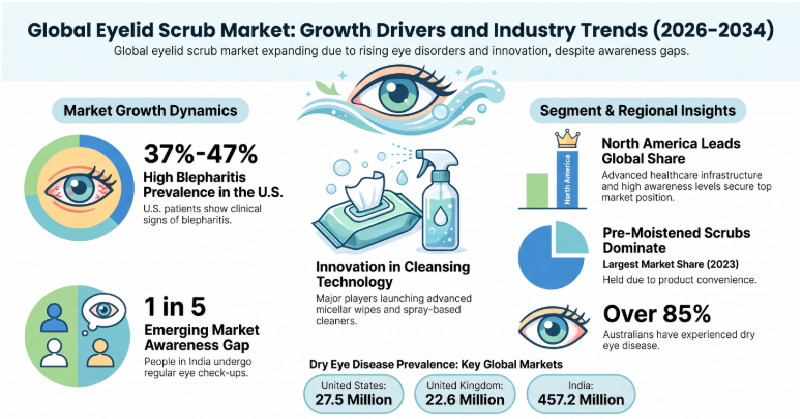
Eyelid Scrub Market Overview Analysis By Fortune Business Insights
Market Size & Growth Outlook
According to Fortune Business Insights: The global eyelid scrub market is experiencing significant growth, driven by the rising global prevalence of eye disorders — including dry eye disease, blepharitis, and related conditions — and the growing awareness of eyelid hygiene as a component of preventive eye care. North America accounted for the largest share of the global eyelid scrub market, supported by a well-developed healthcare infrastructure, elevated disease prevalence, and strong consumer awareness of the therapeutic benefits of regular eyelid cleansing. Europe follows as the second-largest regional market, driven by increasing incidence of eye conditions and active product expansion by leading players. The forecast period covered is 2026 through 2034.
Eyelid scrubs are nonabrasive cleansing products designed to clean the eyelid margins, remove debris, oil, and bacterial biofilm, and soothe irritation associated with eyelid and ocular surface disorders. Available in pre-moistened wipe, spray, and dry pad formats, these products are prescribed and recommended by ophthalmologists and optometrists as daily maintenance tools for patients managing dry eye disease, blepharitis, and related conditions. Their growing integration into routine eye care management — both in clinical settings and at home — is reinforcing sustained market demand across multiple geographies.
Get a Sample Research PDF: https://www.fortunebusinessinsights.com/enquiry/request-sample-pdf/111655
Market Driver
Rising Prevalence of Eye Disorders Generating Sustained Product Demand: The primary growth driver is the escalating global burden of eye conditions that directly necessitate eyelid hygiene management, particularly dry eye disease and blepharitis. According to 2023 statistics published by the National Center for Biotechnology Information (NCBI), the worldwide prevalence of dry eye disease ranges from 5% to 50% of the population — a wide range reflecting significant variation in diagnostic criteria and geographic population characteristics. Country-level NCBI data indicates that dry eye disease affects approximately 27.5 million people in the U.S., 22.6 million in the U.K., 18.0 million in Germany, 2.4 million in Australia, and 457.2 million in India — underscoring the enormous scale of the patient population that represents a potential user base for eyelid scrub products globally. Blepharitis prevalence adds substantially to overall demand: according to 2024 statistics published by the American Academy of Ophthalmology, approximately 37% to 47% of patients in the U.S. showed signs of blepharitis. The growing focus of prominent manufacturers on expanding their product portfolios through continuous new launches is further contributing to growing adoption rates among the patient population.
Market Restraint
Limited Awareness and Low Eye Check-Up Rates in Emerging Countries: The primary market restraint is the limited awareness of eyelid scrubs and their therapeutic benefits among patient populations in developing countries — compounded by low rates of regular eye examinations that reduce the likelihood of physician-guided product recommendation and adoption. In India — one of the world's largest potential markets given its 457.2 million dry eye disease patients — 2024 data published by the Hindustan Times indicated that only 1 in 5 people undergo regular eye check-ups. This low examination rate significantly reduces exposure to eyelid scrub product recommendations by eye care professionals, constraining adoption among the country's large patient population. Similar dynamics apply across other major emerging markets including China, Brazil, and parts of Southeast Asia, where ophthalmology visit rates remain relatively low relative to disease burden and where consumer awareness of specialized eyelid hygiene products is still developing.
Market Opportunity
Rising Demand for Advanced and Innovative Product Formats: A significant market opportunity lies in the growing consumer and clinical demand for advanced eyelid scrub formulations, including spray scrubs and enhanced wipe formats offering improved convenience, ingredient efficacy, and ease of use for daily eyelid hygiene routines. As prominent manufacturers increase their R&D investments in response to growing patient demand, the pipeline for innovative eyelid scrub products is expanding. In July 2021, Bausch + Lomb launched Biotrue Micellar Eyelid Cleansing Wipes — a micellar technology-based product specifically designed for patients with dry eyes — with the aim of strengthening its product portfolio in the eyelid care segment. Increasing physician endorsement of regular eyelid hygiene as a foundational component of dry eye and blepharitis management is further creating a favorable clinical environment for new product introductions and patient education initiatives that drive adoption.
Segmentation Analysis
By Product: Pre-moistened scrubs dominate the market, reflecting their convenience, physician familiarity, and widespread recommendation as the most accessible and practical format for daily eyelid cleansing routines. Their ready-to-use formulation — typically buffered with gentle cleansing agents, tea tree oil extracts, or antimicrobial ingredients — makes them the preferred choice for both clinical recommendation and consumer self-care. The growing focus of prominent players on R&D to develop novel pre-moistened formulations for specific clinical conditions — including allergy-specific eyelid cleansers — is sustaining innovation within this segment. In July 2019, OCuSOFT introduced the new OCuSOFT Lid Scrub Allergy Eyelid Cleanser in convenient pre-moistened pad format, specifically targeting allergy-induced eyelid irritation. Spray scrubs represent a growing format — offering hands-free application and improved contact with the eyelid margin — particularly suited for patients with dexterity limitations. Dry pad scrubs maintain a secondary market share as an alternative format for patients seeking a more traditional cleansing approach.
By Application: Dry eye disease leads the application segment, reflecting the condition's exceptionally high global prevalence — ranging from 5% to 50% worldwide — and the increasing clinical recognition of eyelid hygiene as an essential first-line management strategy for meibomian gland dysfunction and evaporative dry eye. More than 85% of Australians have experienced dry eye disease at some point in their lives, according to 2023 data from Optometry Australia, illustrating the population-level scale of this condition. Regular eyelid cleansing with scrubs is recommended by eye care practitioners to remove biofilm, reduce bacterial load, and improve meibomian gland function — all of which directly address the root causes of evaporative dry eye disease. Blepharitis represents the second major application segment — with U.S. prevalence of 37% to 47% per the American Academy of Ophthalmology — and is tightly linked to dry eye disease pathophysiology, with eyelid scrubs forming the cornerstone of recommended home management protocols. The others segment encompasses additional applications including eyelid hygiene maintenance post-ocular surgery, contact lens-related eyelid conditions, and general preventive eyelid care.
By Distribution Channel: Retail pharmacies accounted for the largest market share, driven by the growing number of retail pharmacy locations globally — with more than 60,000 retail pharmacies operating in the U.S. alone, according to 2021 CommonWealthFund data — and increasing consumer awareness of eyelid scrub products as accessible over-the-counter eye care solutions. The broad retail pharmacy infrastructure ensures high product availability and convenience for patients managing chronic conditions requiring ongoing product replenishment. Hospital pharmacies serve patients diagnosed and managed within clinical settings — particularly those with moderate to severe blepharitis or dry eye disease under specialist care — where physician recommendation and prescription-grade products drive purchasing. Online pharmacies are a growing distribution channel, reflecting broader e-commerce adoption in healthcare, subscription-based purchasing for ongoing eyelid hygiene management, and improving direct-to-consumer access for specialized eye care products not always stocked in standard retail locations.
Regional Outlook
North America leads the global eyelid scrub market, supported by the high prevalence of dry eye disease — affecting approximately 27.5 million Americans — and blepharitis affecting 37–47% of U.S. ophthalmic patients. A well-developed eye care infrastructure, high physician-to-patient referral rates for eyelid hygiene products, strong consumer health awareness, and more than 60,000 retail pharmacy outlets providing broad product access collectively sustain North America's leading market position. Canada also contributes meaningfully, with approximately 21% of the population affected by dry eye disease according to 2021 NCBI statistics.
Europe is the second-largest regional market, driven by the high and growing prevalence of eye conditions across major economies — including 22.6 million dry eye disease patients in the U.K. and 18.0 million in Germany — and active product expansion by leading eyelid scrub manufacturers. The 2024 Journal of Cornea and External Disease survey found that approximately 21.6% of German participants were suffering from dry eye disease — further demonstrating the significant and well-documented patient base driving regional demand. Growing focus by key players on strategic partnerships, mergers, and acquisitions is additionally expected to strengthen European market growth over the forecast period.
Asia Pacific is expected to grow at a considerable CAGR during the forecast period, driven by the region's enormous patient population — particularly India's 457.2 million dry eye disease patients — alongside a rising number of market players introducing novel eyelid scrub products. While current adoption rates are constrained by limited awareness and low eye examination rates, improving healthcare infrastructure, growing ophthalmology services, and rising health consciousness are creating the foundation for accelerating market expansion.
Latin America and Middle East & Africa represent developing markets with moderate growth potential, supported by improving healthcare spending and growing awareness of eye health products among urban populations.
Connect with Our Expert for any Queries: https://www.fortunebusinessinsights.com/enquiry/speak-to-analyst/111655
Competitive Landscape
The global eyelid scrub market is fragmented, with key players including Heyedrate (U.S.), OCuSOFT (U.S.), Bausch + Lomb (Canada), Prestige Consumer Healthcare Inc. (U.S.), Avenova Eyecare (U.S.), Alcon Inc. (Switzerland), and Théa Pharma Inc. (France). Companies are focusing on new product launches, innovative formulations, and geographic expansion to strengthen market positions.
Key recent developments include myze's October 2024 launch of The Daily Lid Wipe — a daily self-care eyelid hygiene product introduced through its digital health platform to expand brand presence in the consumer eyelid care segment; Théa Pharma's April 2022 launch of iVIZIA OTC eye care products including eyelid cleansing wipes in the U.S., strengthening its ophthalmic consumer product portfolio; Bausch + Lomb's July 2021 launch of Biotrue Micellar Eyelid Cleansing Wipes for dry eye patients; and OCuSOFT's July 2019 introduction of the OCuSOFT Lid Scrub Allergy Eyelid Cleanser in pre-moistened pad format — the first dedicated allergy-focused eyelid cleanser product targeting allergy-associated eyelid irritation in the U.S. market.
What’s Driving Japan’s Market? Discover the Latest - Eyelid Scrub Market Insights