
Exosome Research Market Overview Analysis By Fortune Business Insights Analysis
Market Size & Growth Outlook
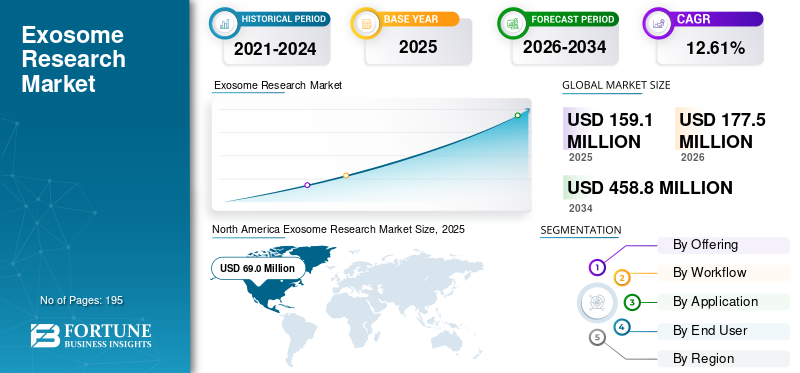
According to Fortune Business Insights: The global exosome research market was valued at USD 159.1 million in 2025 and is projected to grow from USD 177.5 million in 2026 to USD 458.8 million by 2034, exhibiting a CAGR of 12.61% during the forecast period. North America dominated the market with a 43.37% share in 2025, valued at USD 69.0 million — driven by strong life science funding, advanced research infrastructure, and early uptake of novel molecular analysis technologies across U.S. universities, biotech companies, and research institutes.
Exosome research encompasses the tools, technologies, reagents, kits, instruments, and services used to study exosomes — nano-sized extracellular vesicles secreted by cells that mediate intercellular communication by transporting proteins, lipids, and nucleic acids. Exosome research supports biomarker discovery, disease mechanism studies, diagnostics development, and the exploration of novel therapeutic delivery systems. The market is witnessing strong structural growth driven by the rising global cancer burden, increasing emphasis on biomarker discovery, and a shifting focus toward personalized medicine and liquid biopsy-based diagnostics.
Get a Sample Research PDF: https://www.fortunebusinessinsights.com/enquiry/request-sample-pdf/115249
Market Trends
Integration with Multi-Omics Platforms Deepening Biological Insights: The defining trend shaping the global exosome research market is the growing integration of exosome analysis with multi-omics approaches — combining proteomics, transcriptomics, and metabolomics to generate deeper biological insights from extracellular vesicle content. Multi-omics integration improves biomarker robustness by combining multiple molecular signals, while supporting growing interest in understanding EV heterogeneity — linking vesicle subtypes to specific biological functions and disease states. These advanced analytical frameworks require increased spending on standardized isolation, higher-quality characterization tools, and AI-driven bioinformatics pipelines — all of which directly expand the addressable exosome research market. In June 2025, Mursla Bio announced the commercial launch of its AI Precision Medicine Platform — built on organ-specific EV isolation and multi-omics profiling from plasma — to enable AI-powered biomarker discovery and diagnostic translation.
Market Drivers
Rising Global Cancer Burden Propelling Biomarker and Liquid Biopsy Research: The primary market driver is the escalating global cancer burden — which expands the pool of patients requiring earlier detection, risk stratification, and treatment monitoring, positioning liquid biopsy as a preferred, minimally invasive diagnostic approach. As cancer case volumes rise, researchers increasingly pursue high-throughput biomarker discovery — boosting demand for exosome isolation kits, characterization tools, and multi-omics profiling services. Exosomes are especially valuable for liquid biopsy as they circulate in biofluids and carry tumor-derived molecular cargo, enabling signal-rich detection approaches. According to data published by WHO in February 2024, the estimated number of new global cancer cases is predicted to exceed 35 million by 2050 — providing a powerful and sustained structural demand tailwind for exosome-based diagnostics and biomarker research throughout the forecast period. According to an article published by the College of American Pathologists in July 2025, incorporating exosomes into liquid biopsy can meaningfully improve the sensitivity and comprehensiveness of cancer diagnostics and monitoring.
Market Restraints & Challenges
High Cost of Advanced Analytical Instruments Limiting Accessibility: The primary market restraint is the high cost of advanced analytical instruments required for robust exosome characterization — including nanoparticle tracking analysis (NTA) systems, nano-flow cytometers, and other high-sensitivity platforms. According to an article published in the International Journal of Molecular Sciences in October 2023, the Nanosight NTA instrument alone costs over USD 94,000. These high upfront costs are frequently compounded by service contracts, software licenses, accessories, and staff training requirements — substantially increasing total cost of ownership and limiting adoption to well-funded research institutions and large pharmaceutical companies.
A critical market challenge is the lack of universally accepted isolation and characterization standards across the exosome research field. Exosome preparations vary widely depending on the isolation method used — changing yield, purity, and co-isolated contaminants — making results difficult to reproduce across laboratories. Even for characterization, different platforms can produce non-comparable outputs if sample handling and reporting protocols are inconsistent. According to an article published in April 2025, comparing studies across the field is highly challenging due to the lack of validated methodologies for isolation and determination, and the absence of well-characterized reference standards — weakening confidence in biomarker signatures and slowing clinical translation.
Market Opportunities
Expansion of Translational and Preclinical Research Pipelines: The most compelling market opportunity is the rapid expansion of translational and preclinical research programs moving exosome candidates from basic biology into validated development packages. As more programs progress, developers require tighter quality control, scalable isolation processes, and standardized analytics — driving demand for specialized instruments and outsourced characterization and profiling services. In March 2025, Lonza announced that Exogenus Therapeutics selected it to develop a GMP-compliant manufacturing process for Exo-101 — illustrating the growing demand for specialized exosome CDMO and manufacturing capabilities as programs move toward clinical evaluation. In July 2025, the University of Florida College of Pharmacy reported an NIH award supporting an extracellular vesicle loading platform to advance EV-based gene therapy development — exemplifying the expanding frontier of therapeutic research applications.
Segmentation Analysis
By Offering: Products dominate the market, driven by high and recurring usage of reagents and kits across exosome isolation, characterization, and profiling workflows — with Thermo Fisher Scientific, QIAGEN, and others offering broad product portfolios for research applications. The services segment is the fastest-growing offering category, projected at a CAGR of 14.90% through 2034, driven by demand for outsourced analytical characterization, profiling, and GMP manufacturing services as research programs advance in scale and regulatory rigor.
By Workflow: Isolation and purification leads with a projected 36.0% market share in 2026 — reflecting its foundational role as the essential first step upon which all downstream activities depend. Every downstream application relies on first recovering exosomes from complex matrices such as plasma or cell culture media, making isolation a repeat-purchase-intensive, high-volume workflow step. The characterization segment is growing at a CAGR of 11.76%, driven by increasing demand for accurate size, concentration, surface marker, and cargo profiling as programs move into translational stages.
By Application: Biomarker discovery and liquid biopsy research leads with a projected 53.1% market share in 2026 — reflecting exosomes' exceptional attractiveness as biomarker carriers that circulate in body fluids and contain cell-of-origin molecular cargo supporting disease detection and monitoring. The exosome therapeutics research segment is the fastest-growing application, projected at a CAGR of 18.19% through 2034, as the field moves toward validated therapeutic delivery systems exploiting exosomes' natural cell-targeting and cargo delivery properties.
By End User: Academic and research institutes hold the leading position with a projected 49.3% market share in 2026 — reflecting the primarily discovery-driven nature of the field, where universities and dedicated EV research centers operate core facilities that centralize high-cost instruments and drive recurring spending on kits, characterization, and profiling services across many concurrent projects. Pharmaceutical and biotechnology companies are the fastest-growing end-user segment at a CAGR of 16.28% — driven by accelerating investment in exosome-based therapeutic pipelines and the growing number of companies partnering with CDMOs and platform providers to advance clinical-stage programs.
Regional Outlook
North America leads at USD 69.0 million in 2025 (43.37% share), projected to grow significantly through the forecast period. The U.S. market — projected to reach approximately USD 73.2 million in 2026, accounting for roughly 41.3% of global revenues — benefits from substantial NIH and private life science funding, advanced biotech infrastructure, and a dense concentration of research institutes and biotech companies driving high-volume consumption of isolation kits, characterization platforms, and profiling services.
Europe is the second-largest region, projected to reach USD 46.0 million in 2026, growing at a CAGR of 12.37% over the forecast period. The region benefits from collaborative academic networks, strong cancer and biomarker research programs, and active exosome therapeutic development pipelines. The U.K. market is projected at USD 10.3 million in 2026 (approximately 5.8% of global revenues), while Germany is projected at USD 9.4 million (5.3%).
Asia Pacific is the third-largest regional market, projected to reach USD 35.0 million in 2026. The region's growth is driven by expanding biomedical research investment and improving laboratory infrastructure across China — projected at USD 10.5 million in 2026 (5.9% of global revenues) — India at USD 6.2 million (3.5%), and Japan at USD 6.4 million (3.6%).
Latin America is projected to reach USD 10.3 million in 2026, supported by gradual improvements in research funding and laboratory capabilities.
Connect with Our Expert for any Queries: https://www.fortunebusinessinsights.com/enquiry/speak-to-analyst/115249
Competitive Landscape
The global exosome research market features a semi-fragmented structure combining well-established life science leaders with innovative specialist startups. Key players include Thermo Fisher Scientific Inc. (U.S.), QIAGEN (Germany), Lonza (Switzerland), System Biosciences LLC (U.S.), Danaher (U.S.), FUJIFILM Corporation (Japan), IZON Science Ltd (New Zealand), STEMCELL Technologies (Canada), RoosterBio Inc. (U.S.), and Spectris (U.S.). Competition centers on product breadth, service capabilities, strategic collaborations, and innovative platform development.
Key recent developments include Thermo Fisher Scientific and RoosterBio's April 2025 collaboration to advance cell and exosome therapy manufacturing combining RoosterBio's hMSC/exosome platform with Thermo Fisher's GMP manufacturing capabilities; Particle Metrix's April 2025 introduction of ZetaView Evolution — a next-generation nanoparticle tracking analysis system for EV characterization; Daicel's April 2025 showcase of its novel automated exosome isolation system combining chromatography and tangential flow filtration at ISEV 2025; Mursla Bio's June 2025 commercial launch of its AI Precision Medicine Platform built on EV isolation and multi-omics profiling; CD Bioparticles' July 2025 introduction of purified exosomes for drug delivery and therapeutic research; and EXO Biologics' January 2024 launch of ExoXpert — an exosome-focused CDMO offering an MSC-based manufacturing platform used in European clinical trials.
What Everyone Should Know About Japan’s Market - Exosome Research Market Insights