
Europe Foodservice Market Overview Analysis By Fortune Business Insights
Market Size & Growth Outlook
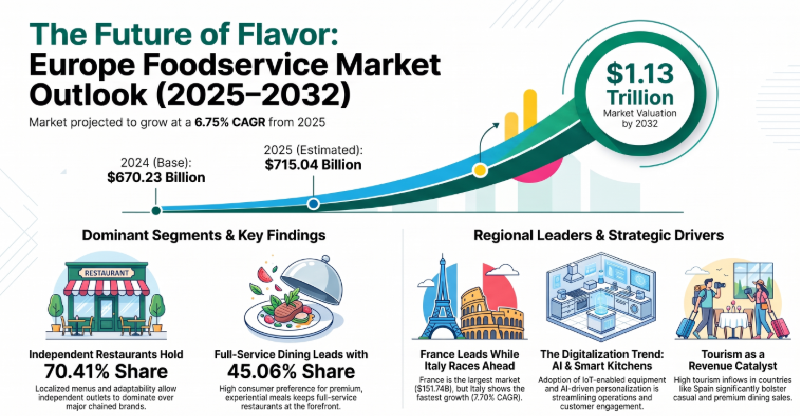
According to Fortune Business Insights: The Europe foodservice market was valued at USD 670.23 billion in 2024 and is projected to grow from USD 715.04 billion in 2025 to USD 1,129.90 billion by 2032, exhibiting a CAGR of 6.75% during the forecast period. France dominated the market with a 22.64% share in 2024, valued at USD 151.74 billion — driven by strong culinary tourism, rapid growth of digital ordering platforms, and the emergence of virtual restaurants and cloud kitchens across major urban centers including Paris–Île-de-France and Provence–Alpes–Côte d'Azur.
Europe's foodservice market has experienced remarkable growth, underpinned by a large and culturally diverse consumer base with a deep tradition of social dining, and accelerated by shifting urban lifestyles, rising discretionary spending on out-of-home meals, and the expanding influence of culinary tourism. Consumers across the continent — particularly urban professionals and the Gen Z cohort — are increasingly prioritizing ease, speed, and experiential dining, generating sustained demand for a broad spectrum of foodservice formats from full-service premium restaurants to digital-first delivery and cloud kitchen models.
Get a Sample Research PDF: https://www.fortunebusinessinsights.com/enquiry/request-sample-pdf/114026
Market Trends
Technological Advancements Reshaping the Foodservice Sector: The defining trend shaping Europe's foodservice market is the accelerating integration of advanced technology across restaurant operations — driven by growing consumer demand for personalized dining experiences, operational efficiency, and contactless convenience. Smart kitchens equipped with IoT-enabled equipment are gaining strong traction, supporting enhanced food safety protocols, real-time inventory management, and customized cooking experiences at scale. Robotics and AI systems — from automated food preparation and assembly to robotic servers and AI-driven customer engagement tools — are being adopted by both large chains and independent operators seeking to improve throughput and reduce labor dependency. Artificial intelligence is being leveraged to analyze customer data, generate personalized menu suggestions, deliver targeted promotions, and streamline back-of-house operations — creating smarter, more profitable foodservice environments across the region. Countries including the Netherlands, Switzerland, and the Nordic nations are leading in the adoption of AI and IoT-enabled smart kitchen technologies alongside growing emphasis on sustainability and eco-friendly dining practices.
Market Drivers
Expansion of Food Chains and Rising Out-of-Home Dining Culture: The primary market driver is the accelerating expansion of foodservice chains — both domestic and international — across European markets, fueled by rising consumer willingness to spend on out-of-home meals. Today's consumers, particularly Gen Z and millennials, are increasingly choosing to dine out as a form of socialization, culinary exploration, and lifestyle expression — selecting foodservice outlets that offer diverse culinary options from plant-based niche offerings to international cuisines. The hectic pace of modern work-life schedules, combined with the convenience and quality increasingly available through out-of-home food options, is further driving habitual dining-out behavior across urban populations. International food chains are actively capitalizing on this momentum by expanding their European presence — exemplified by Chick-fil-A's August 2025 announcement of its first U.K. outlet opening, reflecting the appeal of the European market to major global QSR operators.
Culinary Tourism as a Structural Revenue Driver: Growing culinary tourism across Europe is a powerful and sustained market driver, consistently generating high-spending international visitor traffic through foodservice channels. Spain was recognized as the most visited country in the European region in 2023 — a distinction that directly contributes significant revenue to its foodservice industry across casual dining, premium restaurant, and street food formats. Italy and France similarly attract tens of millions of international tourists annually who prioritize authentic culinary experiences, sustaining premium and mid-market foodservice segments. This tourism-driven demand creates a resilient revenue base for regional operators even during periods of domestic consumer softness.
Market Restraints
Food Safety Challenges as an Operational and Reputational Risk: The primary restraint facing the European foodservice market is the persistent challenge of maintaining rigorous food safety standards across complex, high-volume operations. Food safety risks can arise at any stage of the service chain — product procurement, transportation, storage, preparation, and service — with cross-contamination between raw and cooked food, inadequate hygiene practices among staff or customers, and insufficient workforce training representing the most common failure points. High-profile food safety incidents generate significant negative media coverage, erode consumer confidence, and can result in regulatory penalties, closure orders, and lasting reputational damage for individual operators and chains alike — particularly in Europe's highly regulated and consumer-conscious market environment.
Segmentation Analysis
By Type: Full-service restaurants dominate with a 45.06% share of the European market in 2024, driven by consumers' strong preference for premium dining experiences, diverse menu offerings, and personalized table service — particularly during social and celebratory occasions. Europe's deep culinary heritage and the high cultural value placed on quality dining sustain strong full-service restaurant attendance across all major markets. Quick service restaurants (QSRs) are the fastest-growing type segment, reflecting rising consumer demand for affordable, fast, and accessible meal solutions — particularly among time-pressed urban professionals, students, and younger demographics prioritizing speed and value. Institutional foodservice — encompassing workplace, education, healthcare, and public sector catering — maintains a meaningful secondary share, supported by contract catering growth across corporate campuses, universities, and healthcare settings.
By Service Type: Dine-in holds the leading service type share, reflecting Europe's strong social dining culture and widespread consumer preference for experiential, occasion-driven restaurant visits. Europeans broadly regard dining out as a primary social activity — one that prioritizes atmosphere, quality, and the shared experience of enjoying food together. The dine-in segment is projected to grow at a CAGR of 6.08% over the forecast period. Delivery is the fastest-growing service type, driven by the rapid expansion of digital ordering platforms, food delivery apps, and the emergence of virtual restaurants and cloud kitchen models that are expanding delivery coverage to new price points and cuisine categories. Takeout is growing steadily among urban consumers seeking convenience without the full dine-in experience.
By Restaurant Type: Independent restaurants dominate with a 70.41% market share in 2024, reflecting Europe's deeply fragmented and regionally diverse restaurant landscape. Independent operators benefit from superior menu flexibility, the ability to adapt rapidly to evolving culinary trends, sourcing of seasonal and local ingredients through direct farmer relationships, and the delivery of authentic, localized dining experiences that resonate strongly with both domestic and international consumers. Chained restaurants are growing steadily, benefiting from brand recognition, standardized operational systems, digital ordering integration, and the ability to scale customer acquisition across multiple markets through marketing investment and loyalty programs.
Country Outlook
France led the market with a 22.64% share (USD 151.74 billion in 2024), supported by world-class culinary traditions, high inbound tourism, rapidly expanding food delivery platforms, and the emergence of cloud kitchen and virtual restaurant models in Paris and other major cities — lowering operating costs and expanding digital ordering reach.
Italy is projected to grow at the fastest country CAGR of 7.70% through 2032, fueled by strong and growing culinary tourism, rising consumer spending on out-of-home dining, and active expansion of both domestic and international restaurant chains across its major cities. Italy's globally recognized cuisine positions it as a premium culinary tourism destination with enduring demand across multiple foodservice tiers.
Spain benefits from its status as the most visited European country in 2023, with international tourist inflows generating substantial and consistent revenue across casual dining, tapas bars, beachside restaurants, and urban premium dining venues — making foodservice one of Spain's most commercially significant economic sectors.
The U.K. is witnessing active expansion by international food chains, with Chick-fil-A's August 2025 announcement of its U.K. market entry exemplifying the continued appeal of British urban food markets to global QSR operators. Strong demand for quick-service and takeaway formats among the U.K.'s urban consumer base sustains consistent segment growth.
Germany is characterized by a diversified mix of fine dining, fast-casual, and institutional foodservice segments, with growing digitalization of restaurant operations and an increasing emphasis on food safety compliance and sustainability-driven menu development.
Rest of Europe — including the Netherlands, Switzerland, and Nordic countries — is at the forefront of smart kitchen technology adoption, sustainable sourcing practices, and consumer-driven demand for high-quality, transparent, and convenience-oriented foodservice experiences.
Connect with Our Expert for any Queries: https://www.fortunebusinessinsights.com/enquiry/speak-to-analyst/114026
Competitive Landscape
The European foodservice market features a mix of large contract catering groups, established regional chains, and a substantial base of independent operators. Key players include Autogrill SpA (Italy), Cremonini S.p.A. (Italy), The Restaurant Group (U.K.), Le Duff Group (France), McDonald's Corporation (U.S.), Greggs (U.K.), and Compass Group (U.K.). Companies are pursuing geographic expansion into new European markets, innovating their menus for health-conscious consumers, and investing in digital ordering and technology-driven operational improvements.
Key recent developments include Dave's Hot Chicken's September 2025 agreement with Azzuri Group to open 180 new restaurants across European markets; Koykan's July 2025 announcement of four new restaurant openings in Slovakia, the Czech Republic, and Croatia; and Chick-fil-A's August 2025 announcement of its planned entry into the U.K. market — marking one of the most anticipated international foodservice expansions into Europe in recent years.
Uncover Japan’s Market Trends - Explore the Latest - Europe Foodservice Market Insights