
Engineering Plastics Market Overview Analysis By Fortune Business Insights
Market Size & Future Outlook
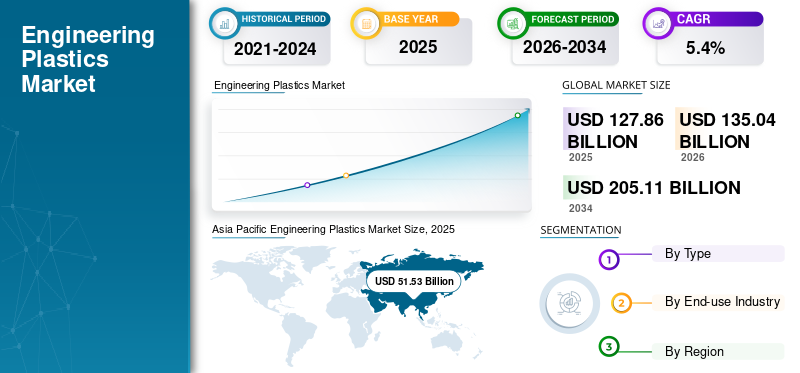
According to Fortune Business Insights: The global engineering plastics market size was valued at USD 127.86 billion in 2025 and is projected to grow from USD 135.04 billion in 2026 to USD 205.11 billion by 2034, exhibiting a CAGR of 5.4% during 2026–2034. Asia Pacific dominated the market with a 40% share in 2025, valued at USD 51.53 billion. The report covers a historical period of 2021–2024, with 2025 as the base year.
Market Overview
Engineering plastics are high-performance polymers, such as ABS and SAN, polyamide, polycarbonate, thermoplastic polyester (PET and PBT), and POM, that offer greater strength, heat resistance, and durability than commodity plastics. They replace metal and other materials in electrical and electronics, automotive, healthcare, packaging, and construction applications.
Get a Sample Research PDF: https://www.fortunebusinessinsights.com/enquiry/request-sample-pdf/111438
Market Drivers
- Electrical and electronics: Demand from smart home devices and wearables.
- Automotive: Lightweighting and electric vehicles.
- Sustainability: Demand for sustainable and recycled materials.
- Healthcare: Need for sterilizable, biocompatible plastics.
- Infrastructure: Growth in the Middle East & Africa.
Market Restraints & Challenges
- High production costs: Polyamide, PEEK, and polycarbonate are costly, limiting adoption in cost-sensitive sectors.
- Recycling difficulty: This conflicts with circular-economy regulations.
- Raw material volatility: Prices and supply are disrupted.
- Trade protectionism: Examples include tariffs and China's antidumping duties on U.S. and EU plastics.
- Geopolitical tension: Petrochemical feedstock supply is affected.
Market Opportunities
3D printing and additive manufacturing, including prototyping and small-batch production, is the opportunity the page highlights.
Market Trends
- Healthcare adoption: Specialized engineering plastics are growing in medical use.
- Localized production: Backward integration and regional supply are increasing.
- Recycled and bio-based resins: Post-consumer recycled and bio-based grades are gaining ground.
- Closed-loop recycling and AI: AI-driven production optimization and closed-loop recycling are emerging.
Segmentation Analysis
By Type: Styrene copolymers (ABS and SAN) lead with 32.48% in 2026. Thermoplastic polyester (PET and PBT) is described as one of the fastest-growing. Polyamide, polycarbonate, POM, and others are also covered, without shares.
By End Use: Electrical and electronics leads with 35.63% in 2026. Packaging is described as the fastest-growing end use. Automotive, healthcare, and other uses are also covered.
Regional Analysis
Regional values are shown for 2025, with 2026 projections.
Asia Pacific leads with USD 51.53 billion (40%), projected at USD 54.69 billion in 2026. China is projected at USD 20.43 billion, India at USD 11.71 billion, and Japan at USD 8.81 billion.
North America holds 23%, with USD 29.34 billion, projected at USD 30.98 billion in 2026. The U.S. is projected at USD 28.08 billion.
Europe holds 22%, with USD 28.29 billion, projected at USD 29.73 billion in 2026. Germany is projected at USD 8.61 billion and the U.K. at USD 6.88 billion.
Middle East & Africa is USD 9.7 billion, projected at USD 10.18 billion in 2026.
Latin America is USD 9.0 billion, projected at USD 9.46 billion in 2026.
Connect with Our Expert for any Queries: https://www.fortunebusinessinsights.com/enquiry/speak-to-analyst/111438
Competitive Landscape & Key Developments
Key players named in the summary are BASF, Covestro, Celanese, SABIC, and DuPont. The full profiled list also includes LG Chem, Mitsubishi Engineering-Plastics, Asahi Kasei, Toray, and Ensinger.
Notable developments include:
- Toray developing a chemical recycling process for nylon 66 (February 2025).
- DOMO Chemicals expanding TECHNYL compounding capacity in Mumbai (May 2025).
- BASF agreeing to acquire the Alsachimie joint venture to secure polyamide 6.6 supply (May 2025).
- Covestro supporting NINETYGO's R-GO suitcase, using polycarbonate with up to 90% post-consumer recycled content (April 2026).
Outlook Summary
The engineering plastics market is positioned for steady growth through 2034, led by Asia Pacific and driven by electronics, automotive lightweighting, healthcare, and demand for recycled materials. High production costs, recycling difficulty, and trade and feedstock risks remain restraints, but additive manufacturing, closed-loop recycling, and bio-based resins are expected to sustain expansion.
Uncover Japan’s Market Trends - Explore the Latest Engineering Plastics Market Insights