
Encoder Market Overview Analysis By Fortune Business Insights Analysis
Market Summary
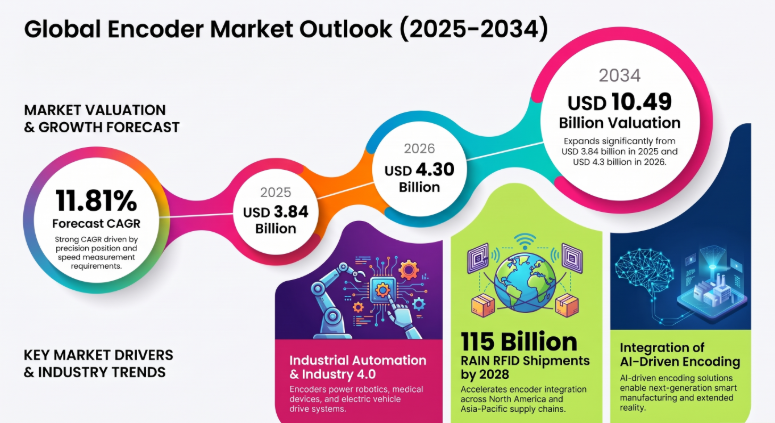
According to Fortune Business Insights: The global encoder market was valued at USD 3.84 billion in 2025 and is projected to grow from USD 4.3 billion in 2026 to USD 10.49 billion by 2034, exhibiting a CAGR of 11.81% during the forecast period. Encoders are sensors that convert motion or position into electrical signals, and they are used in industrial automation, robotics, automotive, healthcare, and precision manufacturing. Asia Pacific is expected to dominate the market, driven by industrialization, automation investment, and the automotive sector in China and Japan.
Key Market Drivers
Industrial automation and Industry 4.0 are the main drivers, since machine makers rely on encoders for precision. Automotive uses, such as electric power steering and transmission control, add demand, as does robotics motion tracking in healthcare and industrial automation.
Get a Sample Research PDF: https://www.fortunebusinessinsights.com/enquiry/request-sample-pdf/111532
Market Restraints
The high upfront cost of high-precision, durable encoders can limit adoption by small and medium-sized enterprises. Integration is also difficult because of interoperability issues across models and communication protocols. Harsh environments, including extreme temperatures and contamination, can affect performance, lifetime, and reliability.
Market Opportunities
Healthcare offers an opportunity through robotic surgery and diagnostic equipment. Asia Pacific is another, thanks to fast industrialization and automation adoption. IoT-compatible encoders for smart factories and predictive maintenance round out the main growth areas.
Segmentation Analysis
By type, rotary encoders are expected to hold the larger share, driven by industrial automation, robotics, and automotive, while linear encoders are expected to grow quickly on demand from CNC machines, semiconductor manufacturing, and precision measurement. By signal type, incremental encoders are expected to dominate, mainly for speed and position monitoring in automation and robotics, while absolute encoders are becoming common in prototype testing because they keep their position values after power loss. By technology, magnetic encoders are expected to hold the higher share because of their resistance to harsh environments and suitability for high-speed use, while optical encoders are expected to grow quickly given their accuracy and resolution in robotics, medical imaging, and semiconductor manufacturing. By application, the market covers healthcare, automotive, consumer electronics, printing, textile, food and beverages, energy and power, and others, with automotive expected to dominate through EV drive systems, electric power steering, and self-driving systems, and consumer electronics cited for rapid growth.
Regional Outlook
Asia Pacific is expected to dominate. North America is seeing promising growth from technology advancement and early automation adoption. Europe holds a substantial share, supported by its manufacturing base, precision engineering, and Industry 4.0 adoption. Latin America and the Middle East & Africa are covered in the report's scope.
Connect with Our Expert for any Queries: https://www.fortunebusinessinsights.com/enquiry/speak-to-analyst/111532
Competitive Landscape
Key players include Sensata Technologies, Mitutoyo, Fortive, HEIDENHAIN, Renishaw, Maxon, Balluff Automation, Pepperl+Fuchs, Pilz, Omron, Honeywell International, Rockwell Automation, Schneider Electric, Panasonic, Faulhaber Group, Koyo Electronics, and Kubler Group.
In September 2024, Fagor Automation launched its H3 Angular Encoder Series, with outside diameters of 90 to 200 mm.
In January 2023, SICK released a new family of linear encoders for measuring piston positions in hydraulic cylinders.
In July 2022, Sensata Technologies acquired Dynapower Company LLC to expand its energy storage and power control portfolio.
What’s Driving Japan’s Market? Discover the Latest Encoder Market Insights