
Electronic Security Market Overview Analysis By Fortune Business Insights Analysis
Market Size & Future Outlook
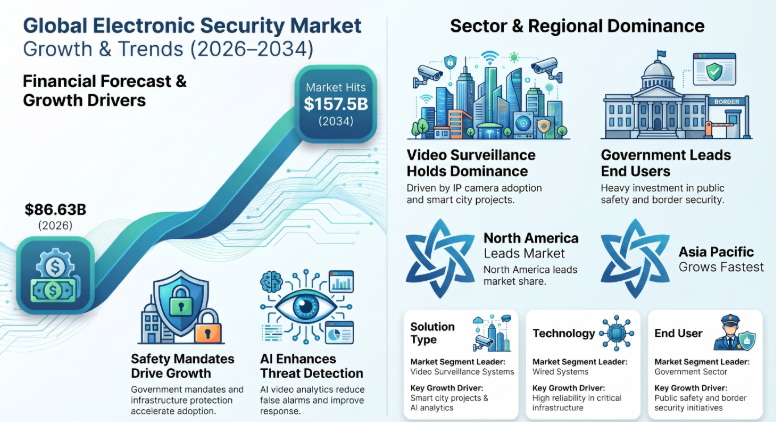
According to Fortune Business Insights: The global electronic security market size was valued at USD 80.39 billion in 2025 and is projected to grow from USD 86.63 billion in 2026 to USD 157.51 billion by 2034, exhibiting a CAGR of 7.76% during the forecast period. North America held the largest regional share. The report covers a study period of 2021–2034, with 2025 as the base year.
Market Overview
Electronic security covers the systems and technologies used to protect people, property, and information, including video surveillance, access control, alarm and intrusion detection, and fire detection. These systems are deployed by governments, transportation operators, businesses, healthcare facilities, and households. The industry is moving from standalone hardware toward AI-driven, integrated, service-oriented ecosystems that combine sensors, analytics, and cloud monitoring.
Get a Sample Research PDF: https://www.fortunebusinessinsights.com/enquiry/request-sample-pdf/114558
Market Drivers
Rising demand for the safety and protection of people, assets, and infrastructure, driven by crime, terrorism threats, and workplace security concerns, is the primary driver. Government mandates tied to smart city, public safety, and critical infrastructure programs add to demand, while advances in AI, IoT, biometrics, and cloud monitoring are making systems more capable and easier to deploy.
Market Restraints
High deployment and maintenance costs weigh on adoption, especially in developing regions and among small businesses. Integration with legacy infrastructure is difficult, and data privacy, cybersecurity, and surveillance backlash concerns create friction in strictly regulated markets. A shortage of skilled installation and management professionals further limits growth.
Market Opportunities
Growing adoption of AI and IoT is enabling real-time threat detection, facial recognition, behavioral analysis, and remote monitoring. Demand is expanding across smart cities, enterprises, and residential markets, creating room for integrated platforms and managed services.
Market Trends & Impacts
The market is shifting from standalone hardware toward AI-driven, integrated, service-oriented ecosystems. Reciprocal tariffs raise import costs for sensors, cameras, and access control systems, which may slow adoption in price-sensitive segments, though they may also encourage localized production and supply diversification. Generative AI is improving anomaly recognition, false-alarm reduction, and predictive maintenance.
Segmentation Analysis
By Solution Type: Surveillance and video security systems hold the largest share, followed by access control, alarm systems, and others such as fire detection.
By Technology: Wired holds the largest share, followed by wireless, cellular, and others such as IoT integration.
By End User: Government is the largest segment, followed by transportation, residential, commercial, healthcare, and others such as hospitality.
Regional Analysis
North America holds the largest share, driven by government, defense, and critical infrastructure spending, and by adoption of AI-enabled surveillance.
Europe is the second-largest market, supported by regulations such as GDPR and EU critical infrastructure directives, plus smart city investment.
Asia Pacific is the fastest-growing region, driven by urbanization, smart city programs, and a strong manufacturing base. China is highlighted as one of the largest surveillance ecosystems.
South America and Middle East & Africa are included in the report's regional segmentation.
Connect with Our Expert for any Queries: https://www.fortunebusinessinsights.com/enquiry/speak-to-analyst/114558
Competitive Landscape & Key Developments
The market is fragmented; in the U.S., the top five players hold roughly 20% combined. Profiled companies include Bosch Security Systems, Honeywell International, Hikvision, Dahua Technology, Axis Communications, Siemens, Thales Group, FLIR Systems, HID Global, and ASSA ABLOY.
Notable developments include the U.S. Department of Defense deploying an AI-based air surveillance system for key sites in Washington, D.C., in November 2024; the European Commission launching its ProtectEU internal security strategy in April 2025; Hexagon launching HxGN dC3 Cloud, a cloud-based video management system, in June 2025; Hikvision launching DeepinViewX AI bullet cameras in July 2025; Sparsh CCTV, Innoviz, and Cron AI partnering on LiDAR and camera perception nodes in India in July 2025; and Hikvision adding AcuSeek AI video analytics to its platforms in September 2025.
Outlook Summary
The electronic security market is positioned for steady growth through 2034, driven by public safety priorities, smart city and infrastructure programs, and rapid advances in AI, IoT, and biometrics. While costs, legacy integration, privacy concerns, and skills shortages remain restraints, the shift to integrated, service-based platforms and strong growth in Asia Pacific are expected to sustain demand.
What’s Driving Japan’s Market? Discover the Latest Electronic Security Market Insights