
Electronic Design Automation (EDA) Software Market Overview Analysis By Fortune Business Insights Analysis
Market Size & Future Outlook
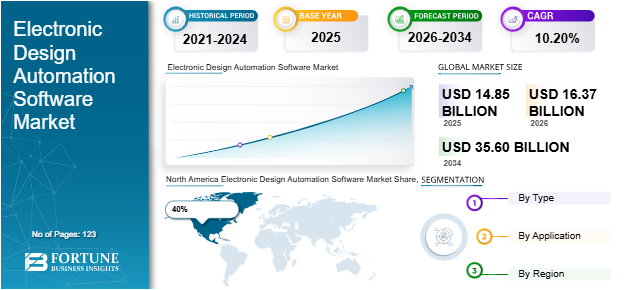
According to Fortune Business Insights: The global electronic design automation (EDA) software market was valued at USD 14.85 billion in 2025 and is projected to grow from USD 16.37 billion in 2026 to USD 35.60 billion by 2034, exhibiting a CAGR of 10.20% during the forecast period. North America dominated the market with approximately a 40% share in 2025, with the United States accounting for roughly 85% of regional demand.
Market Overview
EDA software comprises the specialized tools used to design, simulate, verify, and manufacture integrated circuits, printed circuit boards, and electronic systems. These platforms are indispensable to the semiconductor industry, enabling engineers to manage the extraordinary complexity of modern chips while shortening development cycles and reducing costly design errors. As electronics permeate everything from smartphones and vehicles to industrial equipment and communications infrastructure, EDA tools underpin virtually every new silicon and hardware design.
Get a Sample Research PDF: https://www.fortunebusinessinsights.com/enquiry/request-sample-pdf/105985
Market Drivers
The primary driver is rising semiconductor design complexity, including multi-core, heterogeneous, and system-on-chip architectures built at process nodes below 7nm. These designs demand advanced simulation, verification, and physical design capabilities that only sophisticated EDA platforms can provide. Growth in AI, IoT, and automotive electronics, including electric and autonomous vehicles, is expanding the volume and diversity of chips being designed. The adoption of AI-driven design automation and cloud-based EDA platforms is further accelerating productivity and broadening access to advanced tools.
Market Restraints
High licensing, implementation, and maintenance costs are a major restraint, particularly for startups and smaller firms that struggle to afford enterprise-grade toolchains. A persistent shortage of skilled engineers for chip design, verification, and simulation compounds the challenge, limiting how quickly organizations can adopt and fully exploit advanced EDA capabilities.
Market Opportunities
Significant opportunities lie in AI chips, edge computing, and connected devices, which are driving demand for new, specialized silicon. Automotive safety-critical chip design is another growth avenue as vehicles rely increasingly on complex electronics. The rollout of 5G and next-generation communications is creating demand for advanced RF and baseband designs, while 3D IC and heterogeneous integration tools are emerging as important enablers of continued performance scaling beyond traditional approaches.
Segmentation Analysis
By Type: IC physical design and verification is the largest segment at approximately 32%, reflecting its central role in producing manufacturable, error-free chips. Semiconductor IP (SIP) accounts for approximately 20%, computer-aided engineering (CAE) for approximately 18%, and PCB and multi-chip module (PCB/MCM) tools for approximately 16%. Services represent the remaining approximately 14%.
By Application: Communication leads at approximately 28%, followed by consumer electronics at approximately 26%, industrial at approximately 24%, and automotive at approximately 22%. Aerospace and defense, medical, and other applications are also covered within the report's scope.
Regional Analysis
North America leads with approximately a 40% share in 2025, supported by the concentration of leading EDA vendors, major semiconductor design houses, and substantial R&D investment. The United States accounts for roughly 85% of regional demand.
Asia Pacific holds approximately 30%, driven by large-scale semiconductor manufacturing and design activity. China represents approximately 13% of the global market and Japan approximately 7%.
Europe accounts for approximately 22%, with Germany at roughly 8% and the U.K. at approximately 6% of the global market, supported by strong automotive and industrial electronics sectors.
Rest of the World holds approximately 8%, with demand growing alongside regional electronics and design ecosystem development.
Market Trends
Vendors are embedding AI into design flows to automate layout, optimization, and verification, shortening time to market for complex chips. Cloud-based EDA deployment is expanding, offering scalable compute for resource-intensive simulation and verification workloads. Tool development is also advancing to support process nodes below 5nm, while specialized solutions for automotive electronics are gaining prominence as safety and reliability requirements tighten.
Competitive Landscape & Key Developments
The market is led by Cadence Design Systems with approximately a 20% share, followed by Synopsys at approximately 18%. Other key players include Altium, ANSYS, Autodesk, Boldport, Mentor (a Siemens business), Silvaco, Vennsa Technologies, and Xilinx.
Notable developments between 2023 and 2025 include the launch of AI-driven verification tools, expansion of cloud-based EDA deployments, new tools supporting process nodes below 5nm, specialized tools for automotive electronics, and increased R&D spending on simulation and verification.
Connect with Our Expert for any Queries: https://www.fortunebusinessinsights.com/enquiry/speak-to-analyst/105985
Outlook Summary
The global EDA software market is positioned for strong growth through 2034, driven by escalating chip design complexity and expanding demand from AI, IoT, automotive, and communications applications. While high tool costs and a shortage of skilled engineers remain constraints, the adoption of AI-driven and cloud-based design platforms, together with emerging needs in 3D IC and heterogeneous integration, is expected to sustain robust demand across all major regions.
Curious About Japan’s Market? Explore the Latest Electronic Design Automation Software Market Insights