
Edge Protector Market Overview Analysis By Fortune Business Insights
Market Size & Growth Outlook
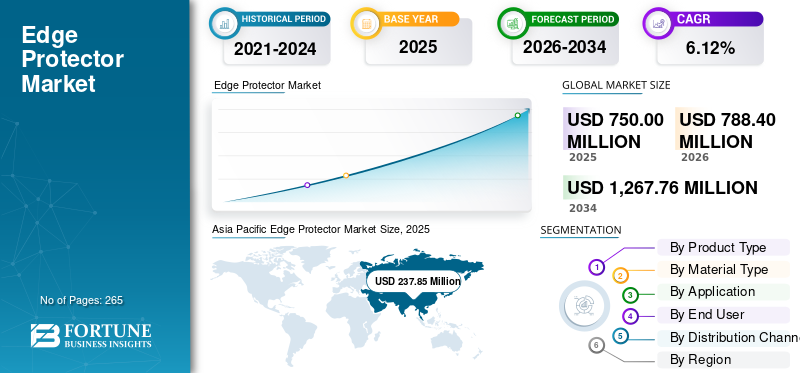
According to Fortune Business Insights: The global edge protector market was valued at USD 750.00 million in 2025 and is projected to grow from USD 788.40 million in 2026 to USD 1,267.76 million by 2034, exhibiting a CAGR of 6.12% during the forecast period. Asia Pacific dominated the global market with a 31.71% share in 2025, valued at USD 237.85 million.
Edge protectors are structural packaging components used to protect the corners and edges of goods from damage during storage and transportation. Available in angle, flat, corner, and specialty formats — and manufactured from paperboard, plastic, metal, and composite materials — they are widely deployed across logistics, manufacturing, construction, food and beverage, and consumer goods operations. Their core function is to prevent edge crushing, carton compression, strap cutting, and load shifting during handling, palletizing, and transit, making them an essential component of modern protective packaging systems. Increasing international trade volumes, rising e-commerce activity, and growing emphasis on sustainable packaging materials are collectively driving consistent demand growth across the global market.
Get a Sample Research PDF: https://www.fortunebusinessinsights.com/enquiry/request-sample-pdf/117848
Market Trends
The defining trend shaping the edge protector market is the accelerating shift toward sustainable and recyclable product formulations. Rising consumer and regulatory awareness around packaging waste is compelling manufacturers to transition from conventional plastic-based edge protectors toward alternatives made from recycled paperboard and other recyclable materials. This transition is reducing packaging waste and carbon footprints while helping brands align with corporate sustainability commitments and evolving regulatory requirements — particularly in Europe, where stringent environmental mandates are reshaping packaging procurement standards. Manufacturers are simultaneously focusing on sustainable material innovation, recyclable product development, and expanding distributor and industrial buyer relationships to strengthen their competitive positioning.
Market Drivers
Expansion of E-Commerce and Global Logistics: The primary growth driver is the rapid increase in e-commerce activities and logistics operations worldwide. As shipment volumes rise through online retail and cross-border trade, the risk of product damage from impacts during handling, sorting, and transportation increases. Edge protectors mitigate this risk directly by preventing corner damage, carton crushing, and load movement — reducing return shipment rates and associated costs for retailers, manufacturers, and logistics operators alike. The ongoing growth of warehouse networks and fulfillment center construction globally is further supporting consistent bulk demand for edge protection solutions.
Industrial Expansion in Emerging Markets: Growing manufacturing activity and export volumes in developing economies — spanning construction materials, consumer electronics, consumer goods, and industrial products — are generating new demand for protective packaging solutions. As companies in Asia Pacific, Latin America, and the Middle East scale production and expand into global markets, the requirement for durable, cost-effective edge protection during transit increases proportionally, creating a sustained demand foundation beyond established mature markets.
Market Restraints & Challenges
Fluctuating Raw Material Costs: The primary market restraint is the volatility of input costs for paperboard, plastics, and specialty packaging materials. Raw material price fluctuations driven by supply chain disruptions, energy costs, and commodity market dynamics put pressure on manufacturer margins and often result in higher product prices, constraining demand — particularly in price-sensitive emerging markets and small-to-mid-sized packaging operations.
Balancing Sustainability and Performance: A key ongoing challenge is reconciling the demand for sustainable materials with product performance requirements. While the market is shifting toward recycled and recyclable edge protector materials, some sustainable alternatives exhibit lower load-bearing capacity, reduced moisture resistance, and higher unit costs compared to conventional materials. Manufacturers must continuously invest in material science and product engineering to deliver edge protectors that satisfy both environmental targets and the structural performance requirements of industrial palletizing, heavy-load transport, and outdoor or high-humidity shipping environments.
Segmentation Analysis
By Product Type: Angle edge protectors dominate the market, driven by their widespread use in palletized load stabilization, strapping reinforcement, and industrial shipping operations. By preventing edge damage and carton deformation at corner points during strapping and stacking, angle protectors have become the default format for logistics and manufacturing companies. The corner segment is the second-fastest-growing product type at a CAGR of 6.04%, expanding in applications requiring multi-point corner protection for high-value or fragile goods.
By Material Type: Paperboard dominates the material landscape, reflecting its recyclability, light weight, and cost efficiency — particularly in high-volume bulk packaging applications. As packaging companies prioritize sustainable materials, paper-based edge protectors are increasingly preferred over plastic or metal alternatives for pallet packaging compatibility and environmental compliance. The plastic segment is the second-fastest-growing material type at a CAGR of 5.92%, sustained by demand for higher moisture resistance and durability in outdoor, flatbed, and cold-chain shipping conditions.
By Application: Palletizing and load stabilization holds the largest application share, as edge protectors are fundamental to securing stacked loads with strapping in warehousing and long-distance transportation. Their role in preventing carton crushing, strap failure, and load movement during handling is critical across a wide range of industrial shipping operations. The packaging and shipping protection segment is the fastest-growing application at a CAGR of 7.00%, reflecting the expanding volume of packaged goods shipments through e-commerce, retail, and cross-border logistics channels.
By End User: Logistics and transportation companies hold the dominant end-user share, driven by high-volume palletizing, strapping, and goods transportation operations requiring consistent edge protection to minimize damage claims and return shipment costs. The consumer goods segment is the second-fastest-growing end-user category at a CAGR of 6.19%, reflecting growing demand for edge protection in electronics, appliances, furniture, and retail product packaging.
By Distribution Channel: Direct sales dominate the channel landscape, as large logistics firms, manufacturing businesses, and industrial packagers require high-volume, custom-specification orders that are best served through direct manufacturer relationships. The online retail segment is the fastest-growing channel at a CAGR of 8.39%, reflecting broader digital procurement adoption and the growing ability to source standard-sized edge protectors efficiently through e-commerce platforms for small and mid-sized packaging operations.
Regional Outlook
Asia Pacific leads the global market at USD 237.85 million in 2025, growing at a CAGR of 7.04% through 2034 — the highest regional growth rate. Rapid manufacturing expansion, rising export volumes, and growing online retail activity across China, India, Japan, South Korea, and Southeast Asia are driving strong demand for edge protection in industrial and e-commerce packaging. China is the region's largest contributor at USD 90.66 million in 2025 (12.09% of global revenues), followed by India at USD 48.48 million (6.46%) and Japan at USD 39.73 million (5.30%).
North America holds the second-largest regional share, valued at USD 232.43 million in 2025 and projected to grow at a CAGR of 6.15% through 2034. Growth is driven by expanding logistics, warehousing, and e-commerce sectors across the U.S., Canada, and Mexico, as rising shipping volumes increase demand for packaging materials that prevent edge damage and load shifting during transit. The U.S. dominates regional demand at USD 170.45 million in 2025 (22.73% of global revenues), supported by its large and well-established manufacturing and retail supply chain infrastructure.
Europe held the third-largest share in 2025 at USD 203.97 million (27.20% of global revenues), with sustainability and recyclability mandates strongly shaping material selection toward paperboard edge protectors. Germany leads at USD 44.69 million (5.96% of global revenues), driven by its automotive, industrial products, and export-oriented manufacturing base. The U.K. follows at USD 34.25 million (4.66%), supported by retail, logistics, and sustainable packaging transition initiatives.
South America reached USD 38.05 million in 2025, with growth supported by expanding manufacturing, agricultural exports, and regional logistics activity across Brazil, Argentina, and Chile. The Middle East & Africa market is developing steadily, with the UAE at USD 9.16 million and South Africa at USD 8.09 million (1.08% of global revenues), driven by growing logistics infrastructure and rising packaged goods demand.
Connect with Our Expert for any Queries: https://www.fortunebusinessinsights.com/enquiry/speak-to-analyst/117848
Competitive Landscape
The global edge protector market features moderate competition, with key players including Signode Industrial Group (U.S.), Sonoco Products Company (U.S.), Smurfit Westrock (Ireland), Cordstrap B.V. (Netherlands), Packaging Corporation of America (U.S.), VPK Packaging Group (Belgium), Paul & Co/Kunert Gruppe (Germany), Eltete TPM Ltd. (Finland), Greenbridge/Polychem (U.S.), and Samuel Packaging Systems Group (U.S.). Competitive differentiation centers on sustainable material innovation, product customization, load-capacity performance, and distributor network expansion.
Notable recent developments include Greif's October 2025 promotion of angle board solutions for glass, metal, and paneling shipments; Cordstrap's June 2025 re-engineered CornerLash container cargo securing solution; Eltete TPM's May 2025 launch of a 100% recyclable die-cut honeycomb board corner protection system positioned as an alternative to EPS packaging; and Signode's February 2025 promotion of its Angleboard and Anglewrap portfolios — both made from 100% recycled, recyclable paperboard — for pallet protection, unitization, load stability, and stacking strength.