
Earned Wage Access Market Overview Analysis By Fortune Business Insights
Market Summary
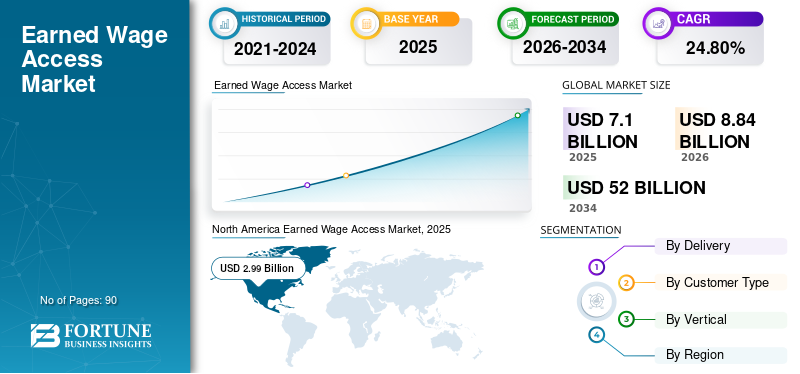
According to Fortune Business Insights: The global earned wage access (EWA) market was valued at USD 7.10 billion in 2025 and is projected to grow from USD 8.84 billion in 2026 to USD 52.00 billion by 2034, exhibiting a CAGR of 24.80% during the forecast period. Earned wage access platforms enable workers to withdraw accrued wages for hours already worked — rather than waiting until the end of a traditional pay cycle — by integrating with employer payroll or time-and-attendance systems to calculate earned wages in real time and facilitate early digital transfers. Growing demand for financial flexibility among employees, rising adoption of instant payment infrastructure, and increasing employer use of EWA as a workforce retention and wellness benefit are collectively driving the market's rapid expansion. North America dominated the market with a 42.10% share in 2025, valued at USD 2.99 billion.
Get a Sample Research PDF: https://www.fortunebusinessinsights.com/enquiry/request-sample-pdf/114221
Impact of Generative AI
Generative AI is bringing transformative change to the EWA industry, with the most significant effects emerging across real-time payroll verification, risk management, and personalized financial wellness support. AI enables EWA platforms to handle unstructured payroll data, automate affordability checks, and provide tailored financial insights at scale. In March 2024, Payactiv launched a Gen-AI-enabled financial assistant that analyzes user spending behavior to recommend optimal earned-wage withdrawal timing and savings opportunities. In May 2024, DailyPay introduced an AI-driven payroll verification engine that automatically reconciles time-and-attendance data with wage disbursement requests to minimize errors and improve employer policy compliance.
Key Market Drivers
The accelerating shift toward instant and cashless payment ecosystems is the primary market driver. Real-time payment rails enable employees to receive earned wages instantly into bank accounts and digital wallets, eliminating traditional payroll delays and improving financial accessibility. In the U.S., FedNow transaction volume grew 172% in Q4 2024 compared to the prior quarter as financial institutions expanded real-time payment adoption. In the EU, the SEPA Instant Credit Transfer regulation requires euro payments to be processed within ten seconds beginning in 2025 — embedding instant payment capability directly into core banking systems across Europe and creating a structural foundation for EWA platform expansion.
The integration of AI and predictive analytics for personal finance management is a defining market trend. As EWA platforms evolve from basic on-demand payment tools into comprehensive financial wellness systems, AI enables personalized, data-driven insights that improve user engagement and long-term financial security. Platforms including DailyPay, Payactiv, and Even are deploying AI-powered analytics dashboards to track spending, monitor financial health scores, and deliver customized recommendations — making EWA services more intelligent, sustainable, and personalized.
Market Restraints and Challenges
An ambiguous and evolving regulatory landscape is the primary market restraint. Regulatory uncertainty varies significantly by region — in many jurisdictions, it remains unclear whether EWA services should be classified as credit products or payroll advances, directly affecting compliance requirements, licensing procedures, and fee transparency. While U.S. states including California and Nevada have begun establishing EWA-specific rules, many states still lack clear guidance, creating compliance difficulties and elevated operational risk. In Europe and parts of Asia, EWA services may overlap with labor laws and wage protection regulations, constraining market growth until consistent regulatory standards are established.
Market Opportunities
Rising real-time payment adoption and the convergence of open APIs and embedded finance represent the most significant growth opportunity. Payroll APIs enable EWA providers to access real-time and historical wage and time-attendance data directly from employer systems, eliminating manual verification and enabling faster, more accurate wage disbursements. According to a BCG report, embedded finance — payment and banking services built into non-financial apps — is transitioning from a future possibility to a common commercial practice, positioning embedded EWA as the next major growth frontier. This convergence of open APIs, real-time payments, and embedded finance ecosystems is establishing the technological foundation for smarter, faster, and more secure EWA platforms.
Segmentation Analysis
By delivery, the employer-sponsored EWA segment led the market with a 59.39% share in 2026, driven by its deep integration with employer payroll systems enabling accurate real-time wage calculations and automated repayment through payroll deductions. This model offers regulatory clarity, higher trust, and lower default risk relative to direct-to-consumer offerings, and employers are increasingly adopting EWA as part of employee financial retention and wellness programs. The direct-to-consumer EWA segment is expected to grow at the highest CAGR of 28.6%, driven by its ability to serve freelancers, gig workers, and employees without employer-sponsored access.
By customer type, large enterprises dominated with a 56.33% share in 2026, as they increasingly partner with leading EWA providers including DailyPay, FlexWage, and Payactiv to enhance employee satisfaction and reduce turnover — particularly in manufacturing, healthcare, and retail sectors with large hourly workforces. Large enterprises have the infrastructure and compliance readiness to integrate EWA seamlessly into existing payroll and HR systems. The SMB segment is expected to grow at the highest CAGR of 28.0%, driven by rising affordability and accessibility of cloud-based and API-driven payroll solutions.
By vertical, the retail segment led the market with a 26.70% share in 2026, as retailers embrace EWA to improve employee financial wellness and reduce churn — particularly during peak seasons. Seamless payroll and HRIS integrations alongside instant payment rails including RTP, UPI, and FedNow are reducing implementation complexity and supporting adoption. Healthcare and manufacturing are other significant verticals, both characterized by large hourly workforces with high demand for financial flexibility between pay periods.
Regional Outlook
North America leads at USD 2.99 billion in 2025, projected at USD 3.76 billion in 2026, driven by early adoption of digital payroll systems and the concentration of major EWA providers including Payactiv and DailyPay. The U.S. market is projected at USD 2.64 billion in 2026, with major employers including Walmart and Target expanding EWA access to hourly workers through integrated HR platform partnerships. Europe reached USD 1.84 billion in 2025 (25.90% share), projected at USD 2.27 billion in 2026, fueled by supportive EU regulations including PSD2 and the SEPA Instant Credit Transfer mandate, with Wagestream and Hastee partnering with major employers in the U.K., Germany, and France. Germany is projected at USD 0.64 billion and the U.K. at USD 0.47 billion in 2026. Asia Pacific contributed USD 1.44 billion in 2025 (20.20% share), projected at USD 1.82 billion in 2026, supported by rising smartphone penetration, digital payment adoption through UPI and PayNow, and government financial inclusion initiatives across India, China, Japan, Australia, and Singapore. South America reached USD 0.33 billion in 2025, driven by Brazil's Pix instant payment network enabling seamless wage disbursements. The Middle East and Africa contributed USD 0.51 billion in 2025, with growing partnerships between employers and regional fintechs accelerating EWA access across the UAE, Saudi Arabia, and South Africa.
Connect with Our Expert for any Queries: https://www.fortunebusinessinsights.com/enquiry/speak-to-analyst/114221
Competitive Landscape
The global EWA market features companies investing in AI-driven risk and affordability analytics, real-time payroll integration, and digital disbursement platforms to enable faster, compliant, and secure transactions. Key players include DailyPay (U.S.), Earnin (U.S.), PayActiv (U.S.), Rain Technologies Inc. (U.S.), FlexWage (U.S.), Wagestream (U.K.), Refyne (India), CloudPay NOW (U.K.), Instant Financial (Colombia), Hastee (U.K.), Branch (U.S.), ZayZoon (Canada), Earnipay (Nigeria), and Strovia (Singapore). In July 2025, Rain launched embedded on-demand pay integration within Workday as part of the Built on Workday program, allowing Workday customers to enable Rain directly within the platform without additional system changes. In December 2024, Fiserv acquired Canada-based EWA provider Payfare to enhance its embedded finance solutions with Payfare's card program management and consumer app capabilities. In December 2024, CloudPay partnered with Banco Santander to offer SME and corporate employees in Spain real-time earned wage access. In May 2024, Chime launched MyPay, allowing users to access up to USD 500 of their wages ahead of payday without mandatory fees, interest, or a credit check.
Curious About Japan’s Market? Explore the Latest - Earned Wage Access Market Insights