
Disinfectant Market Overview Analysis By Fortune Business Insights
Market Summary
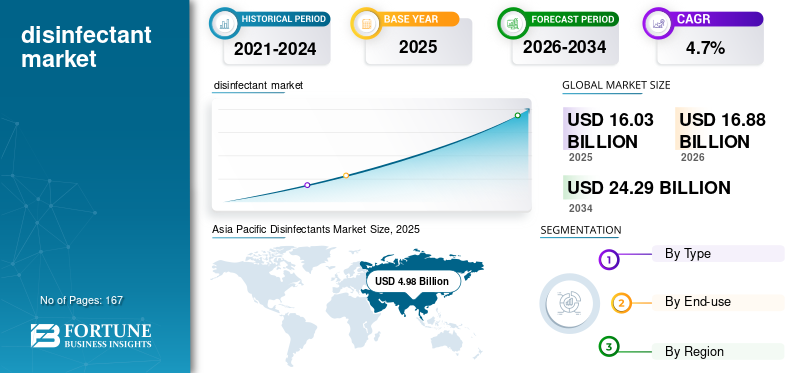
According to Fortune Business Insights: The global disinfectant market size was valued at USD 38.36 billion in 2025 and is projected to grow from USD 42.57 billion in 2026 to USD 98.04 billion by 2034, exhibiting a CAGR of 10.99% during the forecast period. Disinfectants are chemical agents that reduce the number of microorganisms — including viruses, bacteria, and fungi — on non-living surfaces by destroying or inactivating them through mechanisms such as disrupting microbial cell walls or interfering with cellular metabolism. They are deployed across healthcare, commercial, residential, and industrial settings to prevent infection, control disease outbreaks, and maintain hygienic environments. The market is expanding rapidly, driven by lasting shifts in hygiene behavior, tightening regulatory standards, and growing end-use demand across healthcare and food processing sectors. Asia Pacific accounts for a significant share of global demand, while North America holds a dominant position supported by advanced healthcare infrastructure and strict sanitation regulations.
Get a Sample Research PDF: https://www.fortunebusinessinsights.com/enquiry/request-sample-pdf/114140
Key Market Drivers
Rising health concerns and heightened hygiene awareness are the primary drivers of market growth. The COVID-19 pandemic triggered a structural shift in global hygiene practices, elevating disinfection from a routine precaution to an institutional and consumer priority across healthcare facilities, commercial spaces, food processing plants, and households. This behavioral change has largely persisted post-pandemic, sustaining elevated demand levels well beyond the initial emergency period. According to the WHO, hospital-acquired infections affect millions of patients globally each year, with up to 70% of these infections considered preventable through proper hygiene and disinfection protocols — a statistic that reinforces the critical and non-discretionary role of disinfectants in healthcare settings. In India alone, demand for hand sanitizers surged by 3,600% during the COVID-19 outbreak, from approximately 9 lakh liters to 344 lakh liters per annum within a matter of months, illustrating the scale of demand elasticity this market can exhibit during infectious disease events.
The food and beverage industry represents a significant and structurally growing source of demand. According to the Food Standards Agency, approximately 2.4 million cases of foodborne illness occur annually in the United Kingdom alone, reflecting the persistent need for effective disinfection protocols in food processing, packaging, and food service environments. As food safety regulations tighten globally and supply chain hygiene requirements become more stringent, producers are deploying a broader range of food-safe disinfectant products across surfaces, equipment, and water treatment systems. The pharmaceutical industry's expansion is a complementary opportunity driver, as sterile manufacturing environments require rigorous and validated disinfection protocols.
Market Restraints and Challenges
Health risks associated with improper use represent the most prominent market constraint. Many high-efficacy disinfectants — particularly those containing active ingredients such as chlorine, hydrogen peroxide, and quaternary ammonium compounds — can cause skin irritation, respiratory complications, eye damage, and poisoning if used incorrectly, in excessive concentrations, or in poorly ventilated spaces. According to the National Pesticide Information Center (NPIC), misuse of such compounds poses material occupational health risks, particularly in high-frequency commercial and healthcare applications where exposure is frequent. These concerns are driving regulatory scrutiny and creating demand for safer, lower-toxicity alternatives, requiring manufacturers to invest in product reformulation while managing efficacy trade-offs.
Market Opportunities
The expansion of eco-friendly and sustainable disinfectant formulations presents a growing market opportunity. Both commercial and residential consumers are increasingly seeking products that are effective against pathogens while minimizing environmental and human health impacts. The Europe-coordinated SAICM 2.0 project specifically promotes the adoption of safer, more environmentally friendly disinfectants in the healthcare sector without compromising hygiene standards, reflecting a regulatory impetus that is reshaping formulation priorities across the industry. The development of biodegradable, non-toxic, and non-corrosive disinfectant chemistries — including hydrogen peroxide-based systems, plant-derived quaternary compounds, and electrolyzed water technologies — is expanding the addressable market by broadening adoption in segments previously constrained by safety or environmental concerns.
Segmentation Analysis
By type, the alcohol segment leads the market, anchored by ethyl alcohol and isopropyl alcohol's widespread use in healthcare hand hygiene, antiseptic preparations, and surface disinfection. Both variants offer rapid antimicrobial action, broad-spectrum efficacy against bacteria and many viruses, and practical advantages including fast evaporation and residue-free application. The chlorine segment serves large-scale surface and water disinfection applications across healthcare, food processing, and public sanitation. Hydrogen peroxide (H2O2) formulations are gaining traction in healthcare for sporicidal and terminal disinfection applications. Quaternary ammonium compounds are valued for residual surface activity in commercial and institutional settings, while phenolics and aldehydes serve specialized high-level disinfection needs in healthcare and laboratory environments.
By formulation, sprays and solutions hold the dominant share, favored for their ease of broad-surface application, compatibility with automated dispensing systems, and proven efficacy across laboratory, industrial, and healthcare environments. The EPA approved Lysol Disinfectant Spray and Lysol Max Cover Mist for SARS-CoV-2 efficacy in 2020, illustrating the category's critical role during high-demand infectious disease periods. Wipes represent a fast-growing formulation segment, valued for convenience, portability, and controlled dosing in healthcare point-of-care settings and commercial high-touch surface disinfection. Solid formulations including tablets and granules serve institutional and industrial applications where concentrated, stable product formats are preferred.
By end user, healthcare holds the largest market share, driven by the sector's non-negotiable requirement for infection prevention across hospitals, clinics, surgical centers, dental facilities, and long-term care settings. Disinfectants are used for sterilizing medical equipment, treating clinical surfaces, and maintaining aseptic conditions in procedural areas, making them a core component of healthcare operational expenditure. Commercial spaces — including offices, hospitality venues, transportation hubs, and food service establishments — represent the second-largest segment, with demand sustained by occupational health standards and customer hygiene expectations. Residential demand, significantly elevated by pandemic-era purchasing behavior, remains structurally above pre-2020 levels, supported by continued consumer hygiene awareness and product availability through mainstream retail channels.
Regional Outlook
North America holds a dominant position in the global market, underpinned by stringent federal and state hygiene regulations, advanced healthcare infrastructure, high consumer awareness of infection risks, and a dense network of major disinfectant manufacturers. The United States committed USD 49 billion in global water security and sanitation support in March 2023, signaling sustained institutional commitment to hygiene investment. Asia Pacific represents the fastest-growing regional market, driven by a large and rapidly urbanizing population, rising healthcare expenditure, expanding food processing and pharmaceutical industries, and dramatically elevated hygiene consciousness following COVID-19. China is home to some of the world's largest disinfectant production facilities — Sinopec's Jianghan Salt Chemical subsidiary operates with an annual output capacity targeting over 100,000 metric tons — positioning the region as both a major producer and consumer. Europe maintains a substantial market share, with Germany recognized as the world's largest exporter of disinfectant products in 2023 with a global export share of 11.8%, and the region's regulatory framework actively promoting safe and environmentally sound disinfectant use. Latin America and the Middle East and Africa are expanding steadily, supported by improving healthcare infrastructure, growing food safety regulations, and rising hygiene awareness.
Connect with Our Expert for any Queries: https://www.fortunebusinessinsights.com/enquiry/speak-to-analyst/114140
Competitive Landscape
The global disinfectant market is fragmented, with a large number of multinational consumer goods companies, specialty chemical manufacturers, and standalone providers competing across segments. Key players profiled include Procter & Gamble, 3M, Kimberly-Clark Corporation, Cantel Medical Corporation, The Clorox Company, STERIS (Ireland), Lonza Group AG (Switzerland), Gojo Industries, Diversey Holdings, Whiteley Corporation (Australia), and Chembond Chemicals (India). In July 2023, Solenis acquired Diversey Holdings in an all-cash transaction valued at approximately USD 4.6 billion, marking one of the sector's most significant recent consolidation moves. Companies are channeling investment into R&D, new product development, distribution network expansion, and sustainable formulation innovation to strengthen competitive positioning in an increasingly health-conscious and regulation-driven global market.