
Deep Learning Market Overview Analysis By Fortune Business Insights Analysis
Market Summary
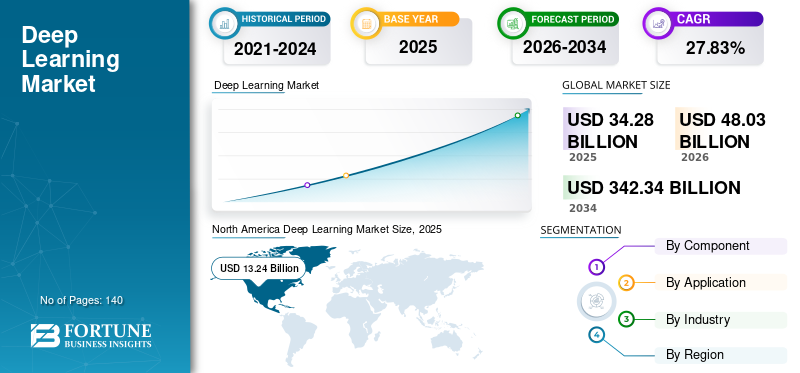
According to Fortune Business Insights: The global deep learning (DL) market size was valued at USD 34.28 billion in 2025 and is projected to grow from USD 48.03 billion in 2026 to USD 342.34 billion by 2034, exhibiting a CAGR of 27.83% during the forecast period. North America dominated the global deep learning (DL) market with a share of 38.61% in 2025. Deep learning is a subfield of AI that models the human brain and machine functions, and it is used for natural language processing, voice recognition, and machine vision, with applications in self-driving vehicles, virtual assistants, digital marketing, and image recognition.
Key Market Trends
Generative AI is advancing rapidly across image, video, and audio generation, including GANs, and Adobe data showing about 15.47 billion AI-generated images online as of August 2023. OpenAI's Sora, introduced in February 2024, is cited as a major driver of interest in AI video. Text-based simulations powered by natural language processing are also spreading across gaming, education, and virtual assistants.
Get a Sample Research PDF: https://www.fortunebusinessinsights.com/enquiry/request-sample-pdf/107801
Key Market Drivers
Automakers' use of machine learning, AI, and big-data analytics is a core driver, with deep learning supporting advances in computer vision. Investment is heavy: the State of AI Report 2022 estimated over USD 50 billion invested in AI startups and scale-ups in 2023.
Market Restraints
Immature or inaccurate algorithms can produce defective products and require human tuning. A global shortage of skilled deep learning professionals makes reliable service delivery difficult, and inconsistent industry standards and protocols complicate machine learning and deep learning deployment.
Market Opportunities
Growth areas it implies include retail and e-commerce personalization and recommendations, and continued startup investment.
Segmentation Analysis
By component, software leads with a projected 54.26% share in 2026, while hardware, covering CPUs, GPUs, FPGAs, and ASICs, makes up the remainder without individual shares. By application, image recognition is expected to hold the largest share, while video surveillance and diagnostics is expected to record the highest CAGR. Signal recognition, data mining, and other uses such as machine translation and drug discovery complete the mix. By industry, automotive is expected to lead with a 21.83% share in 2026, while retail and e-commerce is expected to grow significantly, alongside BFSI, healthcare, aerospace and defense, and media and entertainment.
Regional Outlook
North America led the market with a 38.61% share in 2025 (USD 13.24 billion, rising to USD 18.70 billion in 2026), with the U.S. at USD 13.57 billion in 2026.
Europe held a 28.38% share (USD 9.73 billion in 2025, USD 13.51 billion in 2026), with Germany at USD 3.15 billion and the U.K. at USD 2.94 billion.
Asia Pacific held a 17.97% share (USD 6.16 billion in 2025, USD 8.87 billion in 2026), with China at USD 2.11 billion, Japan at USD 1.99 billion, and India at USD 1.66 billion.
The Middle East and Africa held an 8.72% share (USD 2.99 billion in 2025, USD 4.06 billion in 2026), and Latin America held a 6.32% share (USD 2.17 billion in 2025, USD 2.89 billion in 2026). The regional values reconcile with the global totals.
Connect with Our Expert for any Queries: https://www.fortunebusinessinsights.com/enquiry/speak-to-analyst/107801
Competitive Landscape
AMD, Clarifai, NVIDIA, Google, IBM, Intel, Microsoft, Amazon Web Services, SAS Institute, and Meta Platforms, with no market share figures for any company.
In January 2026, NVIDIA introduced the Rubin platform, including the Vera Rubin NVL72 system, and in April 2026, Meta announced Muse Spark, its first Meta Superintelligence Labs model.
In May 2026, Google launched Gemini 3.5 Flash through the Gemini API and Google AI Studio.
In February 2024, VantAI partnered with Bristol Myers Squibb on molecular glue drug discovery, and in October 2023, Huawei launched its OceanStor A310 AI storage.
In June 2023, GE HealthCare launched Sonic DL for MRI after FDA approval, and in November 2022, H2O.ai expanded into healthcare AI with Hackensack Meridian Health.
Curious About Japan’s Market? Explore the Latest Deep Learning Market Insights