
Counter-UAS Market Overview Analysis By Fortune Business Insights
Market Summary
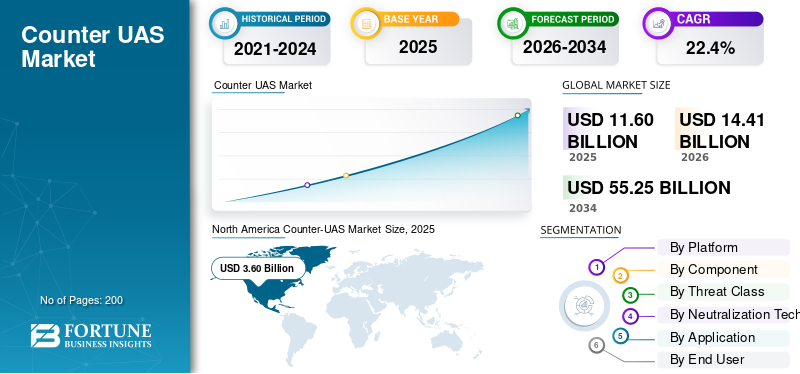
According to Fortune Business Insights: The global counter-UAS (C-UAS) market was valued at USD 11.60 billion in 2025 and is projected to grow from USD 14.41 billion in 2026 to USD 55.25 billion by 2034, at a CAGR of 22.4% during the forecast period. Counter-UAS refers to layered systems designed to detect, track, identify, and neutralize unauthorized or hostile unmanned aerial systems before they can cause safety or security damage. Market growth is driven by the rapid proliferation of low-cost drones as offensive tools across military and civil threat environments, pushing buyers from basic jammers toward integrated systems combining radar, RF sensors, electro-optical infrared, detection tracking, command and control, and real-time mitigation. North America dominated the market with a 31.03% share in 2025, valued at USD 3.60 billion.
Get a Sample Research PDF: https://www.fortunebusinessinsights.com/enquiry/request-sample-pdf/111906
Key Market Drivers
The rapid increase in drone-related threats targeting military bases, borders, airports, ports, energy assets, and critical infrastructure is the primary market driver. Low-cost unmanned aerial systems are now routinely deployed for surveillance, disruption, smuggling, payload delivery, and direct attack missions — transforming drone threats from isolated security incidents into persistent operational risks requiring continuous monitoring and rapid-response capability. In December 2024, the U.S. Department of Defense formally stated that unmanned aerial systems pose an urgent and enduring threat to U.S. personnel, facilities, and overseas assets, aligning counter-UAS efforts with the Joint Counter-Small UAS Office and Replicator 2 programs for the protection of military installations and concentrated forces.
The impact of ongoing conflicts is a transformative market catalyst. The Russia-Ukraine War has made drone threats a central defense-planning priority — with low-cost UAS, FPV drones, loitering munitions, and battlefield reconnaissance systems deployed at scale — pushing armies toward layered C-UAS architectures that integrate detection, electronic warfare, command and control, and hard-kill options. In the Middle East, Houthi one-way attack UAVs and Red Sea maritime threats have increased demand for systems protecting naval vessels, ports, air bases, energy infrastructure, and offshore assets. These conflicts are driving substantial investment in advanced detection and mitigation technologies capable of responding to saturation-style aerial threats in real time.
The defining market trend is the shift toward AI-enabled layered C-UAS architectures. Buyers increasingly prefer integrated systems combining radar, RF sensing, electro-optical infrared, detection tracking, command and control, and multiple mitigation options within a unified operational interface — a direct response to faster, smaller, and more coordinated drone threats that require real-time AI-assisted classification and response. In December 2025, Lockheed Martin and Microsoft announced a collaboration to develop Sanctum, a next-generation C-UAS capability combining Lockheed Martin's mission systems expertise with Microsoft cloud and AI technologies.
Market Restraints and Challenges
Legal restrictions on active mitigation are the primary market restraint. Many active C-UAS technologies — including RF jamming, GNSS jamming and spoofing, cyber takeover, and systems that interfere with communications links — are legally restricted for deployment by airports, private infrastructure operators, local authorities, and law enforcement agencies in many jurisdictions. These restrictions push many buyers toward passive monitoring, detection-only systems, or government-led response models rather than fully integrated C-UAS solutions, slowing overall market penetration. The technical challenge of detecting low-emission and small drone threats in cluttered environments compounds this restraint — commercial drones and low-RF platforms can evade basic RF-based detection systems, while urban terrain, radio interference, and bird activity increase false alarm rates, raising the cost and complexity of deploying effective integrated C-UAS systems.
Market Opportunities
Growing demand for C-UAS solutions across homeland security, airports, ports, energy assets, and public venues is the most significant market opportunity beyond traditional defense applications. These end-users need scalable, modular C-UAS systems that provide early warning, detection, tracking, electro-optical infrared confirmation, and command and control while integrating with law enforcement and critical infrastructure protection operations — without disrupting civilian airspace or communications.
Segmentation Analysis
By platform, the fixed segment dominated in 2025, driven by the requirements of static high-value sites including military bases, airfields, command centers, airports, ports, and energy facilities — which require continuous coverage, layered detection and mitigation, and full-system support including radar, EO/IR cameras, electronic warfare, and kinetic interceptors. The naval/maritime segment is expected to grow at the highest CAGR of 24.0%, reflecting the acute threats to vessels and maritime infrastructure demonstrated in Red Sea conflict operations.
By component, detection and tracking dominated in 2025, as effective counter-drone operations require early identification and continuous threat monitoring before any mitigation can be authorized. This segment encompasses radar, RF detection, acoustic sensors, electro-optical infrared systems, and sensor-fusion software. The C2/software/AI fusion segment is expected to register the fastest CAGR of 22.4%, reflecting accelerating demand for intelligent, automated, multi-layer response platforms.
By threat class, the small commercial/Group 1–2 segment dominated in 2025, as these cheap, widely available, and easily modified drones are the most commonly deployed threat across military bases, airports, borders, and public events, making them the primary driver of detection and tracking investment. Drone swarms are the fastest-growing threat class at a CAGR of 26.1%, reflecting the tactical shift toward coordinated multi-drone attack profiles.
By neutralization technology, RF jamming held the largest share in 2025, valued for its speed of deployment, lower cost per engagement, and broad effectiveness against small commercial drones still dependent on RF links for command, telemetry, and video transmission. High-power microwave is expected to register the fastest CAGR of 31.7%, driven by its effectiveness against drone swarms and its growing adoption in military and critical infrastructure protection programs.
By application, military base and force protection led the market in 2025, as defense organizations represent the largest and most urgent C-UAS buyers — deploying persistent detection, tracking, EO/IR confirmation, command and control, and mitigation across air bases, naval bases, ammunition depots, and forward operating locations. Critical infrastructure is expected to grow at a CAGR of 20.9%.
By end user, defense and military forces held the largest share in 2025, requiring full-layer C-UAS systems including detection tracking, EO/IR, command and control, RF jamming, and kinetic interceptors to respond to the full spectrum of drone threats. Homeland security and border agencies are expected to grow at the fastest CAGR of 23.2%.
Regional Outlook
North America leads the market at USD 3.60 billion in 2025, growing at a CAGR of 16.1%, anchored by the U.S. at USD 3.38 billion — which operates one of the world's most structured and well-funded counter-drone ecosystems across military base protection, homeland security, border surveillance, airport safety, and critical infrastructure defense. Europe held 27.98% of the global market in 2025, driven by the Russia-Ukraine War, NATO rearmament, and the urgent need to protect air bases, borders, and forward-deployed forces. SIPRI reported Europe's military expenditure rose 14.00% in 2025 to USD 864.00 billion. France contributed approximately USD 0.47 billion and the U.K. USD 0.38 billion within the region. Asia Pacific is projected to grow at a CAGR of 19.6%, driven by China's military modernization, India's border security requirements, Japan and South Korea's air-base protection needs, and Taiwan's island-defense posture — with China's counter-UAS revenues at approximately USD 0.82 billion and Japan's at USD 0.27 billion in 2025. The Middle East is projected to grow at a CAGR of 19.7%, driven by repeated drone and loitering munition threats across the Gulf, Red Sea, and wider conflict zones, with Saudi Arabia at USD 0.58 billion in 2025. The rest of the world — Africa and Latin America — is expected to grow at the highest CAGR of 23.6%, with Africa at USD 0.27 billion and Latin America at USD 0.19 billion in 2025, both driven by insurgency-linked drone risks, border security, and critical infrastructure demand.
Connect with Our Expert for any Queries: https://www.fortunebusinessinsights.com/enquiry/speak-to-analyst/111906
Competitive Landscape
The global C-UAS market is led by integrated defense prime contractors and specialized electronic warfare and counter-drone technology companies. Key players include Anduril Industries (U.S.), ASELSAN A.Ş. (Türkiye), Dedrone by Axon (U.S.), D-Fend Solutions (Israel), DroneShield (Australia), Elbit Systems (Israel), HENSOLDT AG (Germany), Israel Aerospace Industries (Israel), Leonardo S.p.A. (Italy), Lockheed Martin (U.S.), Northrop Grumman (U.S.), QinetiQ (U.K.), Rafael Advanced Defense Systems (Israel), RTX Corporation (U.S.), Saab AB (Sweden), SRC Inc. (U.S.), Teledyne FLIR (U.S.), and Thales Group (France). In October 2024, Anduril Industries secured a USD 249.98 million DoD contract for more than 500 Roadrunner-M interceptors and additional Pulsar electronic warfare systems. In October 2024, the U.S. Marine Corps awarded Anduril Federal a combined USD 400.00 million IDIQ contract for an integrated Counter-UAS Engagement System. In January 2024, the U.S. Army awarded RTX USD 75.00 million for 600 Coyote 2C interceptors. In July 2025, Australia awarded approximately USD 11.09 million across 11 vendors under Project LAND 156 to rapidly field threat detectors and drone-defeating technologies into Australian Defence Force service.
Explore Japan’s Market Opportunities - Latest - Counter UAS Market- Insights