
Consumer Electronics Market Overview Analysis By Fortune Business Insights Analysis
Market Size & Growth Outlook
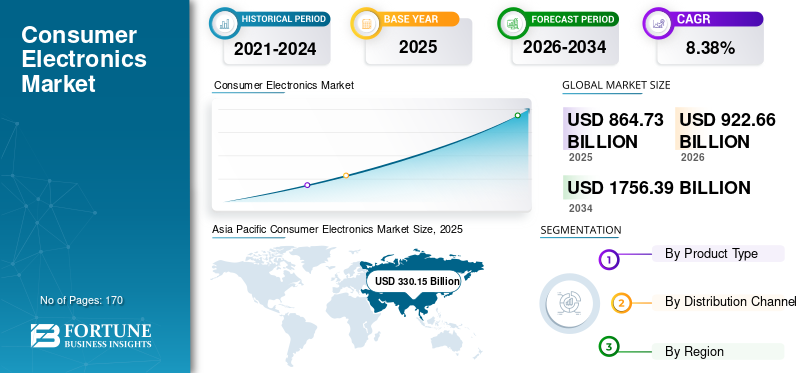
According to Fortune Business Insights: The global consumer electronics market was valued at USD 864.73 billion in 2025 and is projected to grow from USD 922.66 billion in 2026 to USD 1,756.39 billion by 2034, exhibiting a CAGR of 8.38% during the forecast period. Asia Pacific dominated the market with a 38.18% share in 2025, valued at USD 330.15 billion — driven by the robust presence of major global manufacturers including Samsung, Sony, LG, and Panasonic across South Korea, China, and Japan, and rising disposable incomes across the region.
Consumer electronics encompasses a broad range of electronic devices and home appliances used in residential settings worldwide — including televisions, computers, digital cameras, audio and video devices, refrigerators, washing machines, and air conditioners. The convergence of digitalization, artificial intelligence, IoT connectivity, 5G deployment, and rising household incomes is collectively accelerating the adoption of increasingly sophisticated consumer electronics globally.
Get a Sample Research PDF: https://www.fortunebusinessinsights.com/enquiry/request-sample-pdf/104693
Market Trends
Rising Adoption of Smart, Connected, and Voice-Enabled Devices Reshaping Consumer Preferences: The defining trend reshaping the global consumer electronics market is the accelerating consumer preference for smart, connected, and user-friendly devices that integrate seamlessly into digital home ecosystems. The growing trend of connected homes is supporting the penetration of smart appliances globally — with consumers increasingly adopting devices equipped with voice assistance, Bluetooth, and Wi-Fi connectivity for enhanced convenience and home automation capability. Manufacturers are continuously innovating to include multiple smart features within single devices to attract and retain consumers. In August 2021, Indian electronics company boAt collaborated with Actions Technology Co., Ltd to launch the 'Stone 1200' smart speaker, supporting Bluetooth connectivity with smart devices — exemplifying the sector's broad product innovation momentum. The miniaturization of electronic components and simultaneous expansion of screen sizes in television sets are parallel trends reshaping product development priorities across the market.
Market Drivers
Growing Residential Sector and Rising Disposable Incomes Boosting Product Demand: The primary growth driver is the rising income level of the global population — which is enabling consumers to spend more on housing and equip their homes with technologically advanced products. The growing trend of smart device integration in households is expanding the total addressable market for consumer electronics across all price segments. In December 2021, LG Electronics launched a range of expanded TV panels including Mini LED, OLED, and NanoCell TV sets equipped with advanced features — directly targeting households seeking premium home entertainment experiences. As more consumers upgrade to modern, digitally enabled home environments, demand for connected, feature-rich electronic products continues to grow at a sustained pace.
Favorable Government Initiatives Accelerating Market Expansion: Supportive government policy is a critical secondary driver — with national electronics manufacturing and export programs providing structural tailwinds across major consumer electronics markets. India's electronics manufacturing and export market is targeted to reach USD 300 billion by 2025–26 per India Brand Equity Foundation — directly supporting the development of new technologies including 5G, IoT, AI, and machine learning that drive greater adoption of feature-rich electronic products. Green building initiatives globally are also stimulating demand for energy-efficient consumer electronics. In September 2022, Deutsche Telekom announced the launch of 5G smartphones across the entire European region — with initial availability in Germany — further illustrating the role of government and telecom investment in accelerating device upgrade cycles.
Market Restraint
Lower Penetration in Less-Developed Countries Limiting Global Market Expansion: The primary market restraint is the low penetration of smart and high-end consumer electronics in less-developed nations — driven by sluggish economic conditions, limited electricity access, and affordability barriers. According to a research paper published by Springer Nature in 2022, Malaysia's household penetration of IoT-based Smart Home Technology stood at only 12.2% as of 2021 — falling below the global average of 14.2% and substantially behind the U.S. (40.1%), the U.K. (39.3%), and South Korea (36.2%). The adoption of premium smart products remains largely concentrated among high-income population segments — restricting expansion of the premium segment in price-sensitive emerging markets.
Segmentation Analysis
By Product Type: Electronic devices dominate with a projected 58.33% market share in 2026 — driven by high household penetration of televisions, computers, tablets, and laptops, and continuous innovation by companies targeting specific consumer applications. In April 2021, Canon announced the launch of the EOS R3 full-frame mirrorless camera featuring a 35mm CMOS sensor and DIGI X picture processor — exemplifying product innovation that sustains premium device demand. Home appliances maintain a significant secondary share — with refrigerators, washing machines, and air conditioners in particularly strong demand among younger consumers seeking time-saving, high-convenience household solutions. In August 2022, Samsung Electronics launched its 'Bespoke' range of sustainable and intelligent home appliances including kitchen, laundry, and home equipment. In December 2022, LG Electronics launched 'LG ThinQ UP' advanced smart home electronics spanning refrigerators, dryers, ovens, washers, and dishwashers with intelligent, consumer-responsive features.
By Distribution Channel: Offline channels hold the dominant 70.20% market share in 2026 — reflecting the continued importance of specialty electronics retail stores that allow buyers to experience device features in-person, compare brands, and make informed high-value purchasing decisions. The online segment is growing rapidly — driven by COVID-19's acceleration of e-commerce adoption and the expanding digital strategies of major brands. In July 2021, Samsung partnered with Shopee, a prominent Southeast Asian and Taiwanese e-commerce platform, to expand online sales in those regions — illustrating the sector's strategic pivot toward omnichannel digital reach.
Regional Outlook
Asia Pacific leads the global market at USD 330.15 billion in 2025 (38.18% share), projected to reach USD 353.19 billion in 2026. The region benefits from dominant manufacturing capacity, the concentrated presence of global electronics leaders including Sony, Samsung, Panasonic, and LG, and surging disposable income driving home appliance consumption in China, India, and Southeast Asia. Asia Pacific's market grew from USD 293.74 billion in 2023 to USD 310.41 billion in 2024, reflecting consistent expansion momentum. China is projected to reach USD 173.98 billion by 2026, Japan at USD 51.64 billion. Apple's manufacturing network in India — through contractors Foxconn, Wistron, and Pegatron — had collectively created approximately 100,000 employees in India by January 2023, further underscoring the region's growing manufacturing base.
North America contributed USD 226.39 billion in 2025 (26.18% share), projected to reach USD 239.25 billion in 2026. The U.S. market — projected to reach USD 203.74 billion in 2026 — benefits from rising demand for wearables, smart speakers, monitors, and gaming electronics. Growing gaming culture is particularly influential in driving demand for gaming consoles, gaming monitors, and entertainment systems. In September 2022, Nice North America launched new smart home solutions, power management, and entertainment electronics products — reflecting the region's active product innovation pipeline.
Europe generated USD 197.68 billion in 2025 (22.86% share), projected to reach USD 210.09 billion in 2026. European manufacturers are ramping up domestic production to meet growing consumer demand — with Germany's market projected to reach USD 41.68 billion and the U.K. at USD 33.34 billion by 2026. The escalating demand for smart home appliances is a leading regional growth driver.
South America generated USD 73.07 billion in 2025 (8.45% share), projected to grow to USD 79.72 billion in 2026. Rising urbanization, improved broadcasting and internet infrastructure, and 5G rollout — estimated to reach 62 million connections by 2025 per the GSMA — are fueling TV, smartphone, and entertainment electronics demand across Brazil, Argentina, and other markets.
Middle East & Africa reached USD 37.44 billion in 2025 (4.33% share), projected to reach USD 40.41 billion in 2026. In May 2023, Hisense launched Hero U8 TV and ULED X products in Dubai — illustrating growing regional appetite for premium consumer electronics driven by rising living standards.
Connect with Our Expert for any Queries: https://www.fortunebusinessinsights.com/enquiry/speak-to-analyst/104693
Competitive Landscape
The global consumer electronics market is led by Samsung Group (South Korea), LG Electronics Inc. (South Korea), Sony Corp. (Japan), Panasonic (Japan), Apple Inc. (U.S.), Koninklijke Philips N.V. (Netherlands), Whirlpool Corp. (U.S.), AB Electrolux (Sweden), HP Inc. (U.S.), and Huawei Technologies Co. Ltd. (China). Players compete through sustained R&D investment, geographic expansion, strategic partnerships, and production capacity increases. In August 2022, Henkel implemented its first application engineering center in South China to support growing demand from Chinese consumer electronics clients.
Key recent developments include Sony's May 2023 launch of the Xperia 1V smartphone featuring a CMOS image sensor with two-layer transistor pixel; Samsung's August 2022 launch of the sustainable and intelligent 'Bespoke' appliance range; LG's December 2022 launch of 'LG ThinQ UP' smart home electronics; Panasonic's November 2022 launch of new appliances including a built-in-heater washing machine and microwave; and Electrolux's July 2022 implementation of its 'Appliance-as-a-Service' circular economy program.
Uncover Japan’s Market Trends - Explore the Latest - Consumer Electronics Market Insights