
Connected TV Market Overview Analysis By Fortune Business Insights
Market Size & Growth Outlook
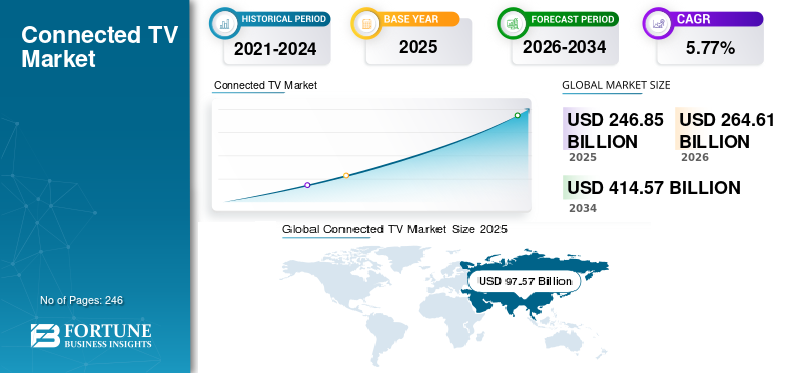
According to Fortune Business Insights: The global connected TV (CTV) market was valued at USD 246.85 billion in 2025 and is projected to grow from USD 264.61 billion in 2026 to USD 414.57 billion by 2034, exhibiting a CAGR of 5.77% during the forecast period. Asia Pacific dominated the global market with a 39.53% share in 2025, valued at USD 97.57 billion — driven by a vast household consumer base across China, India, and Southeast Asia and expanding digital entertainment infrastructure.
Connected televisions integrate internet connectivity directly into television hardware, enabling streaming services, application ecosystems, advertising platforms, and interactive media experiences. They represent the convergence of consumer electronics manufacturing, digital media distribution, advertising technology, and cloud-based content delivery — and have evolved into the primary gateway for premium video consumption globally as households transition from linear broadcasting to internet-delivered entertainment.
Get a Sample Research PDF: https://www.fortunebusinessinsights.com/enquiry/request-sample-pdf/111907
Market Trends
Rising Gaming Adoption and AI-Powered Smart Features: A defining trend shaping the connected TV market is the growing demand from video gamers for televisions compatible with major cloud gaming platforms — including Xbox Cloud Gaming, NVIDIA GeForce, and Google Stadia — alongside manufacturers developing TVs integrated with gaming GPUs and NVIDIA G-Sync and AMD FreeSync technologies. Simultaneously, AI-powered home systems and Vision AI-driven content personalization are becoming standard expectations for premium TV buyers. In May 2025, Samsung Electronics launched its ultra-premium 2025 Neo QLED 8K, Neo QLED 4K, OLED, and QLED TV lineup in India, equipped with Vision AI technology delivering seamless home entertainment experiences. In January 2025, Samsung unveiled its flagship Neo QLED 8K QN990F at CES 2025, showcasing future display and Lifestyle TV capabilities.
Market Drivers
Rising Adoption of Streaming Devices and OTT Platforms: The primary growth driver is the accelerating global adoption of OTT streaming platforms, which is compelling consumers to replace conventional televisions with connected models offering richer, on-demand digital viewing experiences. According to India's Press Information Bureau, as of 2024, OTT streaming platforms serve approximately 600 million users in India alone — with the country's Media & Entertainment sector projected to grow from USD 28.19 billion in 2024 to USD 33.83 billion in 2027. Shifting consumer preferences for IoT-based devices delivering personalized content experiences across smartphones, tablets, laptops, and smart TVs are further expanding the connected TV user base. Rising ad spend by brands to reach targeted audiences through connected TV advertising platforms is also reinforcing revenue growth, as connected television increasingly functions as a measurable alternative to traditional broadcast advertising.
Smart Housing Expansion and Device Upgrade Cycles: Rising global demand for smart housing facilities — including smart apartments, condominiums, and technology-integrated residential developments — is increasing the installation rate of connected TV sets as a core home technology component. Growing consumer preference for replacing conventional television models with the latest AI- and IoT-powered alternatives, combined with the increasing number of single-person households purchasing compact smart TVs for personal living spaces, is sustaining strong device replacement demand across all major markets.
Market Restraints
Data Security Concerns and High Device Costs: The primary restraint is increasing consumer and regulatory concern over data security on connected TV platforms. Smaller CTV platforms may offer weaker privacy protections, raising the risk of data theft and ad fraud through device hijacking schemes — directly reducing willingness to adopt smart TVs in security-sensitive consumer segments. Growing government and regulatory scrutiny of user data collected through connected TV interfaces is raising compliance costs for platform providers and advertisers globally. Additionally, the relatively high cost of connected TVs with advanced features compared to conventional models limits demand among middle-income consumer groups — particularly in emerging markets where repair costs and OTT subscription fees further increase the total cost of ownership.
Segmentation Analysis
By Technology: LED dominates with a 51.90% market share in 2026, reflecting its cost-effectiveness, broad availability across multiple screen sizes, and mature global supply chains that support large-scale production at competitive price points. QLED holds a strong secondary position among premium consumers seeking enhanced color accuracy, high brightness, and advanced high dynamic range imaging. The others segment — encompassing Micro-LED, Mini-LED, and Dual-Cell technology — is the fastest-growing technology category at a CAGR of 13.02% through the forecast period, driven by rising hospitality and corporate demand for cutting-edge display formats.
By Screen Size: The 30–50 inches segment leads with a 56.60% share in 2026, reflecting widespread household preference for this practical and affordable size range as the mainstream residential entertainment format. Compact living environments and 4K Ultra HD content availability are key adoption drivers within this size tier. The above 70 inches segment is the fastest-growing at a CAGR of 10.63%, driven by growing consumer demand for immersive home theater experiences, luxury home renovation trends, and the integration of premium OLED and MicroLED display technologies into large-format TV models.
By Operating System: Android TV leads with a 47.02% global market share in 2026, benefiting from its open ecosystem, broad streaming application compatibility through Google Play, voice assistant integration, and strong developer community. Tizen OS and Web OS are significant proprietary platform competitors — each emphasizing streamlined user interfaces, ecosystem connectivity with other consumer electronics, and AI-driven personalized content recommendations. The others segment — covering Amazon Fire TV, Roku OS, HarmonyOS, and Linux — is the fastest-growing operating system category at a CAGR of 6.08%, reflecting the expanding range of platform providers securing retail ecosystem and content distribution partnerships globally.
By End-User: Households dominate with an 84.88% share in 2026, growing at the highest segment CAGR of 6.26%, driven by broadband penetration, declining hardware prices, and accelerating transition from cable and satellite subscriptions to OTT-based viewing. Hotels represent an important commercial segment deploying connected TVs to allow guests to access personal streaming subscriptions and digital concierge services. Offices are the second-fastest-growing segment at a CAGR of 5.60%, driven by rising adoption of smart TVs for digital signage, video conferencing, and corporate communication in hybrid work environments.
By Distribution Channel: Specialty stores lead with a 44.69% share in 2024, valued for hands-on product demonstrations and expert advisory services that influence high-value purchasing decisions. Brand stores provide curated ecosystem demonstration environments and direct customer education. Online channels are the fastest-growing at a CAGR of 7.68%, driven by improved logistics, consumer confidence in e-commerce purchasing, and promotional pricing — particularly for luxury smart home electronics.
Regional Outlook
Asia Pacific leads comprehensively at 39.53% global market share in 2025 (USD 97.57 billion), with China reaching USD 36.77 billion in 2026 — driven by robust electronics manufacturing capacity, widespread consumer adoption of AI-based TVs, and governmental digital transformation initiatives. Japan represents a technologically advanced market with consistent innovation by domestic electronics manufacturers. India's rapidly expanding OTT ecosystem — with 600 million streaming users — is creating a strong and growing connected TV adoption base.
North America holds the second-largest regional position, with the U.S. market reaching USD 53.50 billion in 2026. The U.S. benefits from the most advanced connected TV advertising ecosystem globally, with major streaming platforms and programmatic advertising technology companies continuously investing in content and platform innovation. High-speed broadband penetration and strong consumer demand for AI-powered home entertainment systems sustain regional market leadership.
Europe is the third-largest regional market, driven by increasing consumer preference for immersive home entertainment experiences and rising demand for energy-efficient televisions in both household and hospitality settings. Germany and the U.K. are leading contributors — with the U.K. seeing particularly strong adoption of streaming-first media consumption and public broadcasters investing in connected TV-compatible streaming platforms.
South America reached USD 14.91 billion in 2025, supported by growing middle-income households and improving broadband infrastructure across Brazil, Colombia, and Argentina.
Middle East & Africa is an emerging market with the UAE projected to reach USD 3.71 billion in 2025, driven by luxury real estate, expanding hospitality infrastructure, and rising upper-income household adoption of premium connected entertainment systems.
Connect with Our Expert for any Queries: https://www.fortunebusinessinsights.com/enquiry/speak-to-analyst/111907
Competitive Landscape
The global connected TV market is highly competitive across hardware manufacturing, operating system development, streaming platform provision, and advertising technology. Leading players include Samsung Electronics Co., Ltd. (South Korea), LG Electronics, Inc. (South Korea), TCL Technology Group Corp. (China), Hisense Group Co., Ltd. (China), Sony Group Corporation (Japan), Xiaomi Corporation (China), VIZIO Inc. (U.S.), Koninklijke Philips N.V. (Netherlands), and Panasonic Corporation (Japan). Samsung opened a network of 1,700 brand stores across India in March 2023 to broaden premium product reach.
Key recent developments include VIDAA International Holdings' September 2025 partnership with Hisense and Deutsche Telekom's MagentaTV to integrate television programming and streaming into smart TV operating systems without external hardware requirements; Samsung's May 2025 launch of its Vision AI-equipped 2025 Neo QLED and OLED lineup in India; Movistar Plus+'s July 2025 launch of Titan OS-powered Philips Smart TVs in Spain; and Xumo's January 2023 joint venture with Comcast and Charter to develop next-generation 4K streaming devices and smart TVs.
Uncover Japan’s Market Trends - Explore the Latest - Connected TV Market Insights