
Ceiling Tiles Market Overview Analysis By Fortune Business Insights Analysis
Market Size & Growth Outlook
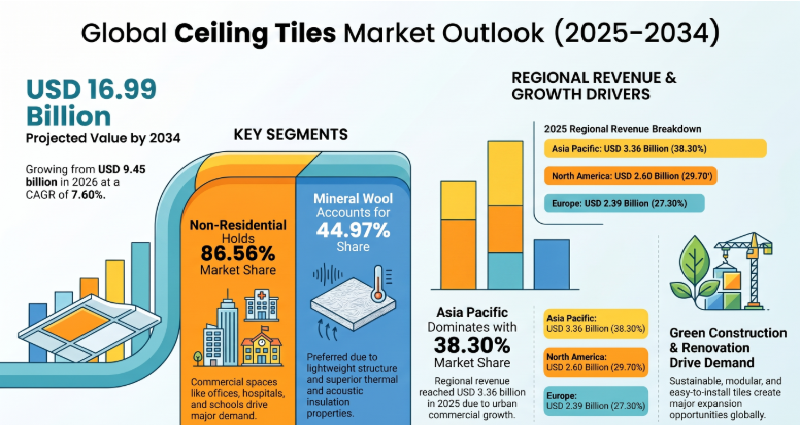
According to Fortune Business Insights: The global ceiling tiles market was valued at USD 8.77 billion in 2025 and is projected to grow from USD 9.45 billion in 2026 to USD 16.99 billion by 2034, exhibiting a CAGR of 7.60% during the forecast period. Asia Pacific dominated the market with a 38.30% share in 2025. The U.S. market is projected to reach an estimated USD 3.20 billion by 2032, driven by rising renovation activity across the region.
Ceiling tiles, also called ceiling panels, drop ceilings, and suspended ceilings, are lightweight construction materials used to cover ceilings. The tiles are placed within an aluminum grid, provide a degree of thermal insulation, and are designed mainly to improve the acoustics and aesthetics of a room. Because they are easy to customize by size, design, and color, they are in high demand across the construction industry. They are used primarily in residential and commercial buildings, including hotels, retail shops, offices, medical institutions, and clinics. Growth in construction project activity is propelling the market.
Get a Sample Research PDF: https://www.fortunebusinessinsights.com/enquiry/request-sample-pdf/105734
Market Trends
Increasing Development of Green Construction: Real estate financiers and investors are accelerating the focus on green building finance. Together with consumer concern about pollution and CO2 emissions, this is creating opportunities for green construction and driving demand for sustainable products. According to an IFC report, green buildings represent one of the largest global investment opportunities in the coming years, estimated at USD 24.7 trillion by 2030. Emerging-market cities in East Asia, the Pacific, and South Asia represent the largest share of that potential, at USD 17.8 trillion. Companies are also adopting decarbonization strategies to create zero-carbon buildings and innovating materials to support sustainable construction, which is opening further opportunities for the market.
Growth Factors
Increasing Commercial Construction Activities: Growing construction in commercial sectors, including hospitals and clinics, office buildings, educational institutions, and industrial complexes, is driving the market. Rising preference for thermal insulation and improved aesthetics, together with growing consumer disposable income, is lifting demand. The rapid growth of the medical industry is leading to hospital construction, which further supports product demand, and use of the tiles to enhance the look of homes is another contributing factor.
Growing Demand for Modular and Easy-to-Install Tiles: The emergence of modular, easy-to-install tiles is a key demand driver, alongside the emphasis on interior decoration, industrial applications, and the need for thermal and acoustic insulation. Manufacturers are innovating with gypsum and mineral fibers to offer sustainable and aesthetically pleasing solutions. Metal tiles are gaining popularity for their acoustic performance and easy installation, especially in car dealerships and retail stores. Infrastructure development in India and China, the expanding U.S. housing market, and U.K. regulations promoting periodic upgrades of ceiling materials are additional factors. Manufacturers are also focusing on renewable materials and increasing R&D into bio-soluble mineral wool tiles to meet demand for eco-friendly products.
Restraining Factors
High Cost and Susceptibility to Damage: The overall process from manufacturing to installation of suspended tiles and supporting grids is expensive, with raw material prices, ceiling design, and skilled installation all adding to the price. Fluctuations in any of these factors directly affect the market. The tiles are also easily damaged by mold and water and need frequent replacement. This damage-prone nature and high cost can push consumers toward cheaper alternatives, restraining market growth.
Segmentation Analysis
By Material Type: Mineral wool is projected to account for a 44.97% share in 2026. Its lightweight and thermal insulation properties make it ideal for ceilings in institutions and offices. The metal segment, covering steel and aluminum tiles, serves both commercial and residential sectors thanks to the material's sturdiness, durability, and long life. Gypsum is expected to grow the fastest during the forecast period, as gypsum tiles are easy to reinstall and repair and are preferred for improving the aesthetics of a structure. The others segment includes plastic, wood, and composite tiles, with changing consumer preferences on ceiling materials supporting demand.
By Application: Non-residential is projected to hold an 86.56% share in 2026, with tiles used in hospitals, educational institutions, retail stores, and corporate offices. Rising urbanization and government infrastructure projects are driving demand, and growing economies such as China, India, and Brazil are investing in their construction industries. The residential segment is expected to see significant growth, supported by the expanding housing sector, rising disposable incomes that shift consumers toward higher-end products, and government investment in housing projects.
Regional Insights
Asia Pacific generated USD 3.36 billion in 2025 (38.30% share) and is projected to reach USD 3.64 billion in 2026. The region is set to account for the highest value in the global market over the forecast period, driven by economic development, population growth, and migration of people to urban areas as the commercial sector expands. China is projected to reach USD 1.27 billion by 2026, with Japan and India each at USD 0.82 billion.
North America was valued at USD 2.60 billion in 2025 (29.70% share) and is estimated to reach USD 2.80 billion in 2026. Consumers are improving their living situations through renovation, which is lifting consumption, while technological advances are helping companies offer sustainable suspended tile solutions. The U.S. market is projected to reach USD 2.04 billion by 2026.
Europe held a 27.30% share in 2025, reaching USD 2.39 billion, and is projected to grow to USD 2.56 billion in 2026, supported by infrastructure construction and favorable regulations to improve medical and healthcare institutions. The U.K. market is projected to reach USD 0.42 billion by 2026 and Germany USD 0.68 billion.
Middle East & Africa stood at USD 0.22 billion in 2025 (2.50% share) and is projected to reach USD 0.23 billion in 2026. Abundant raw materials make it easy for manufacturers to produce locally, and an improving consumer lifestyle is driving demand for modernized housing and offices.
Latin America reached USD 0.20 billion in 2025 (2.30% share) and is expected to reach USD 0.21 billion in 2026.
Connect with Our Expert for any Queries: https://www.fortunebusinessinsights.com/enquiry/speak-to-analyst/105734
Competitive Landscape
Leading players include Armstrong World Industries, ROCKWOOL International A/S, Knauf Gips KG, and Saint-Gobain Gyproc. Armstrong World Industries offers a wide variety of solutions for walls, ceilings, and floors in home and commercial applications, while ROCKWOOL provides tile types including mineral wool, wood, and metal. Profiled companies have adopted strategies such as capacity expansion and new product development to improve their global presence and gain a competitive advantage.
Other key companies include USG Corporation (U.S.), CertainTeed (U.S.), Odenwald Faserplattenwerk GmbH (Germany), SAS International (U.K.), Georgia-Pacific (U.S.), and Hunter Douglas (Netherlands).
Key Industry Developments
July 2021: Saint-Gobain Gyproc launched Gyprex L in the ceiling tile category, manufactured with a 100% recyclable gypsum core. The tiles are low maintenance and provide a degree of sound insulation.
January 2021: Saint-Gobain Gyproc announced the launch of a 21,000 sq. ft. ceiling tile manufacturing facility in India, strategically located to serve the Indian gypsum ceiling tile market and to minimize carbon footprint and material availability issues.
October 2020: Armstrong World Industries announced its 24/7 Defend product portfolio for healthier spaces with cleaner air. It includes AirAssure ceiling systems, which self-seal the ceiling grid to prevent air leakage, and an in-ceiling UV-C air purification system.
Explore Japan’s Market Opportunities - Latest Ceiling Tiles Market Insights