
Breath Analyzer Market Overview Analysis By Fortune Business Insights
Market Snapshot
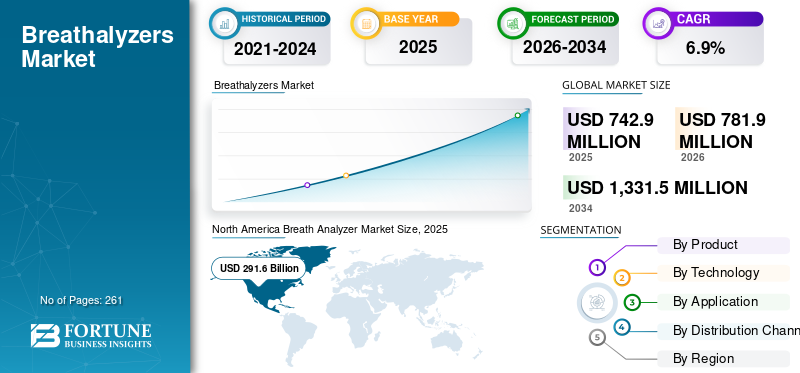
According to Fortune Business Insights: The global breath analyzer market was valued at USD 742.9 million in 2025 and is projected to grow from USD 781.9 million in 2026 to USD 1,331.5 million by 2034, at a CAGR of 6.9% over the forecast period. North America led the global market in 2025, accounting for a 39.25% share valued at USD 291.6 million.
Breath analyzers are devices primarily used to measure blood alcohol content among the general population. Beyond law enforcement, their application is rapidly expanding into medical diagnostics, where non-invasive breath analysis is proving valuable for detecting metabolic and pathogen-specific biomarkers. Key market participants driving innovation include Drägerwerk AG & Co. KGaA, Lifeloc Technologies, Inc., and BACtrack.
Get a Sample Research PDF: https://www.fortunebusinessinsights.com/enquiry/request-sample-pdf/100743
Key Market Drivers
The foremost driver is the rising incidence of alcohol-impaired driving. Law enforcement agencies globally are intensifying roadside alcohol testing supported by zero-tolerance regulations, stricter traffic safety laws, and expanding government initiatives to deploy breathalyzers. In the U.S. alone, approximately 30% of all traffic crash fatalities involve drunk drivers, according to 2023 data from the National Highway Traffic Safety Administration (NHTSA). In low-income countries, alcohol use has been linked to 33–69% of road traffic fatalities, according to data from the World Health Federation.
Government-mandated ignition interlock programs and rising product launches by key players are further accelerating adoption globally.
Market Restraints
The high cost of advanced breathalyzer technologies is a significant barrier, particularly in emerging economies. Infrared spectroscopy and fuel cell-based devices — though highly accurate — are priced at a premium, limiting accessibility in lower-income countries such as India and South Africa. Stringent regulatory requirements for medical diagnostics applications add an additional financial layer, discouraging uptake among budget-constrained healthcare providers and agencies in developing markets.
Market Opportunities
The expansion into medical diagnostics presents the most compelling growth opportunity. Breath analysis is a non-invasive, radiation-free modality capable of detecting volatile organic compounds and metabolic biomarkers relevant to conditions such as diabetes, COPD, cancer, and infectious diseases. Advances in nanotechnology, chemical sensors, and spectrometry are enhancing device accuracy and broadening clinical applicability. Companies like Owlstone Medical are actively developing breathalyzers for early detection of cancer, inflammatory, and infectious diseases, signaling a transformative expansion of the market beyond its traditional law-enforcement role.
Key Market Trends
Technological advancement is the defining trend shaping the breath analyzer landscape. Innovations in semiconductor oxide sensors, nanomaterial-based sensors, and infrared spectroscopy are improving device accuracy, minimizing false positives, and extending application scope. Integration with IoT platforms, telematics, and fleet management systems is enabling real-time reporting and workplace safety monitoring. Additionally, the rise of smartphone-connected personal breathalyzers is broadening consumer adoption, while multi-modal analyzers capable of detecting both alcohol and health biomarkers are emerging as a new product category.
Segmentation Highlights
By Product: Portable/handheld devices dominated the market in 2025, driven by the surge in on-the-spot alcohol testing by law enforcement and growing consumer demand. Standalone/table-top devices are projected to grow at a CAGR of 6.2% through 2034.
By Technology: Fuel cell sensors led the market in 2025, holding a 65.4% share in 2026. Their dominance is attributed to superior accuracy, fast response times, and real-time monitoring capabilities. Semiconductor oxide sensors are projected to record a faster CAGR of 6.6%, supported by declining manufacturing costs and rising consumer-grade applications.
By Application: The medical diagnostics segment was the largest in 2025, fueled by the growing prevalence of chronic conditions — approximately 25 million Americans are currently affected by asthma alone. Drug detection is the next fastest-growing application, with a projected CAGR of 6.6%.
By Distribution Channel: Direct sales dominated with a 42.2% share in 2026, reflecting bulk procurement by hospitals and law enforcement agencies. Online stores represent the fastest-growing channel, forecast to expand at a CAGR of 7.7%, driven by growing consumer self-testing demand.
Regional Outlook
North America led with USD 291.6 million in 2025, anchored by a large installed base in law enforcement and ignition interlock programs, and active R&D investment.
Europe is expected to grow at 5.6% CAGR, supported by strong regulatory mandates on road safety. Germany, the U.K., and France are key country markets.
Asia Pacific reached USD 205.4 million in 2025, with China (USD 78.9 million) and India (USD 26.6 million) as the primary contributors, driven by stricter road-safety enforcement and expanding vehicle fleets.
Latin America and Middle East & Africa represent smaller but emerging markets, growing through pilot public safety programs and expanding regulatory frameworks.
Connect with Our Expert for any Queries: https://www.fortunebusinessinsights.com/enquiry/speak-to-analyst/100743
Competitive Landscape
Drägerwerk AG & Co. KGaA and Lifeloc Technologies, Inc. were the dominant players in 2025. Drägerwerk launched the Alcotest 7000 in April 2025, while Lifeloc introduced two breath alcohol testers — LT7 and LX9 — earlier in the study period. Other notable players include BACtrack, Intoximeters, Alcohol Countermeasure Systems Corp., Owlstone Medical, Lion Laboratories, and Avalon GloboCare Corp. Companies are increasingly competing through R&D expansion, regulatory approvals, and geographic diversification.
Conclusion
The global breath analyzer market is on a sustained growth path, propelled by escalating road safety enforcement, expanding clinical applications, and rapid technological innovation. While cost constraints and limited market penetration in emerging economies pose challenges, the convergence of breath diagnostics with personalized medicine and IoT connectivity opens transformative opportunities for the forecast period through 2034.