
Big Data Analytics Market Overview Analysis By Fortune Business Insights Analysis
Market Size & Growth Outlook
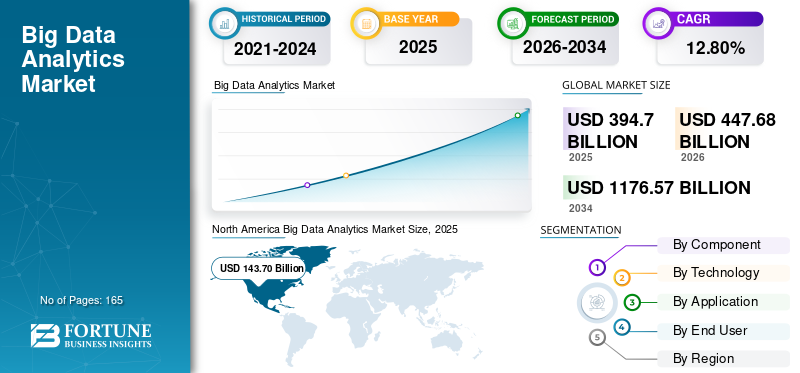
According to Fortune Business Insights: The global big data analytics market was valued at USD 394.70 billion in 2025 and is projected to grow from USD 447.68 billion in 2026 to USD 1,176.57 billion by 2034, exhibiting a CAGR of 12.80% during the forecast period. North America dominated the global market with a 36.40% share in 2025. The U.S. big data analytics market alone is predicted to reach USD 248.89 billion by 2032, reflecting the depth of American enterprise investment in analytics infrastructure.
Big data analytics refers to the use of modernized technologies and tools to process, analyze, and extract insights from massive volumes of unstructured and structured data. Big data has become a vital enterprise asset — enabling real-time decision-making, faster customer service, risk management, and fraud prevention. According to a Harvard Business Review enterprise data and analytics strategies survey, 76% of enterprises stated that real-time data analytics is essential for business performance, while 80% of organizations noted its growing prominence. Key players including IBM, SAP SE, Microsoft, and Salesforce offer a broad range of platforms spanning cloud-based solutions, AI integrations, high-performance computing, and real-time analytics capabilities.
Get a Sample Research PDF: https://www.fortunebusinessinsights.com/enquiry/request-sample-pdf/106179
Impact of Generative AI
Enhanced Generative AI Capabilities Opening Lucrative Market Prospects: Generative AI is profoundly transforming the data analytics industry — playing a vital, multifaceted role in data visualization and analysis. Applications including data cleaning, data processing, and visualization have created new opportunities to extract insights from complex and large datasets. Industry experts forecast that by 2026, nearly 80% of enterprises will utilize generative AI mechanisms — a dramatic rise from less than 5% in 2023. This represents a fundamental paradigm transformation across data analytics applications, with machine learning and generative AI together contributing significantly to market progress.
Market Trends
Growing Adoption of Web Analytical Tools Across Social Media Platforms: Big data mechanisms implemented across social media platforms provide enterprises with insights into customer behavior, preferences, and sentiment — helping businesses understand customer opinions and develop marketing strategies. According to Locowise Insights 2024, Facebook claimed nearly three billion monthly active users in 2024, while WhatsApp is used by an average of 73% of adults in middle-income countries. Due to this growing social media usage, enterprises are investing heavily in web analytical tools — including Google Analytics, AWStats, and Amung.us — to monitor social activity across Facebook, Instagram, YouTube, and Twitter, maintaining regular customer contact and gaining deeper product insights.
Market Drivers
Massive Increase in Data Generated Across the Globe: The primary growth driver is the exponential increase in global data generation — with enterprise-collected data anticipated to grow tenfold yearly, while almost 90% of this data remains unutilized or underengaged. According to Big Data Analytics News 2024, approximately 2.5 quintillion bytes of data are generated daily, with total global data produced reaching 120 zettabytes by 2023 and projected to reach 181 zettabytes by the end of 2025. More than 18 billion text messages are sent daily worldwide, and the anticipated adoption of 5G will make daily data volumes incomprehensibly large. This necessitates expanding storage capacity and analytics tools in parallel. In April 2024, Informatica expanded its alliance with Google Cloud to introduce an MDM Extension for Google Cloud BigQuery — enabling faster, more reliable master data management for analytics and GenAI applications.
Market Restraints
Rising Security Concerns: The primary restraint is the surge in security issues accompanying rapid enterprise cloud migration and cloud-native solution development — driven by misconfiguration and inadequate asset awareness. In 2024, National Public Data, an online background check and fraud prevention service, experienced a substantial data breach exposing personal data of up to 2.9 billion accounts, affecting 170 million individuals across the U.K., U.S., and Canada. Rising data breach instances across organizations are expected to hamper broader big data analytics adoption.
Market Opportunity
Big Data Analytical Tools Enhancing Retail Experience: The growing adoption of big data analytics in retail is creating significant opportunities — shaping inventory management, logistics, and providing detailed consumer habit insights. These tools enhance sales, optimize marketing through product recommendations, improve payment solutions, and elevate overall customer experience. In January 2022, Adobe and Salesforce launched big data tools to improve retail experience — including a beta pickup-store feature program in collaboration with Walmart, giving brick-and-mortar retailers a competitive digital edge.
Segmentation Analysis
By Component: Software dominates with a projected 47.15% market share in 2026 and is expected to register the highest CAGR — driven by technological advancements, evolving business requirements, and rising data volume and complexity. Software categories include business intelligence solutions, CRM analytics, credit risk management, compliance analytics, and workforce analytics. In March 2024, TransUnion unveiled OneTru — a solution enablement platform for governing, managing, analyzing, and distributing data — enhancing innovation speed for fraud, risk, and marketing use cases. Services are projected to grow at a significant rate, offering insights that go beyond customary analysis to support informed decision-making.
By Enterprise Type: Large enterprises dominate with a projected 60.67% market share in 2026 — leveraging data analytics tools to extract deeper insights from vast data availability, with companies including Amazon, Netflix, and Walmart as prominent examples. Small and medium enterprises are projected to register the highest CAGR, as SMEs increasingly adopt website analytics and similar tools to gain valuable insights into user behavior, traffic, and conversion rates.
By Application: Data Discovery and Visualization (DDV) dominates with a projected 57.34% market share in 2026 — driven by its ability to generate insights, adapt to change, and facilitate informed decisions across business intelligence, fraud detection, customer analytics, and healthcare analytics use cases. Advanced Analytics (AA) is projected to grow at the highest CAGR, transforming data into valuable assets that enhance decision-making, operational efficiency, and customer insights. In October 2024, FICO partnered with TCS to deliver advanced decision management and mathematical optimization technology across global industries.
By Vertical: BFSI dominates with a projected 22.31% market share in 2026 — driven by rising AI adoption in financial services to improve customer experience, prevent fraud, and support data-driven decisions. In January 2024, KlariVis launched new data analytics features within its banking analytics platform, including a Report Builder enabling customized trend reports and charts. Healthcare is projected to grow at the highest CAGR, driven by the need to leverage vast healthcare datasets to improve patient care, reduce costs, detect fraud, and support research.
Regional Outlook
North America led the global market at USD 143.70 billion in 2025 (36.40% share), projected to reach USD 161.81 billion in 2026 — driven by early adoption of AI and machine learning across financial institutions, government, and healthcare sectors in the U.S. and Canada. The U.S. market is projected to reach USD 122.949 billion by 2026. In May 2023, Salesforce unveiled Tableau GPT and Tableau Pulse — AI-powered analytics tools offering automated data analysis and personalized analytics experiences.
Europe generated USD 118.43 billion in 2025 (30.00% share), projected to grow to USD 133.98 billion in 2026 — driven by rising cloud services adoption and increasing data generation across telecom, healthcare, financial, and retail sectors. Approximately 70% of European companies are migrating operations to the cloud, with around 50% adopting a cloud-first strategy. Germany is projected to reach USD 32.95 billion by 2026, while the U.K. is projected at USD 27.57 billion.
Asia Pacific reached USD 101.35 billion in 2025 (25.70% share), projected to expand to USD 117.62 billion in 2026 — fueled by rising analytics adoption within financial institutions across China, Japan, India, South Korea, and Southeast Asia. China is projected to reach USD 44.294 billion by 2026, Japan at USD 24.772 billion, and India at USD 16.621 billion — with banks leveraging AI for deeper customer insights and improved propensity modeling.
Latin America maintained a strong presence at USD 17.59 billion in 2025 (4.50% share), projected to reach USD 19.36 billion in 2026 — driven by rising technological investment across digital transformation initiatives, with Brazilian businesses making significant investments in data pipelines and data lakes.
Middle East & Africa stood at USD 13.6 billion in 2025 (3.40% share), projected to grow to USD 14.91 billion in 2026, driven by rising digital transformation, growing 5G penetration, and increasing cloud services adoption. In June 2023, Google announced its inaugural cloud region in Qatar — projected to create 25,000 job opportunities by 2030 and bolster the country's digital economy transition.
Connect with Our Expert for any Queries: https://www.fortunebusinessinsights.com/enquiry/speak-to-analyst/106179
Competitive Landscape
The global big data analytics market is consolidated, with the top players accounting for 45%–47% of total market share in 2023. Key players include IBM Corporation (U.S.), SAP SE (Germany), Microsoft Corporation (U.S.), SAS Institute Inc. (U.S.), FICO (U.S.), Oracle Corporation (U.S.), Salesforce Inc. (U.S.), Equifax Inc. (U.S.), TransUnion (U.S.), Alteryx (U.S.), QlikTech International AB (U.S.), KNIME (Switzerland), Teradata (U.S.), Accenture (Ireland), Moody's Corporation (U.S.), and Verisk Analytics, Inc. (U.S.). Companies focus on new product upgrades, innovation, portfolio expansion, and strategic alliances to broaden their business reach.
Key recent developments include Oracle Corporation's September 2024 introduction of new HeatWave capabilities enabling secure generative AI use across AWS and Oracle Cloud Infrastructure; KNIME's August 2024 investment to accelerate enterprise-grade AI Governance and ModelOps; IBM and Salesforce's May 2024 collaboration to develop open, trusted AI and data ecosystems with bidirectional data integration and prebuilt workflows; Qlik's December 2023 acquisition of Mozaic Data to streamline data handling through a data product-oriented approach; and TransUnion's August 2023 partnership with the McCombs Center for Analytics and Transformative Technologies to provide students with financial data science opportunities. SAS also announced in May 2023 a planned USD 1 billion investment over three years to enhance tailored analytics solutions across insurance, banking, government, retail, and healthcare sectors.
Explore Japan’s Market Opportunities - Latest - Big Data Analytics Market Insights