
Bentonite Cat Litter Market Overview Analysis By Fortune Business Insights Analysis
Market Summary
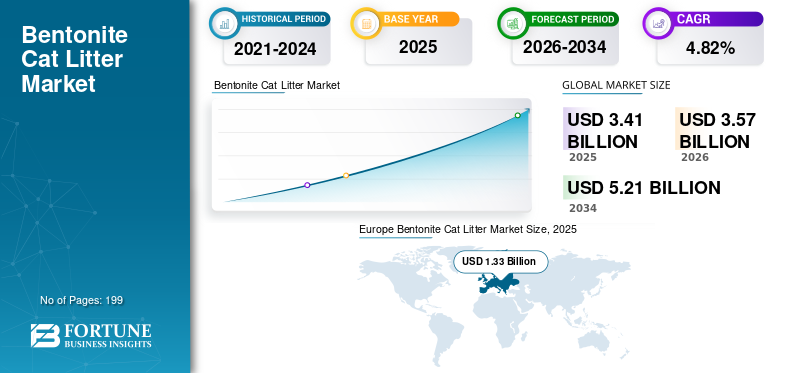
According to Fortune Business Insights: The global bentonite cat litter market was valued at USD 3.41 billion in 2025 and is projected to grow from USD 3.57 billion in 2026 to USD 5.21 billion by 2034, exhibiting a CAGR of 4.82% during the forecast period. Bentonite has become the main component in cat litter due to its superior clumping ability, capable of absorbing approximately 15 times its original volume and forming clumps that can be scooped out without removing the rest of the litter — offering strong odor control, hygiene, and convenience for pet owners. The surge in multi-cat households, a growing global cat population, and the broader shift from pet ownership to pet parenting — particularly pronounced in developing countries — are driving sustained market growth. Europe dominated the market with a 38.95% share in 2025, valued at USD 1.33 billion.
Get a Sample Research PDF: https://www.fortunebusinessinsights.com/enquiry/request-sample-pdf/107148
Key Market Drivers
Growing cat adoption worldwide is the primary market driver. According to the American Pet Products Association, approximately 370 million cats are globally kept as pets, accounting for 70% of pet-owning households, with U.S. pet industry expenditure reaching USD 123.6 billion in 2021. According to the European Pet Food Industry Federation (FEDIAF), Europe's cat population grew from 102.7 million in 2017 to 113.26 million in 2021, reflecting a sustained regional adoption trend. Rising numbers of multi-cat households, increasing single-person homes seeking companionship, and growing demand for litter boxes suited to smaller living spaces are all reinforcing product demand, while busy modern lifestyles are increasing consumer preference for low-maintenance pet care solutions.
The high liquid and odor absorption ability of bentonite is a significant parallel driver. Bentonite cat litter expands to 15 times its original volume upon contact with liquid, forming clumps that can be easily removed without replacing the entire litter substrate. Its antimicrobial properties help keep litter boxes hygienic and odor-free without requiring daily replacement, while its effectiveness in controlling ammonia effects from urine makes it a preferred choice among cat owners seeking convenient, low-effort maintenance.
Market Restraints
Increasing government bans on pet sales are the primary market restraint. Governments across the U.S., Singapore, the U.K., and other countries are introducing regulations restricting pet stores from selling cats and dogs, directly limiting the pool of new pet cat owners. In December 2022, the State of New York passed a law prohibiting pet stores from selling cats, dogs, and rabbits, aiming to halt the puppy-mill-to-pet-store pipeline. According to the U.S. Census Bureau, 46.1% of urban households owned pets in 2021 compared to 65.9% of rural households — with tighter urban living quarters limiting pet ownership in growing metropolitan populations, further constraining market expansion.
Segmentation Analysis
By type, sodium bentonite cat litter is expected to dominate the market throughout the forecast period, offering a clean, hygienic option for indoor pets through its excellent absorption and odor lock formula. Calcium bentonite — referred to as white bentonite cat litter — is preferred by manufacturers for its natural healing benefits, remaining safe even if accidentally ingested by cats during grooming. The blend segment, combining bentonite clay with silica granules for higher absorption and clumping performance, is expected to show the most rapid growth rate, as consumers increasingly favor blended products for superior odor elimination and hygiene maintenance.
By composition, the clay segment dominated the market with a higher share, owing to its cost-effectiveness and the extensive availability of raw materials from vast bentonite reserves across Greece, Australia, India, Russia, Ukraine, the U.S., New Zealand, Germany, Turkey, and China. According to Imerys, bentonite can absorb around 3.5 times its weight upon contact with liquid and does not support bacterial life, helping maintain a hygienic, odor-free litter box. The silica & clay mix segment — a relatively newer blend composition — is expected to grow at a higher CAGR, driven by sodium silicate's strong liquid absorption capability and enhanced ammonia odor control, reflecting evolving consumer preferences toward premium blended formats.
By distribution channel, the offline segment dominated the market, led by supermarkets and pet stores offering wide product ranges under one roof and serving as a crucial global distribution channel for manufacturers. Online distribution channels are expected to grow steadily, benefiting from zero physical outlet expenditure for retailers and rising e-commerce preference among younger consumers — with manufacturers including MARS Petcare actively expanding e-commerce presence, exemplified by the October 2022 launch of its CATSAN cat litter brand on e-commerce platforms in India.
Regional Outlook
Europe leads the global market at USD 1.33 billion in 2025, projected at USD 1.39 billion in 2026, driven by the region's higher cat adoption rate — with at least 90 million European households owning at least one pet according to FEDIAF, and cats remaining the most popular pet category. North America is a significant contributor to market growth, supported by rising overall pet populations; the American Pet Products Association reported approximately 90.5 million U.S. families owned a pet during 2021–2022, with the American Veterinary Medical Association noting that cat ownership rose to 29% of U.S. households in 2022. Asia Pacific, South America, and the Middle East and Africa are expected to record substantial demand growth, driven by rapid urbanization, rising middle-class populations, and increasing pet adoption rates across these developing regions.
Connect with Our Expert for any Queries: https://www.fortunebusinessinsights.com/enquiry/speak-to-analyst/107148
Competitive Landscape
Key players are focused on new manufacturing unit launches, product development, acquisitions, geographic expansion, and advanced technological adaptation to strengthen market position. Leading companies include Church & Dwight Co. Inc. (Arm & Hammer, U.S.), Minerals Technologies Inc. (U.S.), The Clorox Company (Fresh Step, U.S.), Imerys S.A. (France), Mars, Incorporated (CATSAN, U.K.), Klybeck Lifesciences AG (Switzerland), Dr. Elsey's (U.S.), Mcl Bentonite (Turkey), Intersand Group (Canada), and Ceylan Mineral (Turkey).
In October 2022, The Clorox Company opened a new cat litter manufacturing plant in Martinsburg, West Virginia, projected to bring USD 190 million to the local economy with 100 new full-time jobs.
In September 2021, Mars Inc. agreed to acquire PrettyLitter Inc. for a price range of USD 500 million to USD 1 billion, expanding its direct-to-consumer distribution capabilities.
In July 2021, Minerals Technologies Inc. announced a definitive agreement to acquire Normerica Inc., a leading private-label bentonite natural cat litter supplier based in Toronto, Canada.
In June 2021, Imerys expanded into the Asia Pacific region by launching a new manufacturing plant in India to meet growing regional bentonite demand.
Curious About Japan’s Market? Explore the Latest - Bentonite Cat Litter Market Insights