
Autonomous Vehicle Market Overview Analysis By Fortune Business Insights
Market Summary
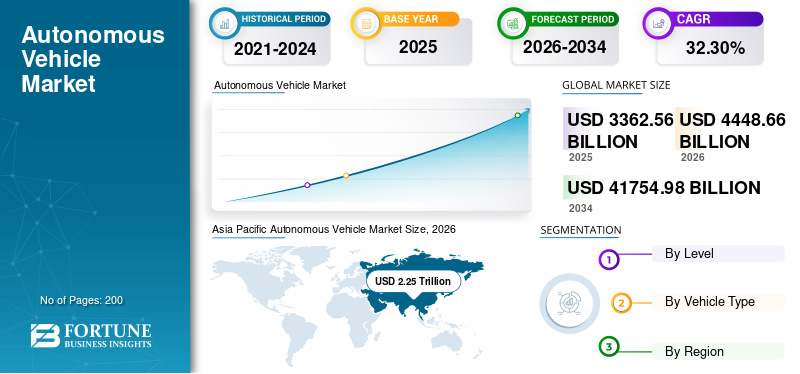
According to Fortune Business Insights: The global autonomous vehicle (AV) market was valued at USD 3.36 trillion in 2025 and is projected to grow from USD 4.44 trillion in 2026 to USD 41.75 trillion by 2034, exhibiting a CAGR of 32.30% during the forecast period. An autonomous vehicle is a self-driving or driverless vehicle capable of navigating and operating without human intervention by combining advanced sensors, artificial intelligence, machine learning, and connectivity technologies to perceive its environment, make real-time decisions, and control movement. The market spans passenger cars embedded with ADAS and self-driving capabilities, as well as commercial vehicles deploying autonomy across logistics, delivery, and ride-hailing services. Asia Pacific dominated the global market with a 52.13% share in 2025, valued at USD 1.75 trillion.
Get a Sample Research PDF: https://www.fortunebusinessinsights.com/enquiry/request-sample-pdf/109045
Key Market Drivers
Continuous advancement in AV technology is the primary market driver. Breakthroughs in AI, sensor technologies — including LiDAR, radar, and camera fusion — and vehicle connectivity are steadily improving the perception, decision-making, and system reliability of autonomous vehicles, making them safer, more efficient, and increasingly viable for mass adoption. Innovation across software-defined vehicle architectures, real-time data processing, and V2X communication is enabling further capability expansion at each level of automation. In June 2023, Minus Zero — an AI startup — revealed a fully autonomous vehicle incorporating a camera-sensor suite built on Nature Inspired AI (NIA) and True Vision Autonomy (TVA) concepts, illustrating the breadth of innovation approaches active in the market.
An increasing focus on commercial applications of AVs is a defining market trend. Companies are shifting attention from purely personal transportation toward autonomous solutions for logistics, last-mile delivery, and robotaxi services. Strategic collaborations between traditional automakers, technology companies, and startups are accelerating development and deployment, with each partner contributing complementary strengths across hardware, software, data, and distribution. In December 2022, Baidu received authorization to conduct AV trials on public roads without a human driver or safety operator in the vehicle — a regulatory milestone that underscored the accelerating pace of commercial AV deployment in China.
Market Restraints and Challenges
The lack of a clear and consistent regulatory framework is the primary market restraint. The absence of standardized AV regulations across regions creates legal uncertainties — particularly around liability, safety certification, and operational domain restrictions — that slow the pace of large-scale deployment. In September 2023, California Governor Gavin Newsom vetoed legislation that would have mandated human drivers in self-driving trucks over 10,000 pounds, reflecting the ongoing tension between regulatory caution and commercial AV deployment ambitions. Adverse weather conditions, complex urban driving environments, and unpredictable edge-case scenarios also represent significant technological hurdles for achieving reliable full autonomy across all driving conditions.
Segmentation Analysis
By level of automation, the L1, L2, and L3 segment held the largest market share, driven by widespread integration of automated braking systems, lane-keeping assistance, and adaptive cruise control into mainstream vehicles — features that enhance safety and driving convenience without requiring full autonomy. The focus on improving existing driving capabilities rather than achieving complete hands-free operation makes L1–L3 technologies broadly accessible and commercially proven, sustaining their dominant volume share. In September 2023, Mobileye and Valeo unveiled a new alliance at IAA Mobility 2023 in Munich to provide software-defined, top-tier imaging radars for ADAS and next-generation automated driving features. The L4 and L5 segment remains in a developing stage, with governments and companies actively exploring commercial deployment in controlled domains. San Francisco launched an autonomous shuttle service in August 2023, expanding the practical footprint of higher-level autonomy in urban transit.
By vehicle type, the passenger cars segment held the dominant share, reflecting the broad integration of ADAS features across consumer vehicles and the rapid expansion of robotaxi and ride-sharing services deploying semi-autonomous and fully autonomous passenger car platforms. In July 2023, Volkswagen outlined plans to launch autonomous vehicles for ride-hailing and goods delivery services in Austin, Texas, targeted for 2026. The commercial vehicles segment is expected to grow at the highest CAGR over the forecast period, driven by the transformative potential of autonomous trucking for logistics efficiency, safety, and operating cost reduction. In July 2023, Kodiak Robotics enrolled its autonomous trucks in the Commercial Vehicle Safety Alliance's Enhanced CMV Inspection Standard program, enabling pre-clearance for roadside inspections and advancing the regulatory maturity of autonomous trucking operations.
Regional Outlook
Asia Pacific leads the global market at USD 1.75 trillion in 2025, projected at USD 2.32 trillion in 2026, anchored by China's dominant manufacturing base, its leading position in AV testing — with Chinese-affiliated companies collectively operating 124 automated vehicles in California covering 438,379 miles as of 2022 — and government-backed deployment programs by companies including Baidu Apollo. The Methanol Institute notes that China's AV and EV ecosystems are deeply interconnected with its broader manufacturing advantages. In August 2023, Baidu extended its Apollo Go autonomous ride-hailing platform to Wuhan Tianhe International Airport, further scaling its commercial AV service network. North America holds a significant market share, supported by a dense ecosystem of leading AV technology companies, major research institutions advancing AI and sensor technologies, and growing robotaxi deployments in cities including San Francisco and Austin. In October 2023, Uber launched access to Waymo's autonomous vehicles in Phoenix, marking the first commercial integration of Waymo rides within the Uber platform. Europe maintains a notable market presence, driven by proactive regulatory leadership — Germany became one of the first countries to permit Level 4 driverless vehicles within specified zones under technical supervision in July 2021 — and strong participation by European automotive and tier-1 technology companies in AV development programs. The rest of the world, including Latin America, is expanding through the growth of ride-sharing services and interest in AV-based mobility solutions.
Connect with Our Expert for any Queries: https://www.fortunebusinessinsights.com/enquiry/speak-to-analyst/109045
Competitive Landscape
The global autonomous vehicle market is highly competitive, with technology leaders, traditional automakers, and specialized AV startups pursuing R&D investment, strategic partnerships, and pilot deployment expansions. Key players include Waymo (U.S.), Tesla Inc. (U.S.), Cruise/General Motors (U.S.), Aurora Innovation (U.S.), Aptiv (Ireland), Uber ATG (U.S.), Nuro (U.S.), Baidu Apollo (China), Mobileye/Intel (Israel), Zoox/Amazon (U.S.), Valeo (France), Yandex Self-Driving Group (Russia), Volvo Car Corporation (Sweden), and Hyundai (South Korea). In October 2023, Uber forged a partnership with Waymo to provide autonomous rides in Phoenix at pricing consistent with traditional Uber rides. In May 2023, Valeo and DiDi Autonomous Driving entered a strategic collaboration and investment agreement to develop intelligent safety solutions for L4 robotaxis. In December 2022, Apple revised its self-driving vehicle timeline, delaying its targeted AV launch by approximately one year to 2026 and scaling back to lower automation level objectives, reflecting the broader industry challenge of managing AV development timelines and technology maturity.
Explore Japan’s Market Opportunities - Latest - Autonomous Vehicle Market - Insights