
Atherectomy Devices Market Overview Analysis By Fortune Business Insights Analysis
Market Size & Future Outlook
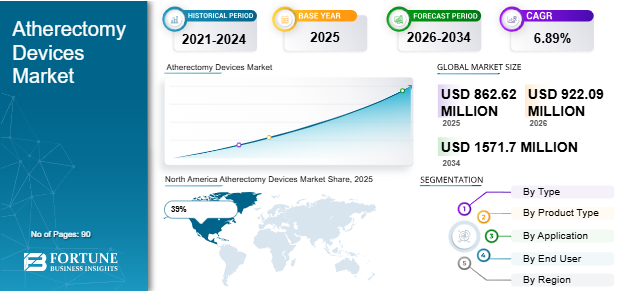
According to Fortune Business Insights: The global atherectomy devices market was valued at USD 862.62 million in 2025 and is projected to grow from USD 922.09 million in 2026 to USD 1,571.7 million by 2034, exhibiting a CAGR of 6.89% during the forecast period. North America dominated the market with approximately a 39% share in 2025, led by the United States as the region's largest individual contributor. The report covers a study period of 2021–2034, with 2025 as the base year.
Market Overview
Atherectomy devices are specialized minimally invasive tools used to remove atherosclerotic plaque buildup from arterial walls, restoring blood flow in patients with peripheral artery disease (PAD) and coronary artery disease (CAD) without the need for open surgical intervention. These devices — including directional, rotational, orbital, and laser-based systems — have become an increasingly important component of interventional cardiology and vascular surgery, offering clinicians a precise, catheter-based alternative to traditional balloon angioplasty and stenting, particularly for complex, calcified, or heavily diseased arterial lesions.
Get a Sample Research PDF: https://www.fortunebusinessinsights.com/enquiry/request-sample-pdf/111844
Market Drivers
The primary growth driver is the rising global prevalence of cardiovascular and peripheral artery disease, fueled by an aging population, increasingly sedentary lifestyles, and the growing burden of diabetes and obesity worldwide. As these risk factors become more widespread across both developed and developing economies, the incidence of arterial plaque buildup requiring interventional treatment continues to climb, directly sustaining demand for advanced atherectomy devices capable of addressing increasingly complex vascular disease presentations.
Market Restraints
The primary restraint is the high cost associated with atherectomy procedures and devices, compounded by variable reimbursement policies across different healthcare systems and regions. These cost pressures can limit patient access and procedural adoption, particularly in markets where insurance coverage for advanced interventional cardiology devices remains inconsistent or where out-of-pocket costs present a significant barrier for patients requiring these procedures.
Market Opportunities
The growing shift toward minimally invasive and outpatient procedures presents a significant opportunity for market expansion, particularly as ambulatory surgical centers (ASCs) increasingly offer atherectomy procedures outside traditional hospital settings. This shift reflects broader healthcare system priorities around reducing procedural costs, shortening recovery times, and improving patient convenience — trends that are expected to meaningfully expand the addressable market for atherectomy device manufacturers as ASC adoption accelerates globally.
Market Challenges
A key challenge facing the market is the inherent procedural complexity of atherectomy interventions, which require specialized physician training to safely and effectively operate these advanced devices. The technical skill required to navigate and operate atherectomy systems — particularly in complex, calcified, or long arterial lesions — can limit the pool of qualified practitioners and create adoption barriers in regions or facilities with limited access to specialized interventional training programs.
Segmentation Analysis
By Type: Instruments hold the dominant share at approximately 62%, reflecting their central role as the core devices used in atherectomy procedures. Accessories account for the remaining approximately 38% of the market, supporting procedural workflows alongside the primary instrument systems.
By Product Type: Directional atherectomy systems lead with approximately 41% share, favored for their precision in removing plaque from specific arterial locations. Rotational systems hold approximately 36% share, valued for their effectiveness against heavily calcified lesions. Other systems — including orbital, laser, and hybrid technologies — collectively account for approximately 23% of the market, reflecting a diversifying technology landscape as manufacturers develop increasingly specialized solutions for complex lesion types.
By Application: Peripheral artery disease represents the larger application segment at approximately 52% share, driven by the high global prevalence of PAD and its strong association with aging populations and diabetes. Coronary artery disease accounts for the remaining approximately 48%, reflecting the substantial and growing burden of coronary disease requiring interventional treatment worldwide.
By End User: Hospitals and ambulatory surgical centers together dominate with approximately 66% combined share, reflecting their role as the primary sites for interventional cardiology and vascular procedures. Specialty clinics account for approximately 24% share, while other healthcare settings make up the remaining approximately 10%.
Regional Analysis
North America leads the global market with approximately a 39% share in 2025, underpinned by high rates of cardiovascular disease, well-established interventional cardiology infrastructure, and strong adoption of advanced device technology, with the United States serving as the region's dominant contributor.
Europe holds the second-largest share at approximately 27%, supported by robust healthcare infrastructure and growing adoption of minimally invasive vascular interventions across the region's major economies. Germany accounts for approximately 9% of the global market and the U.K. approximately 7%, reflecting the region's mature interventional cardiology landscape.
Asia Pacific represents approximately 22% of the global market, driven by rising cardiovascular disease prevalence, expanding healthcare infrastructure, and growing adoption of advanced interventional technologies across the region's major economies. China contributes approximately 8% of the global market, while Japan contributes a notable share reflecting its advanced medical technology adoption and aging population.
Rest of the World, encompassing Latin America and the Middle East & Africa, accounts for approximately 12% of the global market, with growth expected to accelerate gradually as healthcare infrastructure investment and interventional cardiology capacity expand across these regions.
Market Trends
A defining trend reshaping the market is the growing adoption of image-guided atherectomy systems, which enable physicians to visualize arterial plaque and lesion characteristics in real time during procedures, improving precision and reducing the risk of vessel wall injury. The expanding use of atherectomy in treating calcified and long peripheral artery lesions — historically difficult to address with traditional angioplasty alone — is also broadening the clinical application of these devices. Combination therapy approaches, pairing atherectomy with drug-coated balloon treatment, are gaining traction as a strategy to improve long-term vessel patency and reduce restenosis rates. Additionally, manufacturers are increasingly developing low-profile, flexible catheter designs paired with improved debris management systems, enhancing both procedural safety and device maneuverability in complex arterial anatomy.
Competitive Landscape & Key Developments
The market is led by Boston Scientific, holding approximately a 17% share, followed by Medtronic at approximately 14%. Other key players include Abbott, Koninklijke Philips, Terumo, Avinger, AngioDynamics, and BD. Companies are competing through continuous technology innovation and expanding clinical indications for their device platforms.
Notable recent developments between 2023 and 2025 include the introduction of image-guided atherectomy systems offering enhanced real-time visualization during procedures, expanded regulatory indications for peripheral artery disease treatment, the launch of low-profile catheter designs aimed at improving procedural flexibility, new distribution partnerships to broaden market access, and expanded physician training programs designed to build procedural expertise and support wider device adoption across interventional cardiology and vascular surgery practices.
Connect with Our Expert for any Queries: https://www.fortunebusinessinsights.com/enquiry/speak-to-analyst/111844
Outlook Summary
The global atherectomy devices market is positioned for steady, sustained growth through 2034, driven by the rising global burden of cardiovascular and peripheral artery disease, the ongoing shift toward minimally invasive and outpatient procedures, and continued innovation in image-guided and combination therapy approaches. While high procedure costs and the need for specialized physician training remain structural challenges, expanding ambulatory surgical center adoption and broadening clinical applications are expected to sustain robust market demand across both established and emerging healthcare markets.
What Everyone Should Know About Japan’s Market Atherectomy Devices Market Insights