
Air Cargo Market Overview Analysis By Fortune Business Insights Analysis
Market Size & Future Outlook
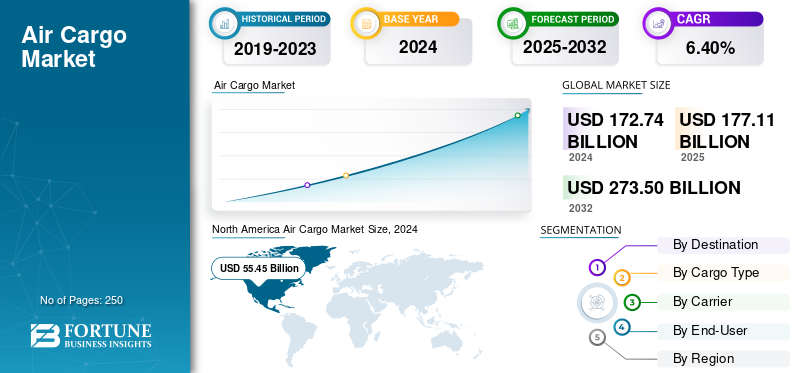
According to Fortune Business Insights: The global air cargo market was valued at USD 172.74 billion in 2024 and is estimated at USD 177.11 billion in 2025, with a forecast of USD 273.50 billion by 2032, exhibiting a CAGR of 6.40% from 2025 to 2032. North America led the market with a 32.10% share in 2024, generating USD 55.45 billion in revenue, up from USD 54.12 billion in 2023. The report covers a study period of 2019–2032, with 2024 as the base year.
Market Overview
Air cargo covers the transport of goods by air on dedicated freighter aircraft and in the belly hold of passenger flights. It is the preferred mode for time-sensitive, high-value, and perishable shipments, including pharmaceuticals, semiconductors, e-commerce parcels, and urgent aerospace parts. Speed, reliability, and global reach make air freight a critical complement to slower, higher-capacity sea transport in modern supply chains.
Get a Sample Research PDF: https://www.fortunebusinessinsights.com/enquiry/request-sample-pdf/108328
Market Drivers
The primary driver is the continued growth of e-commerce, which the report expects to keep rising and which sustains demand for fast cross-border parcel delivery. Passenger-to-freighter (PTF) conversions are also supporting growth by adding dedicated cargo capacity, allowing carriers to expand freighter fleets cost-effectively as demand increases.
Market Restraints
The main restraint is shippers' preference for sea freight, which is cheaper and offers much higher capacity, even though it is slower and less reliable. For non-urgent, bulky goods, this price advantage limits the share of cargo that moves by air.
Market Opportunities
The restoration of belly capacity on passenger routes is lowering unit costs for time-sensitive goods. Digital platforms are letting shippers buy ad-hoc space or charter aircraft more easily, widening access to air freight. Premium, time-definite products serving pharmaceuticals, semiconductors, and aerospace aircraft-on-ground (AOG) needs, along with cross-border e-commerce, offer attractive growth. Demand remains healthy, with IATA reporting August 2025 demand up 4.1% year over year.
Market Challenges
Geopolitical tensions and airspace detours raise fuel consumption and costs while increasing schedule volatility. Red Sea disruptions also affect air-sea multimodal shipments, adding complexity to routing and planning for carriers and shippers.
Market Trends
Blockchain adoption for shipment tracking is gaining traction as the industry seeks greater transparency and data integrity. In July 2025, the Hong Kong Airport Authority showcased a blockchain-enabled cargo data platform, illustrating the push toward digitized, trusted information sharing across the air cargo chain.
Segmentation Analysis
By Destination: Domestic cargo held the larger share in 2024 and is expected to grow at a significant CAGR, supported by regional cargo providers and nearshoring trends.
By Cargo Type: Bulk cargo dominated the market in 2024.
By Carrier: Cargo airlines held over 59% share in 2024, reflecting the role of dedicated freighter operators in the market.
By End User: Commercial and civil users accounted for more than 45% share in 2024.
Regional Analysis
North America is the leading region, with a 32.10% share and USD 55.45 billion in revenue in 2024, up from USD 54.12 billion in 2023.
Europe maintains a strong position, supported by transatlantic trade and pharmaceutical corridors.
Asia Pacific is expected to post the highest CAGR, with carriers reporting about 10% year-over-year demand growth in 2025.
Rest of the World is expected to see moderate growth, with Gulf hubs, African cold-chain expansion, and additional Latin American freighters noted as contributors.
Connect with Our Expert for any Queries: https://www.fortunebusinessinsights.com/enquiry/speak-to-analyst/108328
Competitive Landscape & Key Developments
The market is consolidated, with a mix of global and regional players. Profiled companies include DHL Group, FedEx, The Emirates Group, Cargolux, China Airlines, Turkish Cargo, Qatar Airways, Lufthansa, Cathay Pacific, and ANA.
Notable air cargo developments include Swissport opening an automated cargo terminal at Shanghai Pudong in October 2025 with design capacity of about 1.2 million tonnes; Airbus projecting in October 2025 that the global freighter fleet will rise about 45% to roughly 3,420 aircraft by 2044; and FedEx and UPS adjusting their networks in September 2025 following U.S. de minimis changes.
Outlook Summary
The global air cargo market is positioned for steady growth through 2032, supported by e-commerce expansion, additional freighter capacity, and demand for fast, reliable transport of high-value goods. While competition from sea freight, geopolitical disruption, and routing complexity remain challenges, digital booking platforms, blockchain-enabled tracking, and strong demand in Asia Pacific are expected to sustain growth across major regions.
Explore Japan’s Market Opportunities - Latest Air Cargo Market Insights