
AI in Telecommunication Market Overview Analysis By Fortune Business Insights Analysis
Market Size & Future Outlook
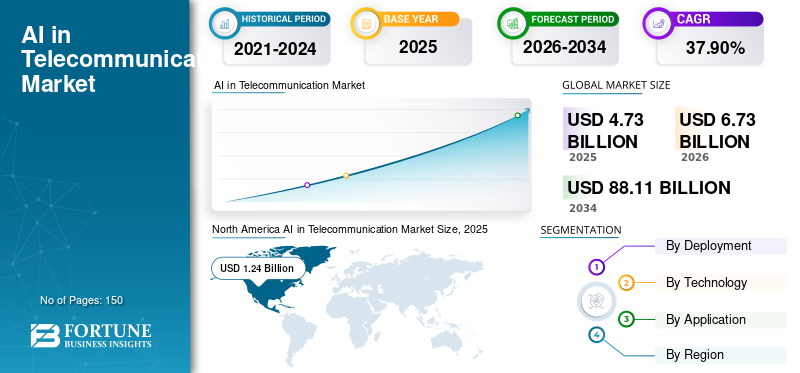
According to Fortune Business Insights: The global AI in telecommunication market was valued at USD 4.73 billion in 2025 and is projected to grow from USD 6.73 billion in 2026 to USD 88.11 billion by 2034, exhibiting an extraordinary CAGR of 37.90% during the forecast period. North America led the market with a 26.40% share in 2025, valued at USD 1.24 billion, while Asia Pacific is expected to register the fastest growth over the forecast period. The report covers a study period of 2021–2034, with 2025 as the base year.
Market Overview
AI in telecommunication refers to the integration of artificial intelligence technologies — including machine learning, natural language processing, and deep learning — into telecom network operations, customer engagement, and infrastructure management. As telecom operators navigate the rising complexity of modern networks driven by 5G rollout and expanding IoT connectivity, AI has become a critical tool for automating data analysis, optimizing network performance, and delivering more personalized, efficient customer experiences at scale.
Get a Sample Research PDF: https://www.fortunebusinessinsights.com/enquiry/request-sample-pdf/109439
Market Drivers
The primary growth driver is the rising demand for automated data monitoring and classification, as AI systems increasingly analyze massive volumes of network and customer data in real time to identify patterns, anomalies, and optimization opportunities that would be impossible to process manually. The growing complexity of telecom networks, driven by 5G deployment and the proliferation of IoT-connected devices, is further accelerating AI adoption as operators seek intelligent tools for network optimization, security monitoring, and operational management. Additionally, telecom providers are increasingly leveraging AI to reduce operational costs through automation while simultaneously improving personalized customer service delivery, creating a dual incentive for continued investment.
Market Restraints
The primary restraint is growing concern around data privacy and the compliance burden associated with regulations such as the General Data Protection Regulation (GDPR) and the California Consumer Privacy Act (CCPA). As AI systems process vast amounts of sensitive customer and network data, telecom operators face significant regulatory scrutiny and potential liability, requiring substantial investment in compliance infrastructure. Compounding this challenge is a persistent shortage of skilled AI talent, which limits the pace at which telecom companies can develop, deploy, and maintain sophisticated AI systems internally.
Market Trends
A defining trend is the rapid adoption of generative AI across telecom operations, which requires operators to modernize underlying data systems, strengthen security infrastructure, and build specialized talent pipelines to support deployment at scale. Many telecom companies are increasingly pursuing in-house AI application development, leveraging pre-built models and open frameworks to accelerate deployment while maintaining greater control over proprietary data and use cases. Additionally, established telecom operators are increasingly investing directly in AI startups, reflecting a strategic shift toward securing early access to emerging AI capabilities and talent through equity partnerships rather than relying solely on off-the-shelf vendor solutions.
Segmentation Analysis
By Deployment: On-premises deployment is projected to hold the largest share in 2026, reflecting telecom operators' continued preference for maintaining direct control over sensitive network and customer data given the heightened regulatory environment. Cloud deployment, meanwhile, is expected to register the highest CAGR over the forecast period, as operators increasingly value the scalability and flexibility cloud infrastructure offers for rapidly evolving AI workloads.
By Technology: Big data analytics holds the largest technology share in 2026, underscoring its foundational role in enabling AI systems to process and extract insights from the massive data volumes generated across telecom networks. Machine learning is expected to post the fastest growth rate over the forecast period, driven by its expanding application across network optimization, predictive maintenance, and customer behavior analysis. Natural language processing and deep learning represent additional significant technology categories supporting the market's expansion.
By Application: Customer service and marketing — including virtual digital assistants (VDAs) — holds the largest application share at 47.52% in 2026, reflecting telecom operators' strong focus on AI-powered customer engagement and support automation. Network and IT operations management is expected to grow at the fastest rate, as operators increasingly deploy AI for automated network monitoring, fault detection, and performance optimization. Other significant applications include customer relationship management, radio access network optimization, customer experience management, predictive maintenance, and fraud mitigation.
Regional Analysis
North America leads the global market with a 26.40% share in 2025 (USD 1.24 billion), projected to reach USD 1.72 billion in 2026, driven by early AI adoption among major telecom carriers and substantial investment in network modernization. The U.S. alone is projected to reach USD 0.93 billion in 2026.
Asia Pacific holds the second-largest share at 23.50% in 2025 (USD 1.11 billion), projected to reach USD 1.65 billion in 2026, and is expected to register the fastest regional growth over the forecast period, driven by massive telecom infrastructure investment and rapid 5G rollout across China, India, and Japan. China is projected to reach USD 0.46 billion in 2026, Japan USD 0.36 billion, and India USD 0.33 billion.
Europe accounts for 21.20% of the global market in 2025 (USD 1.01 billion), projected to reach USD 1.41 billion in 2026, supported by strong regulatory frameworks around AI governance and substantial investment by major European carriers. Germany and the U.K. are each projected to reach approximately USD 0.33 billion and USD 0.31 billion respectively in 2026.
Latin America contributed 15.30% of the global market in 2025 (USD 0.73 billion), projected to reach USD 1.02 billion in 2026, supported by growing telecom digitalization initiatives across the region.
Middle East & Africa accounted for 13.60% of the global market in 2025 (USD 0.64 billion), projected to reach USD 0.94 billion in 2026, driven by expanding telecom infrastructure investment and growing 5G deployment across the region.
Competitive Landscape & Key Developments
Key players include Infosys, IBM, Cisco, Ericsson, Nokia, Intel, Alphabet, Nuance Communications, Nvidia, and AT&T. Companies are pursuing partnerships, strategic investments, and in-house product development to strengthen their competitive position in this rapidly evolving market.
Notable recent developments include Vodafone signing a USD 1.5 billion, 10-year AI partnership deal with Microsoft in January 2024; Jio Platforms launching its proprietary "Jio Brain" AI platform in February 2024; Rakuten partnering with OpenAI in February 2024; Deutsche Telekom unveiling an app-less AI smartphone concept in February 2024; AT&T signing a USD 14 billion network deal with Ericsson in December 2023; SK Telecom investing USD 100 million in Anthropic in August 2023; and Deloitte and NVIDIA launching joint AI telecom solutions in February 2023.
Connect with Our Expert for any Queries: https://www.fortunebusinessinsights.com/enquiry/speak-to-analyst/109439
Outlook Summary
The global AI in telecommunication market is on an exceptional growth trajectory toward USD 88.11 billion by 2034, propelled by escalating network complexity from 5G and IoT expansion, accelerating generative AI adoption, and telecom operators' dual pursuit of cost reduction and enhanced customer experience. While data privacy compliance and AI talent shortages remain persistent challenges, deepening strategic partnerships and substantial capital investment across the telecom sector are expected to sustain the market's remarkable expansion through the forecast period.
Explore Japan’s Market Opportunities - Latest AI in Telecommunication Market Insights