
AI in Sepsis Warning Systems Market Overview Analysis By Fortune Business Insights
Market Summary
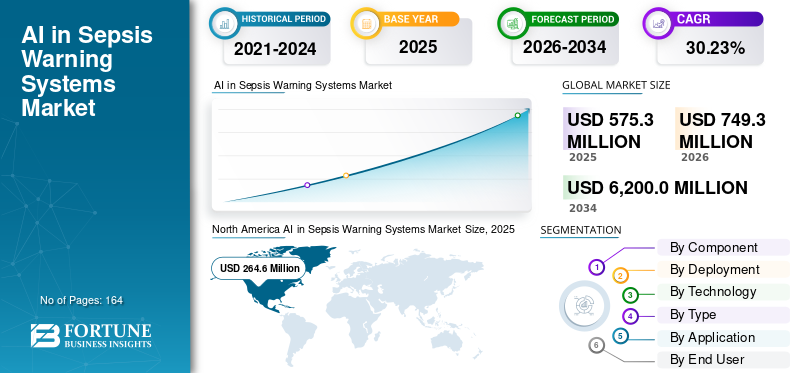
According to Fortune Business Insights: The global AI in sepsis warning systems market was valued at USD 575.3 million in 2025 and is projected to grow from USD 749.3 million in 2026 to USD 6,200.0 million by 2034, at a CAGR of 30.23% during the forecast period. The market encompasses software solutions and associated services used to detect sepsis risk sooner, track patient decline, aid clinical notifications, and direct escalation procedures throughout emergency rooms, ICUs, and hospital-wide care environments. AI is shifting sepsis detection from reactive bedside identification to ongoing, data-informed monitoring — assisting clinicians in prioritizing high-risk patients and facilitating quicker interventions across increasingly strained care settings. North America dominated the market with a 45.99% share in 2025, valued at USD 264.6 million.
Get a Sample Research PDF: https://www.fortunebusinessinsights.com/enquiry/request-sample-pdf/117961
Key Market Drivers
Increasing adoption of AI-powered clinical decision support systems is the primary market driver. Hospitals face mounting pressure to detect sepsis sooner, as delays in diagnosis can swiftly result in organ failure, ICU admission, and increased mortality. Conventional rule-based alerts frequently cause alarm fatigue or miss complex patient deterioration patterns, driving demand for AI tools that instantly assess EHR data, lab results, vital signs, and clinical trends. These systems help clinicians identify high-risk patients, facilitate quicker escalation, and ensure consistent sepsis responses across emergency departments, ICUs, and general wards. As hospital workflows digitize, AI-driven decision support is transitioning from experimental applications to regulated, commercially viable sepsis detection systems. In August 2024, AlgoDx received U.S. FDA 510(k) clearance for NAVOY CDS, its machine learning-based sepsis detection software, supporting AI-based clinical decision support expansion in the U.S. market.
The expansion of cloud-based healthcare platforms for digital monitoring is a significant market trend. Hospitals are shifting from isolated unit-specific tools to cloud platforms that continuously monitor patients across emergency departments, ICUs, and standard wards — enabling large-scale real-time analysis of EHR, vital sign, lab, and workflow data. In September 2025, Cleveland Clinic announced the expanded rollout of Bayesian Health's AI-enabled platform for early sepsis detection across its U.S. hospitals, which was already implemented at 13 facilities and planned for wider expansion across Ohio and Florida.
Market Restraints and Challenges
Data privacy and cybersecurity concerns are the primary restraint on market growth. AI sepsis platforms require ongoing access to confidential patient data including EHR records, lab results, vital signs, medication histories, and live monitoring information. As sepsis warning tools shift to cloud-based and EHR-integrated systems, hospitals face increasing scrutiny around data sharing, interoperability, vendor access, and regulatory compliance. Any security breach can expose protected health information and disrupt clinical alert workflows, extending procurement timelines and increasing IT security evaluation requirements for AI providers. In March 2026, a cyberattack on CareCloud caused an eight-hour disruption in one of its EHR environments and involved unauthorized access to sensitive data, highlighting the operational risks cloud-based healthcare platforms face.
AI model accuracy and interoperability limitations present a parallel challenge. Sepsis is clinically complex, and AI models can produce varying results across hospitals due to differences in patient demographics, EHR formats, lab ordering practices, and documentation methods. A February 2024 University of Michigan study reported that a widely used proprietary AI sepsis prediction tool performed no better than chance when only pre-treatment patient data was used — raising concerns about models that may rely partly on clinician actions rather than independently detecting early sepsis risk. Inadequate interoperability with EHRs, bedside monitors, and lab systems hinders data transfer and reduces alert reliability, requiring localized validation before broad deployment.
Market Opportunities
Rising demand for early disease detection technologies is the most prominent growth opportunity. Sepsis can progress rapidly from infection to organ failure, creating strong demand for AI-based early warning systems that analyze EHR data, lab values, vital signs, and patient trends continuously rather than relying on manual screening or rule-based alerts. In May 2026, Bayesian Health received U.S. FDA 510(k) clearance for its continuous AI sepsis monitoring device, with the company noting that early sepsis detection is a core module of its real-time clinical intelligence platform that continuously monitors every patient and helps clinicians act earlier.
Segmentation Analysis
By component, the software/platform segment captured the largest market share in 2025, as sepsis warning systems are primarily delivered through EHR-integrated platforms, clinical decision support tools, real-time risk scoring engines, and hospital surveillance dashboards offering stronger scalability across emergency departments, ICUs, and hospital-wide workflows. In March 2025, Mednition announced its KATE AI platform received U.S. FDA Breakthrough Device Designation for a sepsis screening model at triage. The services segment is expected to grow at a CAGR of 25.40%.
By deployment, the cloud-based segment led the market in 2025 with a projected 58.3% share in 2026, as cloud platforms enable hospital-wide monitoring without per-site infrastructure, support faster updates and centralized model improvement, and allow clinical teams to access real-time dashboards across departments. The hybrid segment is growing at a CAGR of 29.45%.
By technology, machine learning and deep learning dominated with a projected 47.1% share in 2026, driven by their stronger ability to detect complex sepsis risk patterns from multi-source clinical data and growing regulatory acceptance of AI/ML-based software as a medical device. In April 2024, Prenosis received FDA De Novo authorization for Sepsis ImmunoScore, an AI/ML software combining biomarkers and clinical data to assess sepsis risk within 24 hours. The predictive analytics segment is expected to grow at the fastest CAGR of 30.77%.
By type, the integrated segment led the market in 2025 with a projected 50.5% share in 2026, as AI sepsis systems are most effective when embedded into EHRs, bedside monitors, lab systems, and clinical workflow tools — reducing platform switching and enabling alerts to appear directly within existing clinician workflows. In April 2025, Johns Hopkins University highlighted the TREWS AI-powered sepsis platform, which integrates EHR data with machine learning to help clinicians diagnose sepsis nearly two hours earlier than traditional methods. The standalone segment is projected to grow at a CAGR of 25.15%.
By application, early sepsis detection led the market in 2025 with a projected 29.9% share in 2026, reflecting the core value of AI systems in identifying high-risk patients before clinical deterioration becomes visible. The clinical alerting and escalation segment is expected to grow at the fastest CAGR of 31.04%. By end user, hospitals and health systems held the leading position in 2025 with a projected 57.5% share in 2026, as the highest patient volumes and continuous clinical data generation make them the most suitable setting for real-time AI sepsis surveillance. In January 2024, UC San Diego Health reported that its COMPOSER AI surveillance tool predicted sepsis in emergency departments and reduced mortality by 17%. ICUs and critical care units are projected to grow at a CAGR of 32.49%.
Regional Outlook
North America leads the global market, supported by strong EHR adoption, high healthcare spending, and rapid deployment of AI clinical decision support platforms by major health systems. The U.S. market alone is estimated at approximately USD 313.0 million in 2026, representing about 41.8% of global revenues. Europe is projected to grow at a CAGR of 28.30%, with Germany estimated at USD 42.3 million and the U.K. at USD 36.9 million in 2026, driven by rising focus on patient safety and digital transformation of public healthcare systems. Asia Pacific is expected to reach USD 188.1 million in 2026, propelled by hospital infrastructure development and growing awareness of sepsis-related mortality, with China projected at USD 60.6 million, Japan at USD 40.7 million, and India at USD 22.0 million. Latin America is projected at USD 30.8 million and the GCC at USD 7.4 million in 2026, with growth supported by investment in smart hospitals and AI-enabled healthcare transformation.
Connect with Our Expert for any Queries: https://www.fortunebusinessinsights.com/enquiry/speak-to-analyst/117961
Competitive Landscape
The global AI in sepsis warning systems market is moderately fragmented, consisting of EHR vendors, AI clinical decision support companies, sepsis-specific software providers, and hospital data platform players. Key players include Bayesian Health, Ambient Clinical Analytics, Epic Systems Corporation, Oracle, CLEW Medical, Prenosis Inc., Cytovale Inc., Mednition Inc., Clairyon, and Palantir Technologies. In March 2026, Ambient Clinical Analytics secured USD 5 million in strategic funding to accelerate its real-time clinical analytics and workflow tools. In March 2026, Cytovale announced multicenter real-world data showing that IntelliSep expansion across four additional hospitals produced a 19% relative reduction in sepsis mortality. In June 2026, SEQSTER partnered with Clairyon to combine patient data orchestration with AI-powered clinical decision support for earlier sepsis detection and intervention. Competitive positioning centers on EHR integration depth, real-time surveillance capabilities, FDA clearance status, cloud deployment scalability, and the ability to support standardized sepsis protocols across multi-site hospital networks.