
AI in Patient Flow Management Market Overview Analysis By Fortune Business Insights
Market Summary
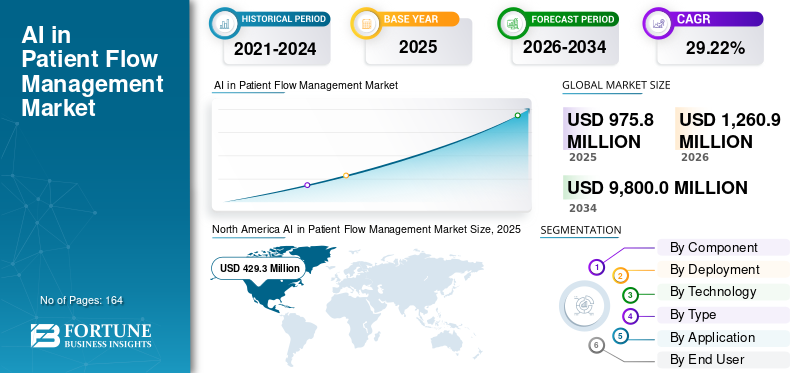
According to Fortune Business Insights: The global AI in patient flow management market was valued at USD 975.8 million in 2025 and is projected to grow from USD 1,260.9 million in 2026 to USD 9,800.0 million by 2034, at a CAGR of 29.22% during the forecast period. The market encompasses software platforms and related services deployed to improve bed and capacity management, admission/discharge/transfer (ADT) optimization, ED flow and boarding reduction, command center operations, and demand forecasting across hospitals and health systems. Hospitals are moving from manual bed management dashboards to predictive and prescriptive AI systems that anticipate capacity challenges, prioritize patient discharges, minimize ED boarding, and manage resources in real time — shifting the care model from reactive to proactive capacity planning. North America dominated the market with a 43.99% share in 2025, valued at USD 429.3 million.
Get a Sample Research PDF: https://www.fortunebusinessinsights.com/enquiry/request-sample-pdf/118105
Key Market Drivers
Rising pressure to reduce ED boarding and overcrowding is the primary market driver. ED boarding — where admitted patients remain in the emergency department due to unavailable inpatient beds or delayed discharges — creates cascading delays across the hospital, increases patient wait times, and restricts the ED's ability to receive new patients. AI-driven patient flow tools are being adopted to predict admissions earlier, project bed requirements, pinpoint discharge obstacles, and manage patient relocation before overcrowding escalates. In October 2025, GE HealthCare reported that its Command Center helped The Queen's Health Systems achieve a 41.2% decrease in emergency department length of stay and a 22.2% increase in patient transfer admissions in the first ten months after opening its hospital operations center — a compelling clinical and operational evidence base that is accelerating adoption across health systems globally.
The growing demand for real-time operational visibility across hospitals and integrated delivery networks is a significant market trend. Large hospitals frequently manage beds, transfers, staffing, transport, environmental services, and discharge readiness through multiple disconnected systems, slowing decision-making and complicating early detection of capacity strain. AI-powered command centers address this gap by delivering near real-time operational perspectives and converting hospital data into actionable insights. In March 2025, Oracle Health announced new capabilities in its health system operations suite — including Oracle Health Patient Flow, Clinical Operations Whiteboard, Transfer Center, and Command Center Dashboard — helping hospitals manage mass transfers, bed management, and emergency response in near real time.
Market Restraints and Challenges
High implementation and integration costs are the key market restraint. AI-based patient flow platforms require deep integration with EHR, ADT, bed management, staffing, transport, environmental services, and command-center systems, increasing deployment complexity and cost. Smaller hospitals, ambulatory centers, and public health systems frequently face budget constraints that limit their ability to fund software licenses, data integration, infrastructure upgrades, cybersecurity controls, and staff training. A January 2025 HIMSS Market Insights study reported that only 18% of healthcare organizations were ready to deploy AI in care delivery, while two-thirds of healthcare leaders cited legacy system integration issues and high upgrade costs as major barriers.
Uneven AI readiness across hospitals and regions is a compounding market challenge. AI patient flow platforms require robust digital infrastructure, reliable EHR/ADT integration, accurate operational data, and skilled teams to act on AI recommendations. A January 2026 Nature Journal analysis of 3,560 U.S. hospitals found that hospital AI implementation was geographically clustered, with regions having greater healthcare access needs being less likely to have hospitals using AI-based predictive models — creating adoption gaps that extend vendor sales cycles and limit market penetration in lower-digital-maturity settings.
Segmentation Analysis
By component, the software/platform segment held the largest market share in 2025, as AI patient flow management is primarily delivered through digital platforms continuously analyzing EHR, ADT, staffing, bed availability, and discharge readiness data to predict bottlenecks and guide faster patient movement across care settings. In February 2025, LeanTaaS was named Best in KLAS 2025 for Capacity Optimization Management, underscoring the central commercial role of AI software platforms in hospital capacity optimization. The services segment is expected to grow at a CAGR of 23.85%.
By deployment, the cloud-based segment dominated in 2025 with a projected 63.9% share in 2026, as cloud platforms allow hospitals to deploy patient flow solutions faster, scale across multiple facilities, support centralized operational visibility without heavy on-site infrastructure, and enable continuous AI model improvement. The hybrid segment is growing at a CAGR of 26.82%.
By technology, the predictive analytics segment dominated in 2025 with a projected 35.0% share in 2026, reflecting its foundational role in forecasting near-term admission demand, bed availability, discharge timing, ED congestion, transfer needs, and staffing pressure. In July 2024, Qventus launched its third-generation Inpatient Solution, fully embedded in EHR workflows, to optimize discharge planning and automate care coordination. The machine learning and deep learning segment is expected to grow at the fastest CAGR of 29.71%.
By type, the integrated segment led the market in 2025, as hospitals strongly prefer patient flow solutions that connect directly with EHR, ADT, bed management, transfer center, and command center systems — reducing manual updates and enabling real-time operational monitoring through connected dashboards. In November 2025, Johns Hopkins Medicine launched Epic's Capacity Management Dashboards enterprise-wide, giving every hospital a single real-time view of patient flow and throughput. The standalone segment is expected to grow at a CAGR of 23.92%.
By application, bed and capacity management captured the largest market share in 2025 with a projected 26.7% share in 2026, as bed availability is the core determinant of admissions, transfers, ED boarding, and overall hospital throughput. In February 2025, Kontakt.io launched a rapid room turnover solution within its patient flow platform to improve hospital capacity and efficiency. The ADT optimization segment is expected to grow at a CAGR of 28.56%.
By end user, hospitals and health systems held the leading position in 2025 with a projected 59.8% share in 2026, driven by the highest patient volumes, most complex patient flow workflows, and greatest need for command-center visibility and predictive decision-making. In February 2025, Philips and Mass General Brigham announced a collaboration to develop and deploy advanced data infrastructure and AI processing live healthcare data from multiple sources. Integrated delivery networks are projected to grow at a CAGR of 31.52% — the fastest among all end-user segments.
Regional Outlook
North America leads the global market at USD 429.3 million in 2025, driven by high hospital digital maturity, strong EHR penetration, rising pressure to reduce ED boarding, and wide adoption of AI-enabled command centers. The U.S. market is estimated at approximately USD 503.9 million in 2026, representing around 40.0% of global revenues. Europe is projected to grow at a CAGR of 27.30%, supported by hospital modernization programs and pressure to reduce waiting times across public and private systems; Germany is projected at USD 65.3 million and the U.K. at USD 59.8 million in 2026. Asia Pacific is expected to reach USD 340.4 million in 2026, propelled by rising hospital volumes, rapid private hospital network expansion, and growing smart hospital investment; China is projected at USD 106.9 million, Japan at USD 70.3 million, and India at USD 34.7 million in 2026. Latin America is projected at USD 51.8 million in 2026, supported by gradual hospital digital transformation and rising demand for better resource utilization. The GCC market is projected at USD 13.5 million in 2026.
Connect with Our Expert for any Queries: https://www.fortunebusinessinsights.com/enquiry/speak-to-analyst/118105
Competitive Landscape
The global AI in patient flow management market is moderately consolidated. Key players include LeanTaaS, Qventus, TeleTracking Technologies Inc., Epic Systems Corporation, General Electric Company, Koninklijke Philips N.V., Palantir Technologies Inc., Care Logistics, Kontakt.io, and Dedalus Healthcare North America. In November 2025, TeleTracking Technologies launched Decision IQ, an AI-driven patient throughput solution piloted at University of Louisville Health to address capacity constraints. In June 2025, TeleTracking and Palantir announced a strategic partnership to transform healthcare operations with AI-powered insights. In June 2026, TeleTracking introduced Operations IQ Ambulatory, extending its platform beyond acute care to outpatient access, referral management, and AI-driven queue prioritization. In January 2026, Kontakt.io introduced Patient Flow Agent, a patient flow orchestration solution designed to reduce length of stay, predict bed availability, identify discharge barriers, and automate interventions across the patient journey. In February 2026, ServiceNow launched Healthcare Operations at ViVE 2026, embedding an AI-native operational system of record into the EMR to connect care teams, facilities, biomed, EVS, and IT on a single platform.