
AI Companion Market Overview Analysis By Fortune Business Insights Analysis
Market Size & Future Outlook
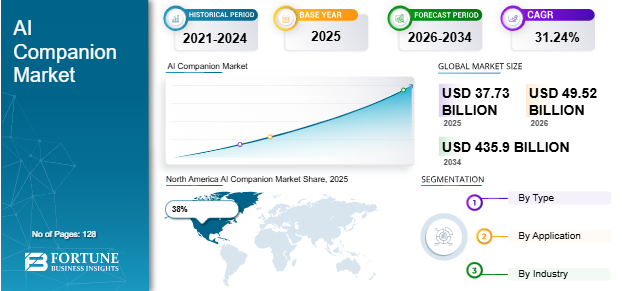
According to Fortune Business Insights: The global AI companion market was valued at USD 37.73 billion in 2025 and is projected to grow from USD 49.52 billion in 2026 to USD 435.9 billion by 2034, exhibiting a CAGR of 31.24% during the forecast period. North America led the market with a 38% share in 2025, followed by Asia Pacific at 29% and Europe at 27%.
Market Overview
AI companions are conversational digital agents designed to provide personalized, emotionally responsive interaction, ranging from friendly chat and social engagement to mental wellness support, personal assistance, and learning. Delivered through text, voice, or multi-modal interfaces that combine images and emotional cues, they are increasingly embedded in smartphones, wearables, VR, and smart home systems, serving consumers, businesses, healthcare providers, and educators.
Get a Sample Research PDF: https://www.fortunebusinessinsights.com/enquiry/request-sample-pdf/113258
Market Drivers
Rising consumer demand for personalized, emotionally supportive digital companions is the primary driver. Growing mental health awareness and the normalization of remote communication are encouraging people to engage with always-available digital tools, while loneliness trends are amplifying interest in companionship that is accessible at any time. Together, these factors are expanding adoption well beyond early technology enthusiasts.
Market Restraints
Privacy, data security, and surveillance concerns are the leading restraints, as companions handle highly personal conversations and emotional data. Ethical issues, including emotional dependency and the risk of users misunderstanding the nature of AI, raise additional scrutiny. Regulatory frameworks remain limited and uneven, with stronger barriers in regions that enforce strict data protection laws.
Market Opportunities
Healthcare offers meaningful potential through patient engagement, adherence reminders, cognitive therapy support, and wellness monitoring. Enterprises are adopting companions for administrative automation and productivity. Smart home ecosystems and ambient intelligence present further integration paths, while multi-modal capabilities open opportunities in education, entertainment, and accessibility.
Market Challenges
Achieving human-level emotional intelligence, empathy, long-term memory, and cultural sensitivity remains difficult. Training data, compute, and model architecture requirements are high, raising development costs. Adoption is also slower in sensitive areas such as mental wellness and relationship support, where trust and safety expectations are especially demanding.
Market Trends
Multi-modal companions that combine text, voice, images, and emotional cues are gaining ground, alongside integration with wearables, smartphones, VR, and smart home systems. AI mental health tools for mood tracking, mindfulness, and stress management are expanding, positioned as support tools rather than replacements for professionals. Enterprise companions for task management, meeting summaries, and workflow support are growing, as are customizable AI personas for gaming, entertainment, and social use. Ethical AI practices, including transparency frameworks and privacy safeguards, are becoming a priority.
Segmentation Analysis
By Type: Text-based companions lead with approximately 46% share, followed by voice-based at about 32% and multi-modal at about 22%. Multi-modal is described as the fastest-evolving segment.
By Application: Mental health support holds approximately 28%, followed by social interaction at about 26%, personal assistance at about 25%, and education and learning at about 21%.
By Industry: Consumer use dominates at approximately 52%, followed by business at about 28%, healthcare at about 12%, and education at about 8%.
Regional Analysis
North America leads with a 38% share in 2025, supported by early adoption of conversational AI, strong technology investment, and a concentration of leading developers.
Asia Pacific holds 29%, with China representing roughly 14% and Japan about 9% of the regional market, driven by large digitally engaged populations and rapid mobile adoption.
Europe accounts for 27%, with Germany contributing roughly 8% of the regional market and the U.K. around 7%, shaped by strong data protection frameworks.
Middle East & Africa holds approximately 6%, with growth tied to expanding digital connectivity.
Competitive Landscape & Key Developments
The market is led by Character Technologies with an 18% share, followed by OpenAI at 14%. Other key players include Amazon, Google, IBM, Nomi.ai, Luka, Soul Machines, Beijing Hongmian Xiaobing Technology, and Meta Platforms.
Notable developments between 2023 and 2025 include multi-modal companions with visual emotion detection, AI wellness companions with mood recognition and behavioral analytics, expanded enterprise assistants for workflow automation, customizable personas for social, gaming, and entertainment use, and increased investment in AI safety frameworks and ethical guidelines. Development focus is also shifting toward edge AI, allowing companions to run on mobile and wearable devices with less cloud dependence.
Connect with Our Expert for any Queries: https://www.fortunebusinessinsights.com/enquiry/speak-to-analyst/113258
Outlook Summary
The global AI companion market is on an exceptional growth trajectory toward USD 435.9 billion by 2034, driven by demand for personalized, emotionally aware digital interaction and expanding use across consumer, healthcare, enterprise, and education settings. While privacy concerns, ethical questions, and technical limits in emotional intelligence remain challenges, multi-modal innovation, edge AI, and stronger safety practices are expected to sustain rapid expansion.
Explore Japan’s Market Opportunities - Latest AI Companion Market Insights