

There is guilt associated with the process of removing your child's arms from around your neck and handing them to somebody else while they scream. Parents who have gone through it will agree that this is tough for two weeks or so, and one day, it's not anymore.
That shift isn't luck. It's a predictable process, and understanding how it works makes the hard mornings easier to get through—and easier to trust.
What's Actually Happening When Your Child Cries at Drop-Off
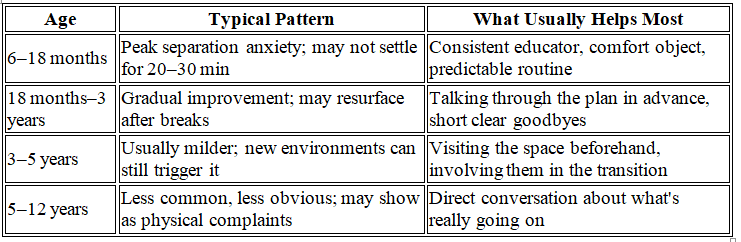
Separation anxiety is not a sign that something is wrong. It's a sign that your child has formed a secure attachment to you, and that attachment supports healthy development. Babies and toddlers don't yet have a reliable sense that people and things still exist when they're out of sight. So when you walk out the door, as far as your eighteen-month-old is concerned, you might genuinely be gone.
This tends to start showing up around 6 to 9 months old, peaks somewhere around 12 to 18 months, and gradually eases off by age 3, once a child's memory and sense of time develop enough for them to hold onto the idea that you're coming back even when you're not there to prove it.
It doesn't always stay gone, either. Kids starting at a new day care centre or returning after a long stretch at home—a summer, a parental leave ending, or a move—can go through a smaller version of it again, even at 4 or 5. Older kids, five to twelve, sometimes show it too, though it looks different: a stomachache before drop-off, quietness, and resistance to getting in the car, rather than obvious tears.
Why It Actually Gets Easier
The short version: your child is running an experiment over and over, and every day it comes back with the same result—you left, and you came back. Eventually the prediction becomes reliable enough that the fear stops firing.
A few things are happening underneath that:
Object permanence solidifies. Somewhere between 8 months and 2 years, children develop a solid idea that objects and people persist even when they cannot be seen. Until this idea becomes fully formed, "gone" and "gone forever" are not separate ideas.
Routine builds prediction. The child who is dropped off in the exact same way at the same time with the same quick goodbye learns the routine before they fully understand it. Predictability transforms what feels unknown and frightening into something familiar and safe.
New attachments form. This one surprises a lot of parents—a good day care centre isn't competing with the parent-child bond; it's adding to it. Kids who build a real relationship with a specific educator settle faster because they're not just tolerating a stranger; they're being cared for by someone they've started to trust.
Children mirror your confidence. Children are remarkably good at reading a caregiver's emotional state. A parent who says goodbye looking anxious, hovering, or repeatedly coming back "for one more hug" is—without meaning to—telling their child that this situation warrants worry. A calm, brief goodbye tells them the opposite.
How Long This Actually Takes
The number isn't constant but an approximate one: typically, children will take anywhere from two to four weeks to adapt to their new daycare schedule. If a child cries when being dropped off but stops crying in about 10 to 15 minutes and then goes on to enjoy the rest of their day, that is all part of the adjustment process.
What Actually Helps — Before, During, and After the Goodbye
Before drop-off starts: Wherever possible, visit the day care centre with your child before their first day. Meet the educator who will be working in the room. Just a brief visit is enough to turn an unknown place into something almost familiar, and it makes a much bigger difference than most parents think.
Talk about the plan out loud more than once—not just on the morning of drop-off, but during the days leading up to it. "You're going to daycare tomorrow, and I'll pick you up after your nap." Repeating the same reassuring message over several days is much more effective than having one long conversation.
During the goodbye: Keep it short. It's the one piece of advice shared by almost every child development expert, and it holds: long, drawn-out goodbyes give extra time to increase distress, not reduce it. A hug, a kiss, a simple "I'll see you after dinner," followed by a wave—don't linger at the door or sneak out. A calm, confident goodbye may lead to tears in the moment, but it helps your child build trust that you'll always come back. Sneaking away without saying goodbye often makes separation anxiety worse.
Stay calm even if you don't feel it. This is hard, especially the first week, but it's one of the more useful things you can control. Kids mirror the adult in front of them.
After you've left: This step is easy to overlook, but it matters. Check in with the educator at pickup—not just about naps and meals but also about the emotional side. How long did it take to settle? What helped? Did anything specific set them off? A good centre will have this information ready without you having to dig for it.
What a Good Day Care Center Should Be Doing on Their End
This is where the quality of the day care centre really matters, especially when you're choosing between centres in North York.
A day care centre that handles separation well usually has a consistent primary educator assigned to each child rather than rotating staff. Familiarity is one of the biggest factors in helping early transitions succeed. They'll offer a settling-in period, sometimes called a gradual entry, where a child attends shorter days or spends a brief time with a parent before transitioning to a full day. They'll actively redirect a distressed child into an activity or routine within the first few minutes, rather than leaving them to cry it out alone. And they'll give you real, specific information at pickup—not just "she was fine," but an actual account of how the transition went.
If you're touring centres and separation anxiety is on your mind—which it should be, especially for infants and toddlers—ask directly: How do you support children during their first two weeks if they're struggling to settle in? A confident, specific answer tells you more about the quality of care than almost anything else on the tour.
Common Challenges Parents Face Without Meaning To
Drawing out the goodbye. It feels comforting in the moment, but it usually makes things worse for the child, not better.
Coming back "just to check." Once you've said goodbye and left the room, going back in — even briefly — resets the process and confuses the message.
Apologizing or looking guilty. Kids pick up on tone more than words. A goodbye said with anxiety in your voice reads as "this is something to be anxious about."
Comparing to other kids. Some children settle in three days, others take three weeks, and both are completely normal. There isn't a "right" pace.
Assuming it means daycare is the wrong choice. Crying at drop-off, on its own, doesn't mean anything is wrong with the centre or the fit. It's usually just the process working itself out.
When It's More Than Typical Separation Anxiety
Most children adjust within a few weeks. If they don't, it's worth speaking with your child's paediatrician. If you've noticed anxiety that doesn't improve after a month or so, physical symptoms such as vomiting or panic that go beyond the usual crying, extreme fear that extends beyond the daycare setting into other types of separation from caregivers, or a child who was previously settled and suddenly regresses without an obvious trigger like a move, a new sibling, or a major family change, these aren't common situations, but they're worth discussing with a healthcare professional rather than simply waiting them out.
St. George Mini School offers gradual entry and consistent, assigned educators across all three of its Day Care Center in North York locations — 33 Mallard Rd., 25 Mallard Rd., and 141 Bond Ave. — specifically to make this transition easier for both kids and parents. Book a tour to see how our team handles drop-off.
This blog “Why Saying Goodbye Gets Easier: Helping Children Cope with Separation” was originally posted Here.