
In today’s hyper-connected, cloud-first world, businesses demand cost-effective, scalable, and reliable communication solutions. Session Initiation Protocol (SIP) trunking has emerged as a dominant force in modern telephony, replacing legacy ISDN and PSTN systems. SIP trunking allows companies to transmit voice, video, and messaging over the internet using VoIP (Voice over Internet Protocol) technology.
The SIP Trunking Services Market is rapidly expanding due to the growing shift toward cloud communication, remote workforces, unified communication platforms, and 5G integration. As companies modernize their communication infrastructure, SIP trunking provides a flexible, scalable, and secure alternative that aligns with digital transformation goals.
Get More Details: https://www.databridgemarketresearch.com/reports/global-sip-trunking-services-market
What is SIP Trunking?
SIP trunking is a technology that connects a private branch exchange (PBX) to the internet using SIP. It enables the transmission of voice, video, and messaging services over the internet rather than traditional telephone lines.
Key Features:
- Eliminates physical phone lines
- Reduces telephony costs
- Scales easily with business growth
- Supports global VoIP connectivity
- Integrates with unified communication (UC) platforms
Market Overview
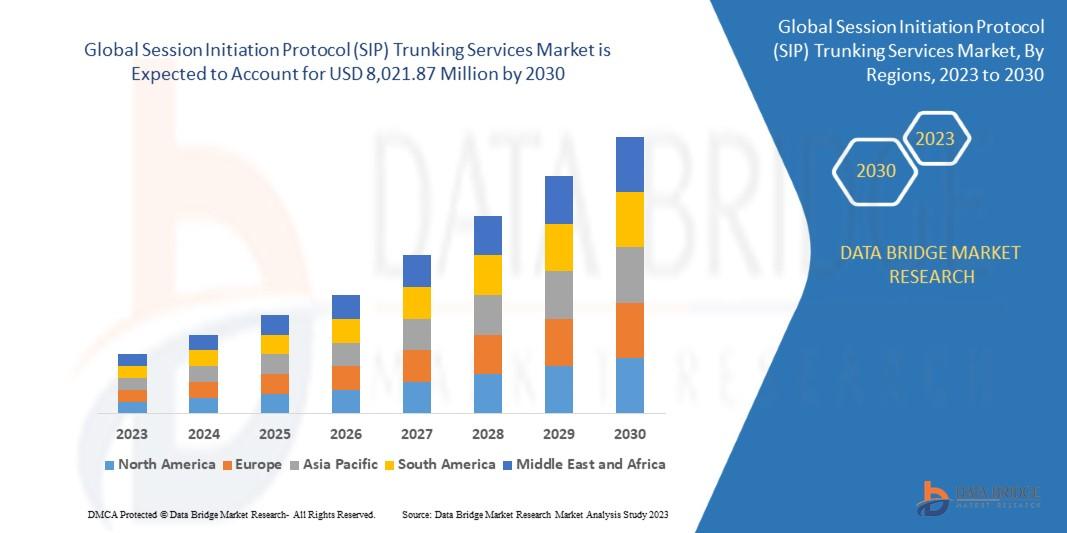
The global SIP trunking services market which was USD 9,067.82 million 2022, is likely to reach USD 8,021.87 million by 2030, and is expected to undergo a CAGR of 12.5% during the forecast period.
Key Drivers of Market Growth
🌐 Digital Transformation Initiatives
Enterprises are upgrading outdated legacy systems and adopting cloud-based communication solutions that SIP trunking readily supports.
📞 Cost Efficiency & Flexibility
SIP trunking drastically reduces long-distance calling charges and infrastructure costs while offering pay-as-you-grow scalability.
💻 Remote Work and Hybrid Models
With remote work becoming mainstream, companies require seamless and secure communication systems accessible from any location. SIP trunking fits the bill.
☁ Growth of UCaaS and CPaaS
SIP trunking is a foundational technology for Unified Communications as a Service (UCaaS) and Communications Platform as a Service (CPaaS) offerings.
Key Market Segments
1. By Organization Size
- SMEs – Quick to adopt SIP due to cost savings and flexibility.
- Large Enterprises – Utilize SIP to connect multiple branch locations across the globe.
2. By Deployment Model
- On-premises SIP Trunking – Used by businesses with existing PBX infrastructure.
- Hosted/Cloud-based SIP Trunking – Preferred for low maintenance and high scalability.
3. By End-User Industry
- IT & Telecom – Heavy users of SIP for customer support and operations.
- BFSI – Ensure compliance while managing high call volumes.
- Healthcare – Use SIP trunking for secure, HIPAA-compliant patient communications.
- Retail & E-commerce – Supports global call centers and omnichannel strategies.
Regional Insights
- North America leads due to high VoIP adoption, tech infrastructure, and enterprise digitization.
- Europe follows with strong telecom penetration and data compliance requirements.
- Asia-Pacific is the fastest-growing region, led by India, China, and Southeast Asia, where cloud adoption is booming.
- Middle East and Africa are gradually adopting SIP as digital infrastructure expands.
Challenges in the Market
⚠ Security Concerns
As voice data travels over the internet, data breaches and VoIP fraud are critical concerns.
⚠ Interoperability Issues
Integrating SIP with legacy PBX systems or across diverse vendor platforms can be complex.
⚠ Regulatory Compliance
Enterprises must ensure SIP trunking systems adhere to telecom laws and privacy regulations (e.g., GDPR, HIPAA).
Future Trends in SIP Trunking
🚀 5G Integration
Faster networks will enhance call quality, reliability, and video conferencing through SIP.
🧠 AI and Analytics Integration
Voice AI will integrate with SIP to offer call transcription, sentiment analysis, and fraud detection.
☁ Migration to Cloud-native Communication
SIP trunking will increasingly integrate with cloud-native PBX and contact center solutions.
🌍 Global SIP Peering and SD-WAN
Improves latency and quality for global voice traffic by routing SIP traffic through software-defined networks.
Key Players in the SIP Trunking Services Market
- Twilio Inc.
- RingCentral, Inc.
- AT&T Inc.
- 8x8, Inc.
- Vonage Holdings Corp.
- Nextiva Inc.
- CenturyLink (Lumen Technologies)
- Verizon Communications
- BT Group plc
Conclusion
The Session Initiation Protocol (SIP) Trunking Services Market is a cornerstone of the modern, cloud-based communication ecosystem. As businesses seek to reduce telephony costs, improve communication quality, and scale globally, SIP trunking provides a reliable, secure, and flexible solution.
With ongoing innovation in VoIP, cloud computing, AI, and 5G networks, the future of SIP trunking is poised for dynamic growth and integration across industries.
FAQs
1. What is SIP trunking, and how does it work?
SIP trunking allows voice and multimedia communication over the internet by connecting a PBX system to a VoIP provider, eliminating the need for traditional phone lines.
2. What are the main benefits of SIP trunking?
Cost reduction, scalability, high-quality calls, remote accessibility, and integration with UCaaS platforms.
3. Is SIP trunking secure?
Yes, when implemented with firewalls, encryption (TLS/SRTP), and fraud detection systems, SIP trunking is highly secure.
4. What industries use SIP trunking the most?
IT & Telecom, BFSI, Healthcare, Retail, and Education sectors heavily rely on SIP trunking for high-volume, reliable communication.
5. Can SIP trunking replace my current phone system?
Yes. SIP can either integrate with your existing PBX or be used with a cloud-based VoIP system, depending on your needs.