

Evolving SEO: Traditional to Modern Search Strategies
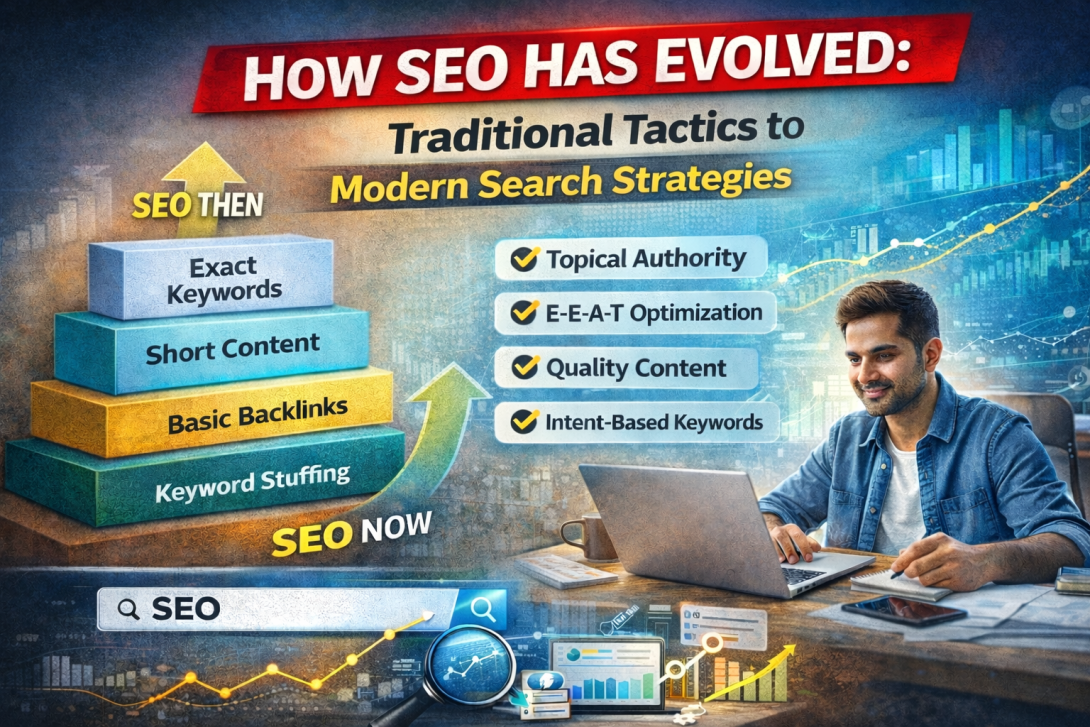
Search Engine Optimization (SEO) has undergone a remarkable transformation over the last decade. What once revolved around basic keyword placement and link building has now become a sophisticated discipline that blends technical expertise, content quality, user experience, and brand authority.
Businesses today, SEO is not just about ranking higher on search engines—it is about building credibility, delivering valuable information, and providing the best possible experience to users. Companies working with a digital marketing company often discover that the strategies that worked five or ten years ago are no longer effective in today’s search landscape.
In this article, we explore how SEO strategies have evolved and what modern businesses should understand to remain competitive online.
Early Phase of SEO
In the earlier days of search engines, SEO was relatively straightforward. Search algorithms were less complex, and ranking a website primarily depended on a few key factors, such as keyword density and backlinks.
Businesses focused heavily on inserting target keywords repeatedly within their website content. The assumption was simple: the more frequently a keyword appeared on a page, the more relevant that page would appear to search engines.
As a result, websites often contained content that felt unnatural or overly repetitive. While these methods sometimes helped pages rank temporarily, they did little to enhance the reader’s experience.
Backlink building was another major component of early SEO strategies. Websites often attempt to gain as many links as possible from directories or unrelated platforms. Quantity was prioritized over quality, which eventually led to manipulation and spam-like practices.
Over time, search engines began recognizing these tactics and introduced algorithm updates designed to improve search quality.
Algorithm Updates Changing SEO Landscape
Major search engine updates significantly reshaped the way SEO works today. Instead of rewarding keyword-heavy pages or excessive links, algorithms started prioritizing relevance, authority, and user satisfaction.
Updates such as Panda, Penguin, and later advancements in machine learning shifted the focus toward high-quality content and trustworthy websites. These updates penalized low-quality pages and forced businesses to rethink their approach.
As a result, SEO evolved from a purely technical exercise into a more comprehensive digital strategy that combines content marketing, technical optimization, and brand credibility.
Businesses that partnered with experienced professionals—such as a reliable digital marketing agency—began adapting to these changes more effectively by focusing on sustainable, long-term strategies rather than short-term ranking tricks.
Content Quality Matters Now
One of the most significant changes in SEO has been the growing importance of content quality.
Search engines now aim to provide users with the most accurate, relevant, and useful information. Instead of evaluating pages solely on keyword presence, algorithms analyze the depth of information, context, and user engagement.
Modern SEO content is designed to answer real questions and solve real problems. Articles must provide genuine insights rather than simply repeating commonly used phrases.
Google Trust Signals E-E-A-T
Google strongly values trust signals.
Important factors:
- Author expertise
- Real experience
- Brand authority
- Credible references
High-quality, trustworthy content performs better than generic articles. High-quality content today typically includes detailed explanations, clear structure, supporting examples, and practical value for readers.
If you want your website to rank better than your competitors, then you need to follow the EEAT, which is Experience, Expertise, Authority, and Trust. If you are still using the old techniques, then you need to adapt to these trust signals of Google, and if you are not able to do so, then it’s time to consult with the professionals in digital marketing and seo companies for better results.
Shift Toward Search Intent
Another major evolution in SEO is the concept of search intent. Earlier strategies focused heavily on ranking for specific keywords without necessarily understanding why users were searching for them.
Modern SEO takes a different approach. Instead of targeting keywords alone, marketers analyze the purpose behind each search query.
Search intent generally falls into four categories:
- Informational – when users are looking for knowledge or explanations about certain topics in a niche, or even common topics, to get more information.
- Navigational – when users want to find a specific website or brand for a specific product that people know about more, rather than searching for new websites.
- Commercial – when users compare services or products before making a purchase, or using products or services to get the best possible result.
- Transactional – when users are ready to take action, such as purchasing or contacting a service provider.
Understanding intent allows businesses to create content that aligns more closely with user expectations.
For example, someone searching for insights about digital growth strategies in a specific location, such as a business that is mainly in Lucknow, may explore articles written by a trusted digital marketing agency in Lucknow that explain practical approaches rather than purely promotional messages.
The Role of Technical SEO
While content remains crucial, technical optimization also plays an important role in modern SEO.
Earlier websites were often slow, difficult to navigate, and not optimized for mobile devices. Today, search engines emphasize user experience as a major ranking factor.
Technical SEO now includes elements such as website speed, mobile responsiveness, structured data, secure connections, and efficient site architecture.
Search engines also analyze how easily users can navigate a website. A well-structured website helps search engines understand the relationships between pages, making it easier for content to rank.
The businesses that are working with a professional digital marketing company, technical SEO ensures that even the most informative content can be discovered and indexed effectively. If you are not in touch with some professional companies, then your business will suffer in Google search results.
The Importance of Authority and Trust
Another major shift in SEO is the growing emphasis on credibility.
Search engines aim to promote trustworthy information, especially for topics related to business, health, finance, and education. Websites that demonstrate expertise and reliability are more likely to rank well.
Factors contributing to credibility include:
- Author expertise
- Verified company information
- Genuine customer reviews
- High-quality backlinks from reputable sources
- Consistent brand presence across platforms
This focus on trust has encouraged businesses to invest more in their brand identity and reputation. Organizations that establish themselves as knowledgeable authorities in their field often experience stronger and more stable search rankings.
The Emergence of AI and Semantic Search
Recent developments in artificial intelligence have further transformed SEO strategies.
Search engines now understand context and relationships between topics rather than relying solely on exact keyword matches. This advancement, often referred to as semantic search, allows algorithms to interpret the meaning behind queries more accurately.
For example, a search about improving online visibility may lead users to resources published by a reputable digital marketing agency, even if the exact wording of the query differs.
AI-driven search also evaluates content comprehensively. It considers readability, topical relevance, and how well the information answers the user’s question.
Because of this shift, modern SEO content is more conversational, informative, and naturally structured.
Local SEO and Its Growing Importance
Another notable trend in modern SEO is the increasing importance of local search.
Many users now search for services within their geographic area. Queries related to marketing services, web development, or advertising frequently include location-based terms.
Local SEO helps businesses appear in relevant searches by optimizing business listings, maintaining consistent contact information, and encouraging customer reviews.
Let me give you an example: Businesses looking for digital marketing services often explore local providers, comparing expertise and experience before making a decision. Working with the best digital marketing agency can help businesses improve their local visibility and reach potential customers within their region.
Ranking to Real Value
Perhaps the most important change in SEO is the shift in mindset. Earlier strategies focused almost exclusively on rankings. If a website appeared at the top of search results, it was considered successful.
Today, rankings are only one part of the equation. Successful SEO now prioritizes long-term value by delivering meaningful information and building relationships with audiences.
Websites that genuinely help users understand topics, solve problems, or make informed decisions tend to perform better over time.
This is why many businesses choose to collaborate with experienced professionals—such as, for example trusted digital marketing agency in lucknow if living in Lucknow to get attention of the local searches rather than going for a digital marketing agency which could have more volume but keyword difficulty will be high and will create difficulty in ranking, which is why working with professionals gives more clarity as they will focus not just on search visibility but on sustainable digital growth.
SEO Future
As search technology continues to evolve, SEO strategies will keep adapting. Artificial intelligence, voice search, and user behavior analysis will likely play even greater roles in determining how websites rank.
However, one principle is unlikely to change: search engines will continue rewarding content that is helpful, reliable, and relevant.
Businesses that invest in quality content, technical excellence, and strong brand credibility will remain competitive in the evolving digital environment.
Conclusion
SEO has evolved significantly from its early days of keyword repetition and mass link building. Today, it represents a comprehensive approach that combines content strategy, technical optimization, user experience, and brand authority.
Businesses that are aiming to grow online, understanding these changes is essential, and they are already working with a knowledgeable digital marketing company to ensure that strategies remain aligned with current search trends and industry standards.
By focusing on authentic value rather than shortcuts, businesses can build a strong online presence that continues to perform well as search technologies evolve.