

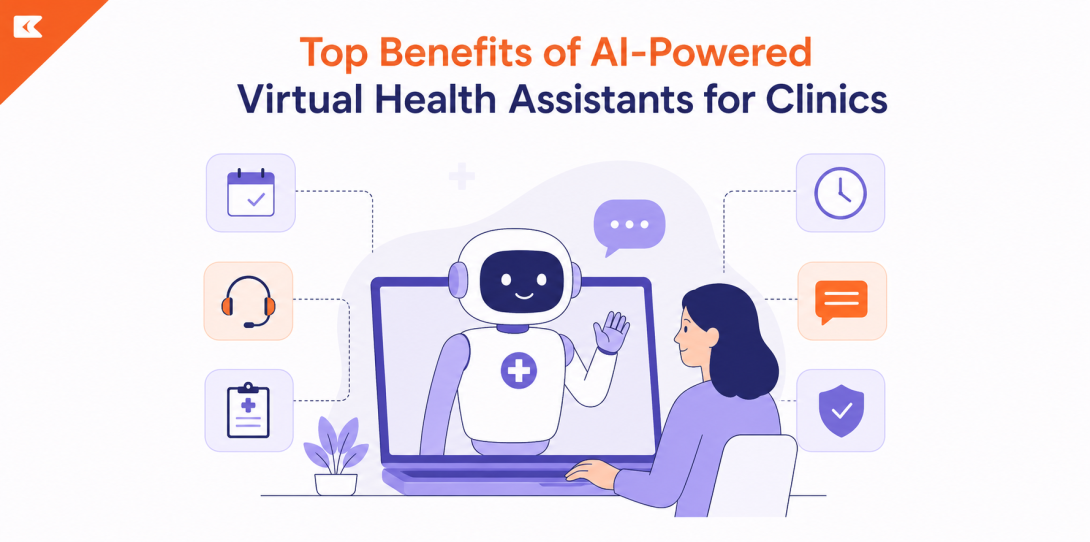
Virtual health assistants for clinics are reshaping how practices manage patient communication, scheduling, and administrative workload.
As patient volumes rise and staffing budgets stay tight, clinics are turning to AI-driven tools that operate around the clock without adding headcount.
This article covers what these assistants do, why adoption is accelerating, the top benefits clinics gain, and the practical challenges worth planning for before rollout.
What Are AI-Powered Virtual Health Assistants?
AI-powered virtual health assistants are software systems that use natural language processing and machine learning to manage patient-facing and administrative tasks without constant human input.
Unlike scripted phone trees or basic web chatbots, these systems understand context, pull data from clinic records, and carry on multi-turn conversations across channels like SMS, web chat, and phone.
They can schedule visits, collect symptoms, send reminders, and answer routine questions, freeing clinical staff to focus on care delivery rather than repetitive coordination work. This shift matters most in clinics juggling high call volumes with limited front-desk capacity.
Common Capabilities Beyond Basic Chatbots
Most virtual health assistants go well beyond a simple FAQ bot. Interest in AI chatbots in healthcare has grown alongside broader automation efforts, and clinics typically deploy assistants across five core workflows:
- Appointment management: assistants check provider availability, book, reschedule, and send confirmation messages without staff intervention.
- Symptom intake: patients describe symptoms in plain language before a visit, and the assistant structures that data for the care team.
- Patient follow-ups: automated check-ins after appointments or procedures catch complications early and keep patients engaged in their care plan.
- Medication reminders: scheduled prompts and refill alerts support adherence without requiring a nurse to place manual calls.
- Billing and administrative support: assistants answer insurance questions, send payment reminders, and route complex billing issues to staff.
Why Clinics Are Investing in AI-Powered Virtual Health Assistants
Clinics face rising patient expectations alongside chronic staffing shortages, and virtual health assistants for clinics address both pressures directly.
Front-desk teams are often stretched across phones, check-in, and billing simultaneously, which creates delays and missed calls during peak hours.
An AI-powered virtual health assistant platform absorbs repetitive, high-volume interactions, letting existing staff focus on tasks that need clinical judgment.
Combined with growing patient comfort using text and chat for healthcare interactions, this makes adoption less of an experiment and more of a competitive necessity across primary care, specialty, and multi-location practices.
Top Benefits of AI-Powered Virtual Health Assistants for Clinics
1. 24/7 Patient Support Without Increasing Staff
Patients don't limit their questions to business hours, and a virtual health assistant closes that gap without a night shift. It handles appointment requests, prescription questions, and general inquiries at 2 a.m. as reliably as at 2 p.m.
Reviewing leading healthcare chatbot platforms shows this round-the-clock availability consistently improves patient satisfaction scores while keeping payroll costs flat, since the same platform scales across unlimited simultaneous conversations without additional shifts.
2. Faster Appointment Scheduling and Reduced No-Shows
Automated scheduling lets patients book, reschedule, or cancel visits instantly through chat or text instead of waiting on hold.
Assistants also send timely reminders and confirmation prompts, which measurably cuts no-show rates.
For clinics running tight schedules, recovering even a handful of missed slots each week translates directly into recovered revenue and better provider utilization across the practice.
3. Streamlined Patient Intake and Pre-Visit Data Collection
Instead of patients filling out paperwork in the waiting room, assistants collect intake forms, symptom details, and insurance information ahead of the visit.
This pre-visit data flows into the clinic's records system, giving providers a clearer picture before the patient sits down. Shorter in-office intake also reduces waiting room bottlenecks during high-demand periods and improves overall visit throughput.
4. Reduced Administrative Workload
Front-desk and billing staff spend significant time on repetitive questions: insurance coverage, office hours, referral status, and payment balances.
Virtual assistants absorb this volume, cutting call center load and inbox backlog substantially. Staff can then redirect their time toward tasks that require judgment, such as complex billing disputes, prior authorizations, or hands-on care coordination that automation cannot replace.
5. Improved Patient Engagement Between Visits
Care doesn't end when a patient leaves the office, and assistants keep that connection alive between appointments. Automated check-ins, educational nudges, and symptom tracking prompts help patients stay engaged with their treatment plan.
Clinics investing in patient engagement software development see this ongoing touchpoint pay off most in chronic disease management, where consistent monitoring improves outcomes and reduces avoidable readmissions.
6. Better Medication Adherence
Missed doses are a leading cause of poor outcomes and preventable complications. Virtual assistants send scheduled medication reminders, refill prompts, and adherence check-ins that don't rely on staff bandwidth to deliver consistently.
Patients managing multiple prescriptions particularly benefit from this low-friction nudging, which supports better long-term adherence without adding extra clinical staff time or manual outreach.
7. Enhanced Triage and Care Navigation
When patients describe symptoms through a virtual assistant, the system can apply rules-based or AI-driven triage logic to flag urgency and direct patients to the right resource, whether that's a same-day slot, telehealth visit, or emergency care.
Growth in conversational AI in healthcare market reflects how much clinics rely on this structured intake to reduce guesswork for staff and prevent both under-triage and unnecessary ER visits.
8. Improved Data Collection for Better Clinical Decisions
Every patient interaction through a virtual assistant generates structured data on symptoms, concerns, and engagement patterns. Aggregated over time, this data helps clinics spot trends, staffing gaps, and recurring patient needs well before they become larger operational problems.
Providers gain better context before each visit, and administrators get analytics that inform staffing, scheduling, and resource planning decisions with more confidence.
9. Increased Operational Efficiency
By automating scheduling, intake, reminders, and routine billing questions, virtual assistants reduce the total labor hours needed to run day-to-day clinic operations.
This efficiency gain compounds across multi-location practices, where consistent automated workflows replace fragmented, location-specific manual processes and reduce variability in patient experience, staffing needs, and turnaround times between front desk and billing teams.
10. Scalable Patient Communication During Peak Demand
Flu season, open enrollment, and public health events all create sudden spikes in patient inquiries that overwhelm phone lines.
Virtual assistants scale instantly to handle simultaneous conversations without hiring temporary staff, keeping response times consistent even when call volume triples overnight.
This elasticity is difficult, and expensive to replicate with human-only staffing models during short-term surges.
Challenges Clinics Should Consider Before Implementation
AI-powered virtual health assistants deliver real gains, but clinics need to plan around a few recurring implementation challenges before going live.
Patient Privacy and Security
Virtual health assistants handle sensitive patient data, making security a non-negotiable requirement rather than an afterthought.
Clinics need assistants built on HIPAA-ready application development standards, with encryption, access controls, and audit trails in place before go-live.
Vendor due diligence and a clear data-handling agreement are essential steps before any patient-facing deployment reaches production.
Integration with Existing Systems
An assistant that can't talk to the clinic's EHR or practice management system creates duplicate work instead of removing it. Successful deployments depend on solid EHR integration services and API connectivity so appointment data, intake forms, and patient records sync automatically rather than requiring manual re-entry by front-desk or billing staff.
AI Accuracy and Human Oversight
AI assistants are strong at structured, repetitive tasks but can misinterpret ambiguous symptom descriptions or edge-case requests.
Clinics should build in clear escalation paths so uncertain or high-risk interactions route to a human immediately.
Ongoing accuracy monitoring, not a one-time validation, keeps the assistant reliable as patient language and use cases evolve over time.
Staff Training and Adoption
Even a well-built assistant fails if staff don't trust it or understand how to intervene when needed.
Clinics should train front-desk and clinical teams on how the assistant works, what it escalates, and how to review its outputs.
Early involvement from staff also surfaces workflow issues before they become larger, harder-to-fix problems.
Best Practices for Successfully Implementing AI-Powered Virtual Health Assistants
Clinics that get the most value from virtual health assistants tend to follow a similar rollout pattern.
- Define clinical and administrative use cases: map exactly which tasks the assistant will own, scheduling, intake, or billing questions, rather than deploying a general-purpose bot on day one.
- Start with high-volume workflows: prioritize automating the interactions that consume the most staff time first, since that's where return on investment shows up fastest.
- Keep human escalation available: every automated flow needs a clear, fast path to a human for complex, urgent, or sensitive situations.
- Monitor performance using patient feedback and analytics: track resolution rates, patient satisfaction, and escalation frequency to catch issues early and adjust course.
- Continuously optimize AI responses: treat the assistant as a living system, refining scripts and logic based on real patient interactions rather than a one-time setup.
Conclusion
Virtual health assistants for clinics offer a practical way to manage rising patient demand without proportionally increasing staff.
From faster scheduling to better medication adherence and 24/7 support, the benefits compound across both patient experience and operational efficiency.
Success depends on strong system integration, solid security practices, and clear human escalation paths. Clinics that plan for these factors position themselves to scale patient communication sustainably as demand grows.