

Introduction: When Your Lifted Chevy Feels Unpredictable
Adding a lift to your Square Body can transform its off-road capability—but many owners quickly run into a frustrating side effect: wandering steering, jerky wheel movement, and unpredictable handling at highway speeds.
That sudden snap in the wheel after hitting a pothole is called bump steer, and it’s extremely common on lifted 1973–1991 K5 Blazers, K10/K20 pickups, and Suburbans.
The problem isn’t worn-out parts or poor alignment—it’s the factory steering geometry, which GM never designed for lifted ride heights.
Understanding the Factory Push-Pull Steering System
Stock Square Body Chevys use a push-pull steering setup. The steering box pushes a drag link forward to the passenger-side knuckle, which moves the tie rod to steer both wheels.
At stock height, the system works because:
- Drag link angles are shallow
- Suspension travel is limited
- Steering and axle move in sync
Once you lift the truck, all of this changes.
How Lifts Create Steering Problems
- Axle sits farther from the steering box
- Drag link angle steepens
- Suspension travel increases
Now, the drag link and axle move through different arcs. Every bump or dip can cause the drag link to turn the wheels without input from the driver. This involuntary movement is bump steer, causing wandering, darting, and sometimes “death wobble.”
Why Stabilizers and Drop Pitman Arms Aren’t Enough
Many builders reach for steering stabilizers or heavy-duty tie rods to fix wandering.
While these reduce how harsh the movement feels, they do not correct geometry. A stabilizer only resists motion—it doesn’t stop the suspension from steering the wheels.
The only way to truly eliminate bump steer is to fix the steering geometry.
Crossover Steering: The Real Solution
Crossover steering moves the drag link side-to-side from the steering box to the passenger-side knuckle. This aligns the steering movement with axle travel and removes involuntary wheel input.
Benefits of Crossover Steering
- Drag link and axle move in the same plane
- Suspension travel no longer causes unintended steering
- Steering becomes predictable and stable
For lifted Square Bodies, this is the most reliable bump steer fix available.
The Factory Limitation: Round-Top 10 Bolt Knuckles
Even with crossover steering, many builds are limited by the stock knuckle.
The “Round Top” Problem
From 1977 onward, Chevy 10 bolt front axles have round-top passenger-side knuckles, which:
- Lack a flat mounting surface for a steering arm
- Cannot accept crossover steering arms
- Were never designed for lifted trucks
Builders used to hunt for a Dana 44 flat top knuckle passenger side—but these parts are rare, often damaged, and usually require machining.
The Modern Solution: EWO Chevy 10 Bolt Knuckle & Arm Kit
Rather than modifying rare OEM parts, modern builders rely on engineered components.
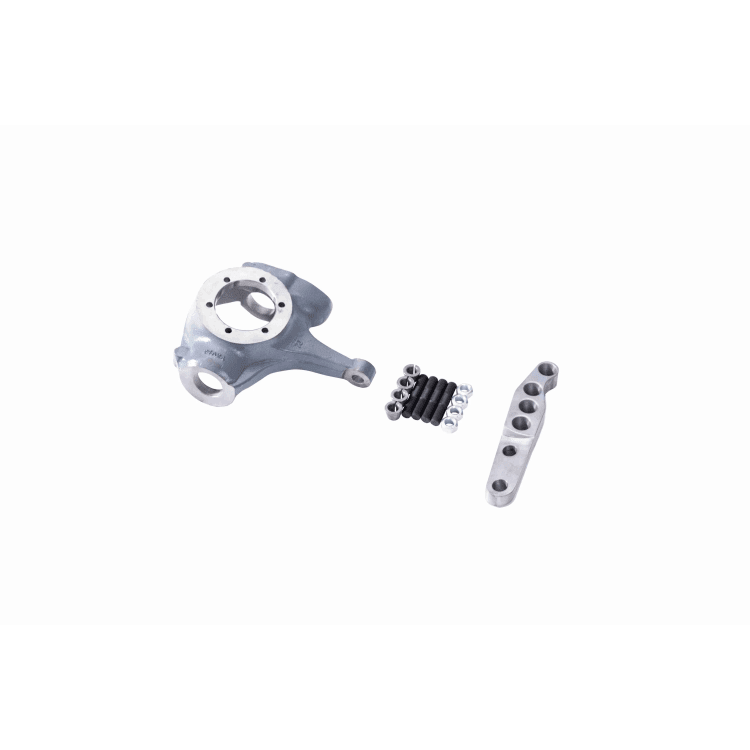
The EWO Chevy 10 Bolt Knuckle and Arm Kit replaces the round-top knuckle with a flat-top design built for crossover and high-steer setups.
This provides the proper foundation for a Chevy 10 Bolt Crossover Steering Kit that eliminates wandering and bump steer in lifted trucks.
4-Stud Steering Arm Design: Strength That Matters
Steering forces increase significantly with larger tires.
Factory vs. EWO Knuckle
- Factory: 3 steering arm studs
- EWO: 4 studs
The extra stud spreads load and reduces stress, preventing failure.
Benefits
- Improved arm stability
- Reduced risk of stud flex or failure
- Safer, more precise steering on- and off-road
This is critical for lifted K5 Blazers and Suburbans running 35”+ tires.
Reversible Taper Insert: Simplifying GM Compatibility
GM steering swaps often create taper mismatch headaches. Dana 44s, Chevy 10 bolts, and GM 1-ton tie rods all use different tapers.
The EWO knuckle includes a reversible taper steering insert, which allows:
- Tie rod installation top down or bottom up
- Compatibility between Dana 44 and Chevy 10 bolt tapers
- Easy integration with GM 1-ton tie rod components
This feature eliminates guesswork and makes installation easier for DIY builders.
Installation & Compatibility
Designed for practical, real-world use:
Compatible With:
- Chevy Dana 44 front axles
- Chevy 10 bolt front axles
- 1973–1991 K5 Blazers, K10/K20 pickups, and Suburbans
Requirements:
- 2WD steering box
- Correct drag link setup and alignment
No welding, cutting, or custom fabrication is required.
Conclusion: Geometry First, Control Restored
Bump steer and wandering are not inevitable when lifting a Square Body—they result from incorrect steering geometry.
Crossover steering fixes the problem, but only when paired with the right knuckle. The EWO knuckle kit delivers the strength, geometry, and compatibility needed for lifted GM trucks.
With this upgrade, your Square Body will track straight, respond predictably, and restore the confidence you expected when you installed that lift.