

Two patients can walk into Total Wellness Chiropractic with the exact same complaint — low back pain — and leave with completely different treatment plans. That's not inconsistency. It's the point. No two spines, gaits, or bodies compensate for stress in the same way, and treating them identically is one of the more common reasons pain keeps coming back after generic care.
Key Takeaways
- Identical symptoms can have different root causes. Back pain from foot pronation needs a different plan than back pain from a sedentary desk job.
- Off-the-shelf orthotics and inserts support an average foot, not yours. Custom orthotics are built from your own gait and foot structure.
- Gait analysis is the diagnostic step most generic treatment skips, and it's often what reveals the actual cause of recurring pain.
- Personalized plans combine multiple tools — adjustment, corrective exercise, and orthotics — matched to what your body specifically needs.
- In Huntsville, custom orthotics are typically built from a gait-referenced casting process, not a generic mold or a kiosk scan.
Why "One-Size-Fits-All" Often Falls Short
Generic treatment plans work from averages. A standard stretching handout, a mass-produced shoe insert, or a fixed number of adjustments all assume that most people's pain comes from the same place and responds the same way. In practice, it rarely does.
Gait analysis has become a cornerstone of individualized chiropractic care precisely because it reveals what a generic exam misses. Watching how someone actually walks — foot placement, knee alignment, pelvic rotation, even arm swing — surfaces dysfunctional patterns that a static exam table assessment can't catch. A pronated foot, for example, often shows up as toeing out, a shortened stride, and an abrupt shift from heel strike into stance phase — details that only appear in motion.
This is also where personalization starts to matter clinically, not just in principle. Chiropractors trained in biomechanics use gait and posture findings to build a plan around the specific muscles and joints compensating for each patient's pattern — commonly the gluteus medius and iliopsoas in cases involving pronation, since a weak glutemedius is tied to low back, SI joint, and knee pain, while a tight iliopsoas can drive low back pain and pelvic misalignment on its own.
Why "Custom" Actually Matters for Orthotics
Custom orthotics get lumped in with drugstore shoe inserts, but the two solve different problems. A generic insert cushions an average foot shape. A custom orthotic is built from your own foot structure and the way your specific gait loads pressure through your arches.
Recent orthotic research backs up why that distinction matters. A 2025 clinical study using AI-driven, 3D-printed orthotics built from individual gait data found significant biomechanical changes at the hip, knee, and ankle after just four weeks, along with a measurable shift in how pressure was redistributed across the foot. That level of correction depends on the orthotic matching the person's actual movement pattern, not a generalized shape.
The clinical reasoning behind this is straightforward: patients with pronation-related distortion tend to have reduced proprioception and balance, and they need support across all three arches of the foot, not just the inner arch that most standard inserts target. A properly built custom orthotic supports all three while also stimulating the small stabilizing muscles in the foot itself, something a flat, uniform insert simply isn't shaped to do.
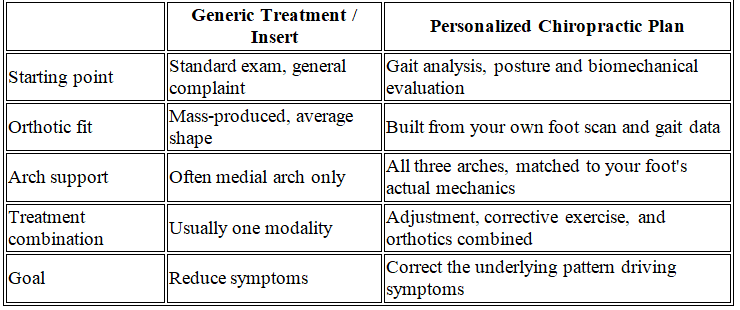
Generic vs. Personalized Approaches, Side by Side
What Personalized Care Looks Like at Total Wellness
Dr. Hunter Lee's approach starts with figuring out what's actually happening before deciding how to treat it:
- History and physical exam, to understand where and how the pain shows up.
- Gait and posture assessment, watching how you actually move rather than relying on symptoms alone.
- Custom orthotic casting, using gait-referenced technology Dr. Lee is specifically certified in — not a generic mold or in-store kiosk scan.
- A combined treatment plan, pairing chiropractic adjustment with corrective exercises targeted to the muscles compensating for your specific pattern.
- Reassessment, adjusting the plan as your gait and symptoms change rather than running a fixed, identical program for every patient.
This is the same whole-chain thinking behind our chiropractic care services and chiropractic approach — treating the cause specific to you, not a generic version of your complaint.
Signs a Generic Plan Might Not Be Working for You
- Pain that improves temporarily but consistently returns
- Previous orthotic inserts that never quite felt like they fixed anything
- Symptoms in one area (like your back) despite treatment focused elsewhere (like stretching your hamstrings)
- A past diagnosis that never fully explained why the pain kept coming back
If any of that sounds familiar, it may be less about the amount of treatment you've had and more about whether it was built around your specific body.
Custom Orthotics in Huntsville, AL
Total Wellness Chiropractic builds Custom Orthotics in Huntsville from real gait data, not a generic template. Backed by more than 100 five-star Google reviews, Dr. Lee's certification in gait-referenced orthotic casting means the orthotic is designed around how your foot actually moves and loads pressure — the same evaluation used to shape the rest of your treatment plan. Learn more about the practice or see common conditions we address on our conditions treated page.
Curious whether custom orthotics could be part of your plan?Schedule an evaluation with Total Wellness Chiropractic in Huntsville, AL, or call (256) 880-6199. 7533 Memorial Pkwy SW, Suite B, Huntsville, AL 35802.
FAQs
How are custom orthotics different from store-bought inserts? Custom orthotics are built from your own foot scan and gait analysis, supporting all three arches based on how your foot specifically moves. Store-bought inserts are mass-produced to an average shape and typically support only the inner arch.
Do I need custom orthotics if I don't have foot pain? Not necessarily just for foot pain — orthotics are also used to address back, hip, or knee pain that originates from foot mechanics, even when the feet themselves feel fine.
How long does it take to notice a difference with custom orthotics? Some biomechanical changes have been measured within a few weeks in clinical studies, though full adjustment and symptom improvement varies by individual and how long the underlying pattern has been present.
Why did my last treatment plan not work? Generic plans treat the average version of a complaint. If the actual cause is specific to your gait, posture, or foot mechanics, a plan that doesn't account for that is unlikely to resolve the pain long-term.
The Article "Personalized Chiropractic Care: Why One Treatment Plan Doesn’t Fit Everyone” was originally posted Here.