

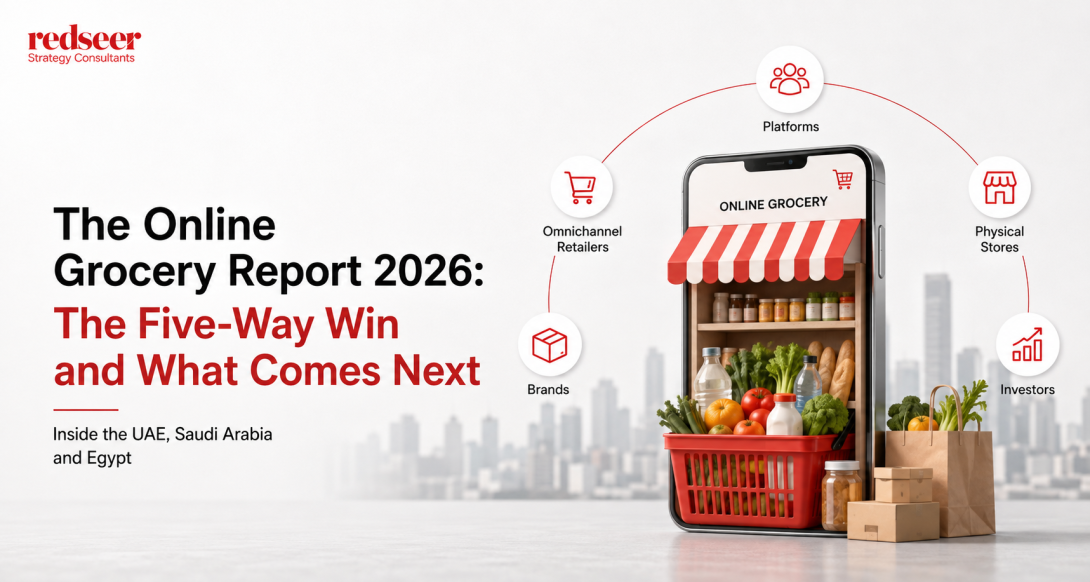
For years, the online grocery market was talked about as a race with one eventual winner, usually a single app or a single dark store network that would slowly absorb the whole category. A new market study from Redseer Strategy Consultants, titled The Online Grocery Report 2026: The Five Way Win and What Comes Next, makes the case that this framing no longer holds true. Across the UAE, Saudi Arabia and Egypt, the online grocery industry has grown into what the report calls a genuine five way win. Platforms, omnichannel retailers, brands, physical stores and investors are all pulling value out of the same shift in consumer behaviour, and none of them appears to be doing so at the others' expense.
This matters for anyone tracking the MENA online grocery market, because it changes the question worth asking. It is no longer just about who is growing the fastest. The more useful question, at least according to the report, is who is best positioned to turn today's broad based growth into something durable before the market becomes more selective.
The Size and Shape of the Online Grocery Market in 2026
Per the report, gross demand across the GCC online grocery market and Egypt has reached roughly $7.6 billion. What is interesting is not just the size of that figure but what has been happening alongside it. Offline grocery has kept expanding rather than shrinking. Online grocery still makes up only around 6% of total grocery demand, yet that share is compounding at close to 28% a year.
That combination, a small but fast growing online share sitting on top of a still expanding offline base, is central to understanding online grocery market trends 2026. Redseer's analysis suggests this growth is largely additive rather than cannibalistic. New shopping occasions such as impulse top ups, urgent last minute needs and small basket convenience missions appear to be creating new demand rather than simply pulling existing footfall out of stores. The full breakdown of how these missions are reshaping shopper behaviour sits in the online grocery market report.
Why the Online Grocery Industry Has Become a Five Way Win
Most category disruptions, whether it is travel, streaming, online retail or food delivery, eventually settle into a market with one or two dominant winners. The report spends time on why online grocery has, so far, avoided that outcome. Because a single grocery order can involve one player capturing the order entry relationship and a different player handling supply and fulfilment, the same order can count as a win for two businesses at once. It is one of the more counterintuitive findings in the online grocery market report, and it helps explain why simple order growth or app download numbers can seriously understate what is actually happening across the value chain.
The report frames five groups as today's winners: digital first grocery platforms, omnichannel retailers, brands, physical stores and the investors backing them. Each one is described as pulling value from a different layer of the same demand pool, which is what makes this online grocery market structurally different from earlier internet driven category shifts.
UAE Online Grocery Market: Retailers Still Supply and Fulfil Most Demand
One of the sharper data points in the report concerns the UAE online grocery market. While digital first platforms capture most of the order entry share, omnichannel retailers still supply and fulfil roughly 60% of online grocery demand in the UAE. That gap between who actually takes the order and who stocks, picks and delivers it is, according to Redseer, routinely miscounted, since most public narratives simply credit the whole order to whichever app the shopper happened to open.
This point connects well with a related Redseer piece on how dark stores have gained momentum while retailers still hold the market in UAE online grocery. It is a useful companion read for anyone trying to compare how digital first platforms and omnichannel retailers are each building out their positions.
Saudi Arabia Online Grocery Market and the Wider GCC Picture
The Saudi Arabia online grocery market is one of the three core markets covered in the report, alongside the UAE and Egypt. As with the UAE, the report finds that KSA online grocery growth is being driven by a widening set of shopping missions rather than one dominant format. That reinforces a broader theme running through the report: reach and discounting, once the main differentiators in this market, are gradually giving way to a race for the ongoing customer relationship.
This pattern lines up with what Redseer has already tracked in adjacent categories in Saudi Arabia. In quick commerce, for example, a separate Redseer study on how quick retail is surging across the region shows a similar multi player structure playing out at speed. Readers interested specifically in the food delivery comparison, which the online grocery report uses as a benchmark for how consolidation typically unfolds, may also want to look at Redseer's report on KSA food delivery economics.
Egypt Online Grocery Market: An Emerging Growth Frontier
The Egypt online grocery market rounds out the three market scope of the report. Its inclusion alongside the UAE and Saudi Arabia is a signal in itself: the five way win dynamic is not confined to the wealthier Gulf markets. It appears to be emerging as a broader regional pattern across the MENA online grocery market, with brands increasingly using the digital shelf to prove demand within weeks instead of waiting on national retail listings, a theme the full report explores in more depth.
Online Grocery Market Outlook: How Long Will the Five Way Win Last
Perhaps the most strategically important part of the report is its online grocery market outlook. Is the window for broad based gains still open, or is consolidation close behind? Redseer points to the earlier cycle in food delivery as a useful benchmark and concludes that online grocery still has meaningful time left before a similar consolidation phase repeats itself. That gives platforms, retailers, brands and investors real room to act, though the report is careful to note that this window will not stay open indefinitely.
This ties into a wider theme Redseer has explored elsewhere in MENA e-commerce, including its work on the next wave of MENA e-commerce growth and how private label strategy is shifting from retail shelves to dark stores. Both point to a similar underlying idea. Category winners are increasingly defined by who owns the customer relationship, not simply who has the biggest catalogue or the fastest delivery time.
Building an Online Grocery Market Strategy for the Next Phase
For operators and investors, the report reads more like a call to action than a simple observation. An effective online grocery market strategy in 2026 needs to move past order growth and reach metrics and toward a clearer picture of where value is actually sitting: order entry share versus supply and fulfilment share, mission level density, and how durable the customer relationship really is. The report sets out specific, group by group recommendations for:
- Digital first grocery platforms deciding where to lean further into retailer enablement versus running their own dark stores
- Omnichannel retailers defending their supply and fulfilment position as platforms scale up their order entry share
- Brands sequencing their go to market approach around the digital shelf before chasing national listings
- Private equity and venture capital investors weighing durability, not just growth rate, when they underwrite online grocery businesses
The same underlying question, who owns the customer once discovery and fulfilment start to split apart, also runs through Redseer's broader coverage of online retail strategy in the region, including its look at how omnichannel is claiming a large share of online retail in KSA and the UAE's next frontiers of online retail growth. Anyone putting together a grocery e-commerce strategy for the region would do well to read these alongside the main grocery report to see how the five way win compares with what is unfolding in nearby retail categories.
Why This Report Is Worth Reading in Full
This article only touches on the headline findings. The full Online Grocery Report 2026 goes a lot deeper. It breaks down the five consumer groups driving the shift, explains how digital first platforms have scaled from retailer enablement into running their own dark stores, lays out the specific actions each stakeholder group should take to extend their gains, and offers a fuller comparison against the consolidation cycles seen in travel, streaming, online retail and food delivery.
For platforms, omnichannel retailers, brands and investors trying to plan their next twelve to eighteen months in the online grocery industry, the report is a genuinely practical reference point for checking strategy against where the market actually stands today, rather than where a single winner narrative might assume it to be. The complete online grocery market report is available to download directly from Redseer Strategy Consultants.
Download the full report here: https://redseer.com/reports/online-grocery-market-report/