
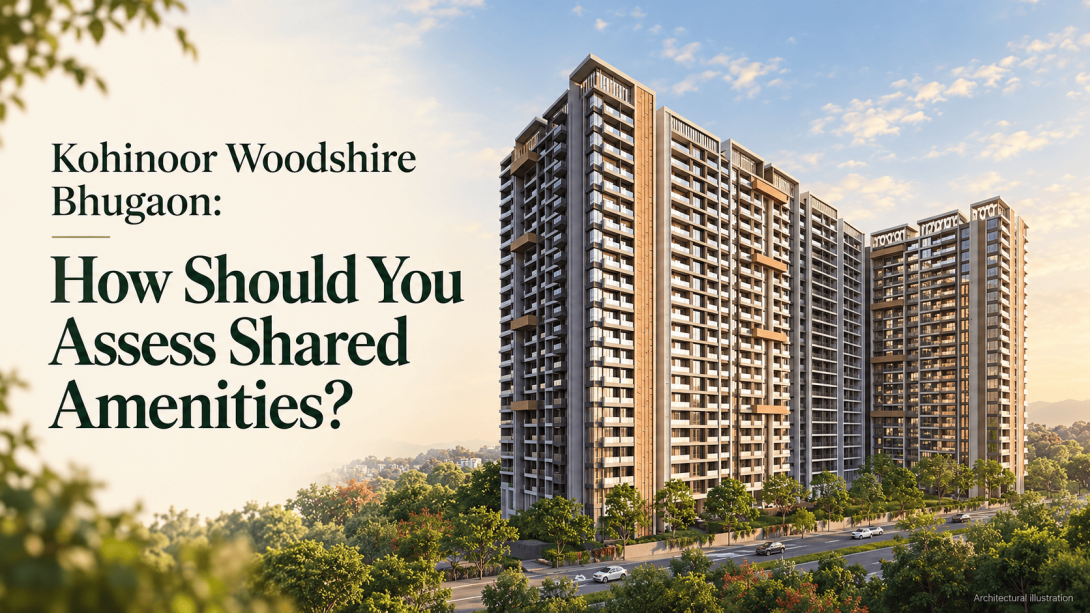
A long amenities list can look useful, but families may wonder how those spaces will work during an ordinary week. Will children have room to play after school? Will a quiet work area remain quiet? Understanding shared facilities means looking beyond their names.
This article looks at Kohinoor Woodshire Bhugaon through that practical lens. It explains how to assess amenity access, community capacity, everyday movement, and written responsibilities. The aim is to help readers ask clearer questions without treating published illustrations or descriptions as evidence of completed facilities.
Amenities and Everyday Use
An amenity is useful when its design and operating arrangements suit the people who will use it. The website lists a swimming pool, gymnasium, co-working space, children’s play area, and other shared facilities. These provide starting points for questions, but their dimensions, equipment, and operating rules still need confirmation.
- Check usable capacity. At Kohinoor Woodshire Bhugaon, ask how many people each facility is designed to accommodate. A room name alone does not explain seating, equipment numbers, or available circulation space.
- Understand different uses. Ask whether the co-working area has power sockets, suitable seating, and arrangements for calls. These details matter more for daily work than an attractive illustration.
- Check supervision arrangements. For children’s facilities, ask who manages access and whether any supervised service is actually included. A designated space does not automatically mean staffed care.
- Ask about access rules. Can residents use facilities throughout the day? Are reservations required? Are guests permitted? Written rules help explain how shared areas may function.
Community Size and Shared Capacity
The website describes five towers and 600 residences across 3.5 acres. These figures describe the advertised development, not how crowded individual facilities will feel. For Kohinoor Woodshire Bhugaon, the useful question is how shared-space capacity relates to the number of households and the timing of their use.
- Read the master plan. Ask which facilities serve which towers and whether the published residence count covers the same registered development as the amenities.
- Consider overlapping routines. Families may use recreation spaces at similar times. Ask how bookings, queues, and simultaneous activities would be managed rather than assuming every facility is freely available.
- Check delivery stages. Will shared areas open together or in stages? Ask for the relevant written schedule and whether access changes while other work continues.
- Ask about quieter spaces. Where can residents sit away from active recreation? Check the separation shown in the plan, then confirm it against the actual site conditions.
Access, Noise and Everyday Movement
The route to an amenity affects whether people use it regularly. For Kohinoor Woodshire, access should be assessed from the relevant tower rather than from a central promotional view. Published material does not establish walking comfort, noise levels, or the convenience of reaching every shared area.
- Trace everyday routes. Ask to see the path from the tower entrance to recreation spaces. Check crossings, steps, ramps, lighting, and any interaction with vehicle movement.
- Consider apartment-facing activity. Where are active recreation areas located relative to bedrooms and balconies? Ask about operating hours and assess the relevant orientation without assuming a particular noise outcome.
- Check weather protection. Are frequently used routes covered? Ask how rainwater drainage, slippery surfaces, and shaded resting points are addressed in the relevant plans.
- Review access for different ages. Can children, older adults, and people with reduced mobility reach the facilities comfortably? Confirm route widths and access arrangements rather than relying on general descriptions.
Maintenance and Project Documents
Shared facilities need continuing upkeep, clear responsibilities, and funding. The website’s amenity list for Kohinoor Woodshire Bhugaon does not establish the eventual maintenance charge or management structure. Written documents should explain what is included, who operates each facility, and how residents will receive information about costs.
- Separate included access from additional charges. Ask whether any facility involves separate fees, refundable deposits, or paid services. Obtain the applicable terms in writing.
- Check recurring responsibilities. Who maintains equipment, cleans shared rooms, and handles repairs? Ask how complaints and temporary closures would be communicated.
- Match promises to records. Check the registered project details, approved plans, and agreement provisions. An image or website statement should not replace the applicable documentation.
- Record unresolved points. Ask for clarification on facility sizes, completion stages, management arrangements, and costs before treating them as settled facts.
Assessing Kohinoor Woodshire Pune means connecting published amenity names with actual capacity, access, operating rules, and upkeep. Exact apartment layouts, written costs, approvals, project documents, applicable records, and travel conditions also deserve attention. Together, these checks provide a clearer picture of everyday use without assuming that attractive shared spaces will function in a particular way.