

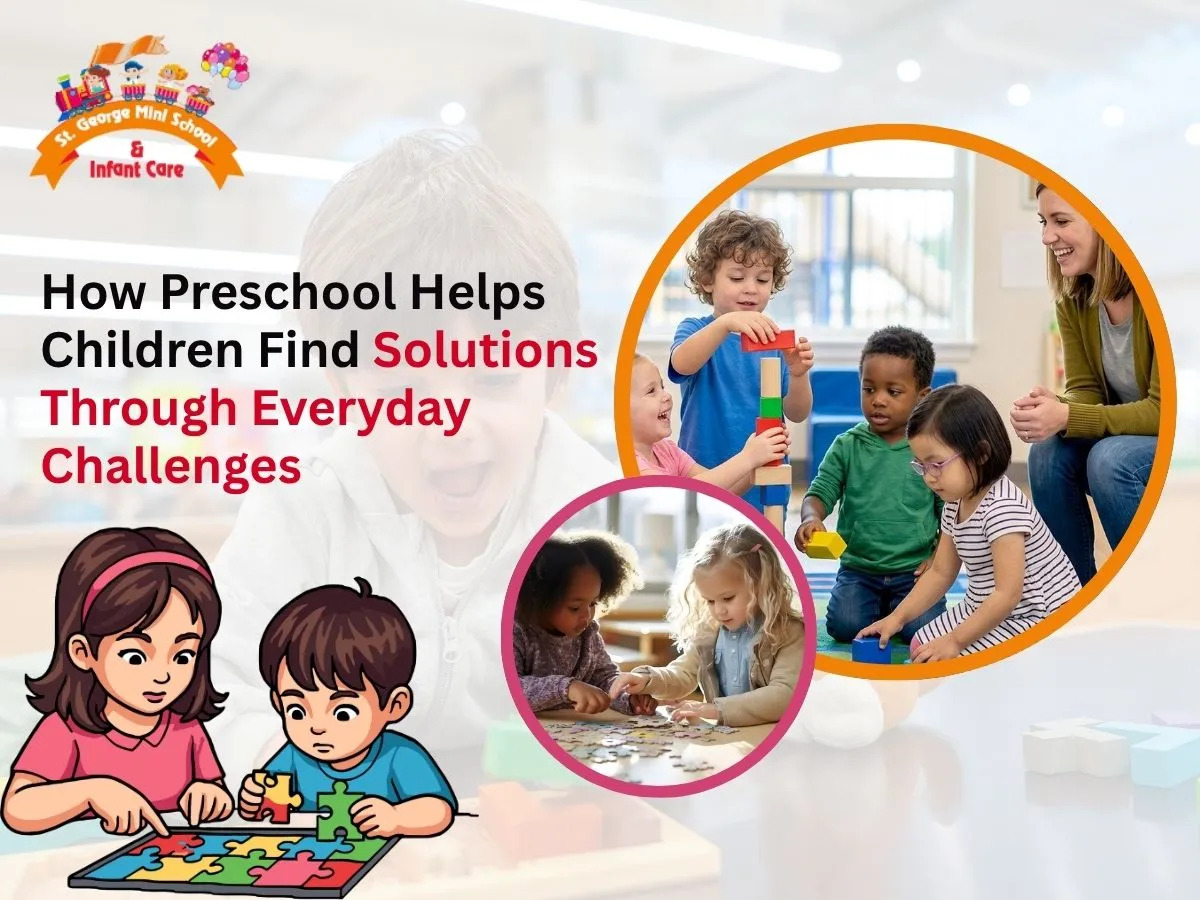
A young child faces small challenges throughout the day. A tower of blocks tumbles down, a puzzle fails to fit in place, two children both want the same toy, or an art work does not meet the expectations that were set by a child while creating it. Such instances are considered very common by grownups, yet they provide invaluable experience for children.
Preschool provides a supportive environment where children can explore these situations without being expected to get everything right the first time. Through playing being part of groups talking with others and getting help, from teachers kids slowly learn to face challenges. They start to try solving problems themselves of giving in right away or waiting for someone else to fix everything.
These everyday experiences help build important foundations for critical thinking, independence, resilience, creativity, and school readiness.
Quick Answer: How Does Preschool Develop Problem-Solving Skills?
Preschool helps children develop problem-solving skills by giving them opportunities to make choices. Children get to experiment. They learn to overcome challenges. They work with others. They also learn from mistakes. Activities such as puzzles, building, pretend play, creative projects and group interactions encourage children to think. These activities help children explore solutions. These activities help children explore solutions, with guidance from educators.
Learning to Try Again When Something Goes Wrong
One of the earliest lessons in problem-solving is understanding that a failed attempt does not mean something cannot be done.
Imagine a child building a tall tower with blocks. When the structure falls, the child has an opportunity to think about what happened. Should they use a wider base? Are some blocks too heavy for the bottom? Would a different arrangement work better?
Instead of immediately rebuilding the tower for them, an educator can ask simple questions that encourage thinking: “What do you think made it fall?” or “What could we change this time?”
This approach teaches children to observe, experiment, and try again. They begin to understand that mistakes are part of learning, helping them develop persistence, resilience, and confidence.
Everyday Play Encourages Creative Thinking
Play gives children the freedom to explore possibilities without worrying about finding one correct answer.
Children may use a group of chairs as a bus, create a shop with toy food or come up with a story with friends while playing make-believe. These activities require imagination, planning, communication, and flexible thinking.
Construction toys, puzzles, art materials, and sensory activities offer similar opportunities. Children learn to compare options, test ideas, notice patterns, and adjust their approach when something does not work.
This is the importance of play learning. It is not just that the children are having fun; they are actually learning how to think in order to respond to situations.
Social Interactions Teach Children to Solve Problems Together
Some of the most meaningful preschool challenges happen when children interact with one another.
Two children may want the same toy, disagree about the rules of a game, or have different ideas about what to build. These situations provide them opportunities to practise sharing, listening, negotiating and cooperating.
Teachers can support kids during these situations by enabling them to articulate their needs and put themselves in someone else’s shoes. For example, children might take turns, find another toy, or work together to create a shared activity.
These experiences support development because children learn that solving a problem is not always, about getting their own way.
Sometimes it’s about listening, compromising and finding a solution that works for everyone.”
Asking Questions Helps Children Think Independently
Preschool educators play an important role in helping children develop problem-solving abilities, but effective guidance does not mean providing an immediate answer to every question.
Instead, educators can encourage curiosity through open-ended questions such as:
•“What else could we try?”
•“How could we make this work?”
•“What do you think will happen next?”
•“How can we solve this together?”
These questions help children slow down, observe what is happening, and consider different possibilities.
Over time, children become more comfortable exploring ideas independently. They also develop early reasoning and communication skills because they learn to explain what they are thinking.
Everyday Responsibilities Build Decision-Making Skills
Simple preschool routines can also teach children how to make decisions and take responsibility.
Choosing an activity, organizing materials, putting toys away, washing hands, or preparing for outdoor play may involve several small steps. Children learn to understand instructions, remember what needs to be done, and decide what to do next.
These experiences strengthen executive functioning skills, including working memory, planning, attention, and self-control.
Rather than expecting children to complete everything perfectly, educators can provide age-appropriate support and gradually encourage greater independence.
Learning to Manage Frustration Is Part of Problem-Solving
Finding a solution is not always easy, especially when children feel disappointed, tired, or frustrated.
A child who cannot complete a puzzle may become upset. Another may struggle when a friend does not want to play the same game. These moments provide opportunities to develop emotional regulation alongside thinking skills.
Educators can acknowledge the child's feelings, help them identify what is difficult, and guide them toward a manageable next step. A few moments’ pause, breathing calmly, or seeking help could result in the child approaching the situation from another perspective.
This teaches an important lesson: managing emotions can make it easier to think clearly and solve problems.
Creative Activities Encourage Experimentation
Art, music, building, and hands-on exploration provide children with opportunities to test ideas.
When painting, a child might discover what happens when two colours are mixed. During a simple science activity, they may observe which objects float or sink. While creating a craft, they might realize that they need a different material to complete their idea.
These experiences encourage children to make predictions, observe results, and adjust their thinking.
The focus should not always be on producing a perfect finished project. The process of experimenting, discovering, and making decisions is where much of the learning happens.
How Parents Can Strengthen Problem-Solving at Home
Parents can reinforce these skills by doing family activities. Parents can let children help by preparing a snack arranging toys choosing clothes solving puzzles or deciding how to build something. These activities give children chances to think for themselves and reinforce these skills.
When a child runs into a problem give them some time to think it through and come up with their ideas. Ask them what they have already tried and what they could try. Offer help if they need it. Let them stay involved, in figuring things out. Let them lead the way much as they can.
It is equally important to recognize effort. Praising a child for trying another approach or asking for help can encourage persistence without making them feel that they must always succeed.
Final Summary
Children do not develop problem-solving skills through worksheets alone. They build them through everyday experiences: trying again when a tower falls, finding a way to share, asking questions, experimenting with materials, and learning to manage frustration.
A supportive preschool environment makes these opportunities part of daily learning. For families exploring Preschool Programs North York, Preschool North York, or Before And After School Care, it is worth considering how a program encourages children to think independently, work through challenges, and develop confidence in their own abilities.
The goal is not to remove every difficulty from a child's day. It is to help children discover that, with patience, curiosity, and the right support, they can find ways forward.
Common Questions Parents Ask About Problem-Solving in Preschool
At what age do children start developing problem-solving skills?
Children begin developing early problem-solving abilities during infancy and toddlerhood. Preschool years provide increasingly complex opportunities to practice decision-making, reasoning, cooperation, and independent thinking.
Why is play important for problem-solving?
Play allows children to experiment, explore different outcomes, make decisions, and learn from mistakes in a low-pressure environment. It also creates opportunities to solve challenges with other children.
Should educators solve problems for children?
Educators should provide support, especially when a situation involves safety or strong emotions, but they can also encourage children to think through manageable challenges themselves. Guided problem-solving helps build confidence and independence.
How does problem-solving prepare children for school?
Problem-solving supports skills that children use throughout their education, including critical thinking, following instructions, managing frustration, working with classmates, making decisions, and approaching unfamiliar tasks.
This blog “How Preschool Helps Children Find Solutions Through Everyday Challenges” was originally posted Here.