

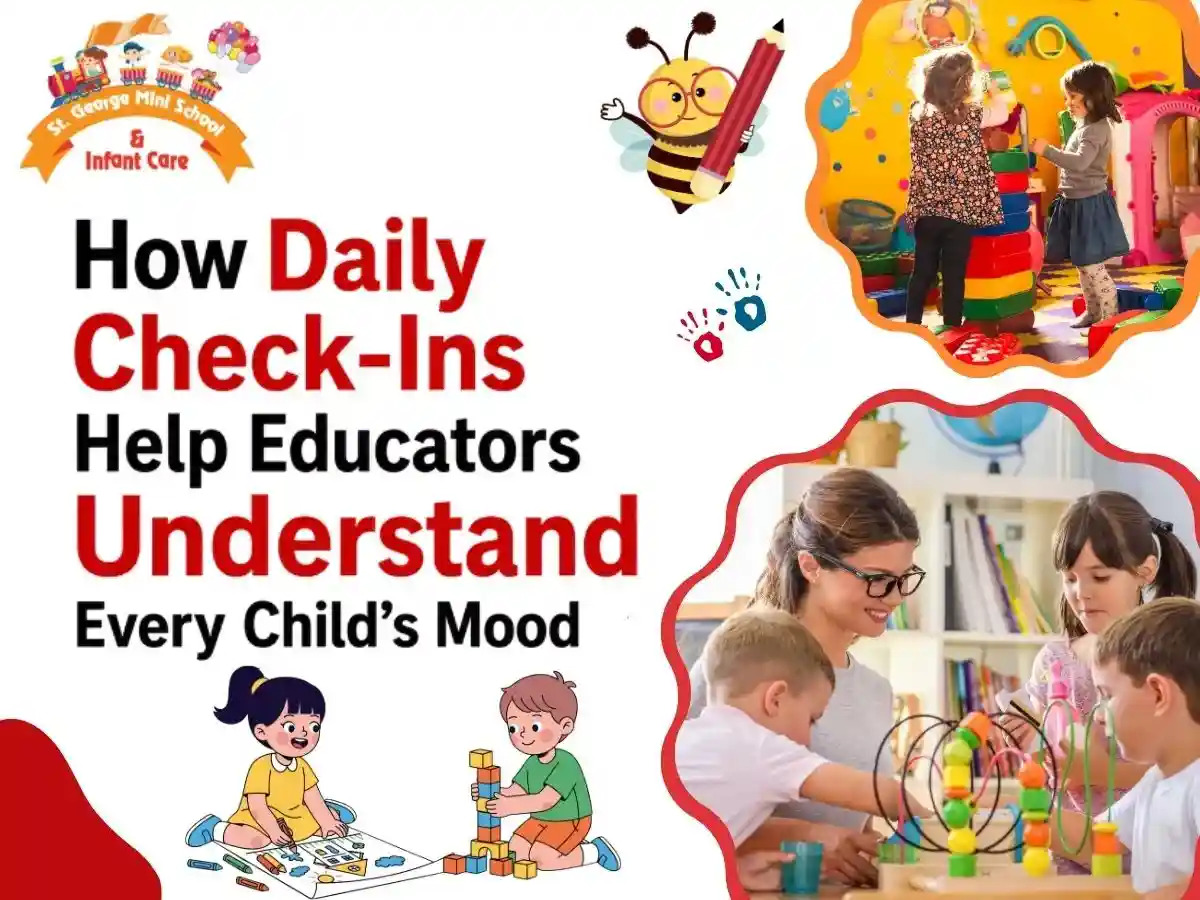
Ask most kids how their day was, and you might get a shrug, or "good," or nothing at all. Ask a toddler, and you may get even less. So how does an educator know that a child showed signs of tiredness and needed extra support around 10 a.m., or was restless after transitions or group activities, or just seemed to be having an off day for no obvious reason?
Mostly, they don't find out from asking. They find out from watching closely and consistently from the moment the child walks in the door.
That's the true role of a daily check-in at a good daycare in North York: not a single question at pickup, but a running read on each child that informs how the day is handled for them specifically.
What a Daily Check-In Actually Involves
There's no single format for this, but at a well-run center, it tends to happen in three stages.
At drop-off, an educator will usually trade a few sentences with whoever's dropping the child off. Did they sleep? Are they teething? Was there a rough morning at home? It sounds minor, but that thirty-second conversation is often the single best predictor of how the next hour is going to go.
Through the day, educators are watching for shifts—a child who's usually chatty going quiet, someone who normally shares toys suddenly guarding them, or a kid who's clingy at drop-off but fine an hour later. Some of this gets jotted down on a whiteboard or logged in a parent app; a lot of it just gets carried in the educator's head and acted on in the moment.
At pickup, the good version of the report isn't "she had a great day!" It's something specific: she was teary after a nap but came around during outdoor time and had a strong afternoon.
Why This Isn't Just Being Attentive — It's Actually Developmental
Ontario's early years framework, ELECT (Early Learning for Every Child Today), puts a lot of weight on self-regulation—a child's growing capacity to manage their own emotions, behavior, and attention. And the research behind that framework is fairly consistent on one point: kids don't develop that capacity in isolation. It develops through consistent interactions with attentive adults who recognize a child's emotional state and respond appropriately, rather than merely reacting when issues arise.
In practice, it simply means that if an educator notices that a toddler has come to school already tired, they may make adjustments to their plans accordingly, such as allowing a less stimulating free-choice activity, an earlier naptime, or reduced participation in group circle time, depending on the individual needs of the child.
What This Looks Like at Different Ages
Infants can't tell you anything in words, so it's almost entirely behavioral—feeding cues, sleep patterns, how much tension they're holding, whether they're making eye contact the way they usually do. The response is individual: flexible nap timing, more one-on-one soothing, and feeding on their rhythm rather than the group's.
With toddlers comes separation anxiety and frustration tolerance. For example, a clingy child at drop-off time might simply need more transition time, a favorite item for soothing, simple choices, and a short first activity.
By preschool age, kids can start participating in the process themselves. Feelings charts, short guided conversations, and being asked directly how they're feeling—all of it starts to work, alongside the same behavioral watching educators have been doing all along.
None of this works as a fixed rulebook, though. The same three-year-old can walk in wound up on Monday and subdued on Wednesday, and a good educator treats those as two different days requiring two different approaches—not the same script applied twice.
Staffing Is What Makes This Possible
It's important to be clear about this: none of this happens in an overloaded room. Ontario sets minimum staff-to-child ratios under the Child Care and Early Years Act—1 educator to 3 infants, 1 to 5 toddlers, and 1 to 8 preschoolers. Those numbers exist for exactly this reason. An educator managing eight preschoolers has room to notice one child going quiet in the corner. An educator managing fourteen doesn't, no matter how good they are at their job.
So when a center in North York talks about individualized care, ratios are the part that either backs that up or exposes it as marketing.
What to Actually Ask When You're Touring a Daycare
Skip "Do you communicate well with parents?"—everyone says yes to that. Better questions:
Walk me through what happens if my child shows up upset or overtired. How do you let me know how their day actually went, not just what they ate and when they napped? Can you give me an example—a real one, recent—of a time you adjusted the day for a specific child's mood?
If an educator or director answers with something concrete and recent, that tells you something. If the answer stays vague and circles back to "we really care about every child," that's worth noticing too—not necessarily disqualifying, but worth pushing on.
Where Centres Get This Wrong
A few patterns show up even in decent programs:
The check-in becomes a formality—"How'd they sleep?" is asked out of habit, without anything changing based on the answer. Apps end up doing the job conversation should be doing; a well-filled-out digital log at pickup is not the same as a human actually telling you something. And quieter kids get missed more than kids who act out, simply because withdrawal is less disruptive to notice than a meltdown—even though it deserves just as much attention.
A Few Questions Parents Ask
Is this a legal requirement or just good practice? There's no regulation that spells out "daily check-ins" as a specific procedure. But Ontario's early years framework does require programs to be responsive to each child's development, and in practice that's what leads good centers to build this kind of routine, even without a rule forcing it.
Isn't this basically what the daily report app already does? Not quite. The app is the written record—snaps, meals, diaper changes. The check-in is the actual observation and the conversation behind it. You can have a perfectly filled-out app and still have a center that isn't really watching your kid closely.
How is this different for infants versus preschoolers? Infants communicate entirely through behavior, so it's all caregiver observation. Preschoolers can start telling you directly or pointing to a feelings chart—though educators are still reading behavior underneath whatever the child says.
Does every good daycare do this the same way? No, and that's fine. What matters is whether it's happening consistently and whether it actually changes anything about the child's day—not whether it follows a specific format.
St. George Mini School runs three licensed, CWELCC-approved locations in North York — 33 Mallard Rd., 25 Mallard Rd., and 141 Bond Ave. It offers infant, toddler, and preschool programs that are centered on such personalized care.
Would you like to experience it in a real classroom? book a tour.
This blog “How Daily Check-Ins Help Educators Understand Every Child's Mood” was originally posted Here.