

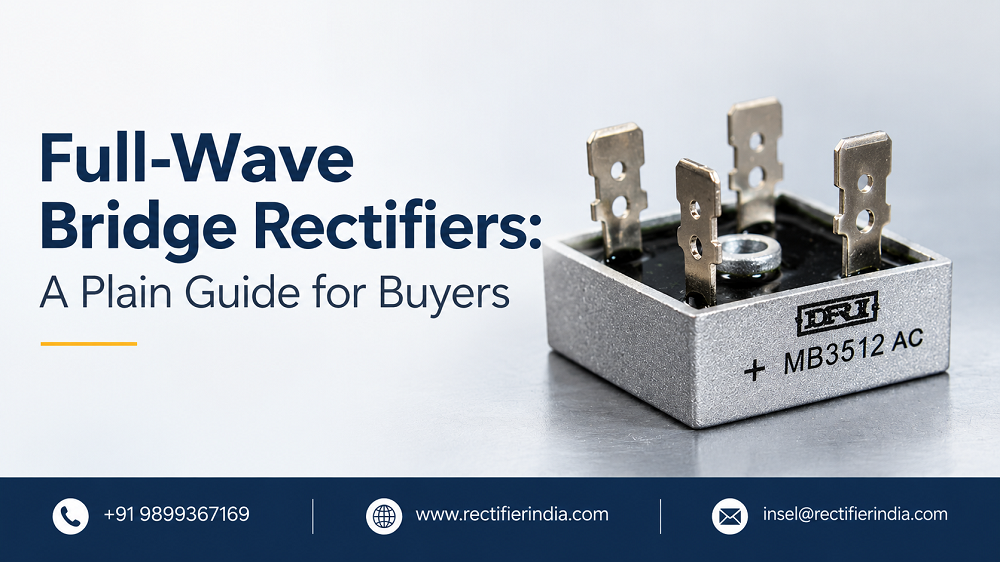
Why does a bridge rectifier drop about 1.4 V when a single silicon diode drops about 0.7? Because the current always crosses two diodes in series on its way through. Four diodes sit in the circuit, but only two carry the load at any instant.
What the bridge gives you
A full-wave bridge rectifier uses the whole AC input. On 50 Hz mains, the ripple comes out at 100 Hz, double the supply frequency, so the smoothing capacitor has less to fight. A single diode, the half-wave circuit, leaves ripple at 50 Hz and throws away half the waveform. I'd rarely pick it for anything past a toy supply.
Pair the bridge with a capacitor sized for the load. Too small and the ripple turns up as hum in audio gear. Too large and the charging surge at switch-on hits the bridge hard. That surge is the reason the surge rating matters.
The half-wave bridge rectifier mix-up
People search for half-wave bridge rectifier a lot. Strictly, it's a muddle of two ideas. A bridge handles both halves of the wave by design, and a half-wave circuit uses one diode. The nearest real thing is a half-controlled bridge, with two diodes swapped for thyristors so the output can be varied. If a quote says "half-wave bridge", ask what they actually mean before you order.
Picking a bridge rectifier manufacturer
Specs first. Look at average forward current and reverse voltage, then the surge rating, since the switch-on surge is what kills cheap parts. Don't forget about heat. A 10 A bridge on a 10 A load runs hot, so I'd leave a margin, often 30 to 50 per cent, and check the thermal resistance figure before deciding on a heat sink. Mounting matters too. A bridge bolted flat to a clean metal surface with thermal paste runs noticeably cooler than one left floating on a board. Seen the difference myself. Check the pin pitch before ordering as well, because it catches people out.
A bridge rectifier manufacturer worth trusting shares test data, not only a datasheet. I've seen two parts with identical printed ratings behave very differently on a bench, which is why a test report on your exact part counts for more than the brochure.
Insel Rectifiers is one name to check when you compare suppliers. Ask them for that report.
FAQs
Does a full-wave bridge rectifier need a heat sink?
At low currents, no. Once the load gets close to the rated current, yes, and sooner if the enclosure is cramped.
Is a half-wave bridge rectifier a real thing?
Not in the strict sense. People usually mean either a single-diode half-wave circuit or a half-controlled bridge.
What should I ask a bridge rectifier manufacturer?
For a test report on your exact part, the surge rating and the thermal resistance. If they can't produce those quickly, that tells you something.
What is the ripple frequency on 50 Hz mains?
100 Hz for a bridge. 50 Hz for a single diode.