

Starting a food business in India is exciting, but before you sell food, you must follow the legal rules. One of the most important requirements is getting an FSSAI License. This license shows that your food business follows safety and hygiene standards.
Whether you own a small home kitchen, restaurant, cloud kitchen, bakery, food factory, or online food business, knowing the right documents can save you time and avoid application rejection.
What is an FSSAI License?
An FSSAI License is issued by the Food Safety and Standards Authority of India (FSSAI). It allows food businesses to manufacture, store, distribute, transport, or sell food legally in India.
Having an FSSAI License also builds customer trust because people know your food meets safety standards.
Types of FSSAI License
There are three types of licenses based on your business size:
1. Basic FSSAI Registration
Suitable for:
- Home-based food businesses
- Small food shops
- Street food vendors
- Small retailers
2. State FSSAI License
Suitable for:
- Restaurants
- Medium-sized manufacturers
- Food processors
- Hotels
- Caterers
3. Central FSSAI License
Suitable for:
- Large food manufacturers
- Importers and exporters
- Large warehouses
- Businesses operating in multiple states
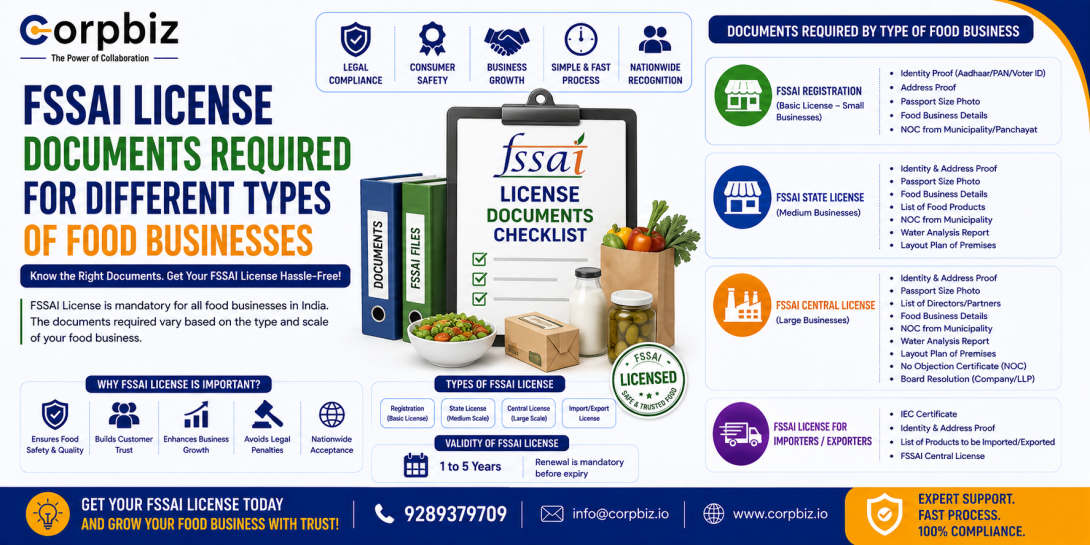
Common Documents Required
Most food businesses need these documents:
- Aadhaar Card or PAN Card
- Passport-size photograph
- Identity proof
- Address proof
- Business address proof
- Email ID and mobile number
- Food category details
These documents help verify your identity and business.
Documents Required for Different Food Businesses
Home-Based Food Business
If you prepare food from home, keep these documents ready:
- Aadhaar Card
- Passport-size photo
- Address proof
- Kitchen address
- Food product details
This is usually enough for Basic Registration.
Restaurant or Cafe
Restaurants need additional business documents like:
- Identity proof
- Address proof
- Business registration
- Rent agreement or ownership proof
- Kitchen layout (if required)
- List of food items
Many restaurants also obtain a Shop Establishment Certificate because it proves the business is legally registered under local labour laws.
Cloud Kitchen
Cloud kitchens require:
- Identity proof
- Business address proof
- Kitchen ownership or rental agreement
- Food product list
- Business registration documents
Since cloud kitchens work only through online delivery, keeping documents updated is very important.
Food Manufacturing Unit
Manufacturers generally need:
- Company incorporation documents
- Factory address proof
- List of machinery
- Water testing report
- Food safety management plan
- Product details
Larger manufacturing units usually require a State or Central FSSAI License.
Food Importers and Exporters
Required documents include:
- Import Export Code (IEC)
- Company registration
- PAN Card
- Address proof
- Food product details
- Import or export information
These businesses generally need a Central License.
Online Food Sellers
If you sell food through websites or marketplaces, prepare:
- Identity proof
- Business address proof
- Product details
- Business registration documents
- Storage information (if applicable)
Why Business Documents Matter
Many food businesses think only an FSSAI License is enough. However, depending on your business, other registrations may also be required.
For example:
- A Shop Establishment Certificate helps prove your shop is legally operating.
- If your business name or logo is unique, Trademark Registration protects your brand from being copied.
- Businesses that also provide security services alongside food operations should separately obtain a PSARA Licence, though it is not a requirement for getting an FSSAI License.
Having all required registrations keeps your business legally safe and builds customer confidence.
Common Mistakes to Avoid
Many applications get delayed because of simple mistakes.
Avoid these errors:
- Uploading unclear documents
- Entering the wrong business address
- Choosing the wrong license type
- Providing incorrect food category details
- Forgetting to renew the license before expiry
Always double-check your application before submission.
Benefits of Having an FSSAI License
An FSSAI License offers many advantages:
- Builds customer trust
- Helps expand your business
- Required for online food delivery platforms
- Supports legal compliance
- Improves your business reputation
- Makes business growth easier
Conclusion
Getting an FSSAI License is one of the first steps toward running a successful food business in India. Keeping the right documents ready makes the application process faster and smoother. Whether you own a small food stall or a large manufacturing company, proper documentation helps you avoid delays and legal issues.
If your business is growing, consider completing other registrations like a Shop Establishment Certificate and Trademark Registration to strengthen your business identity and legal protection. While a PSARA Licence is meant for private security agencies and is unrelated to food licensing, understanding different compliance requirements helps businesses stay fully compliant.
At Corpbiz, our legal experts help startups, restaurants, manufacturers, and food businesses obtain their FSSAI License and other business registrations with a simple, hassle-free process.
About the Author
Gaurav Sharma
Gaurav Sharma is a Legal Consultant at Corpbiz with extensive experience in business registrations and regulatory compliance. He helps entrepreneurs obtain FSSAI License, Shop Establishment Certificate, Trademark Registration, and other legal approvals. His goal is to simplify complex legal procedures so every business owner can understand and complete compliance with confidence.