

Modern vehicles are no longer dependent only on mechanical components. They increasingly rely on sophisticated electronic systems that can sense the surroundings, interpret information and assist drivers in making safer decisions.
Advanced Driver Assistance Systems (ADAS) are a major part of this transformation. Features such as forward-collision warning, adaptive cruise control, lane assistance, blind-spot detection and automated emergency braking depend on a complex network of sensors and electronic control units.
Behind these intelligent functions is a carefully controlled electronics manufacturing process where accuracy, testing and reliability are critical.
What Goes Into an ADAS Electronic System?
An ADAS platform can include several electronic assemblies working together. Depending on the vehicle architecture, these may include:
- Camera modules
- Radar electronics
- LiDAR-related electronics
- Sensor interface boards
- Electronic Control Units (ECUs)
- Power management circuits
- Communication interfaces
- High-performance PCB assemblies
These components collect and process large amounts of information before the vehicle's control systems respond.
How Are ADAS Electronics Built?
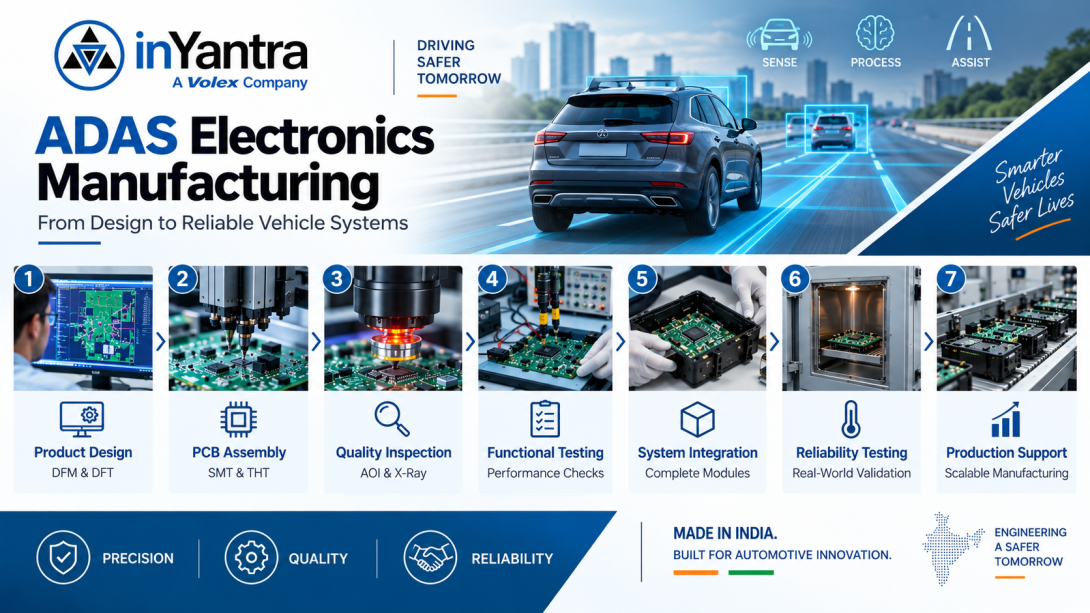
Manufacturing ADAS electronics involves considerably more than simply mounting components onto a circuit board. Each stage is designed to maintain consistency and reliability.
1. Engineering the Product for Production
Before manufacturing begins, engineers examine the product design from a production perspective.
PCB layout, component placement, thermal considerations, assembly methods and testing requirements are evaluated to identify potential manufacturing challenges early. This Design for Manufacturability approach can help improve production efficiency and reduce avoidable issues.
2. High-Precision PCB Assembly
ADAS boards often contain compact components and high-density layouts. Automated SMT equipment places components onto the PCB with controlled accuracy and repeatability.
Depending on the application, assemblies may include fine-pitch packages, BGAs, QFNs and other miniature components.
3. Combining SMT and Through-Hole Processes
Not every component is suited to the same assembly technique.
Certain connectors, power components and mechanically stressed parts may require through-hole assembly. Combining SMT and THT processes allows manufacturers to build boards that balance electrical performance with mechanical robustness.
4. Automated Quality Inspection
Inspection plays a major role in automotive electronics manufacturing.
Automated Optical Inspection (AOI) can identify problems such as misplaced components, incorrect orientation and soldering irregularities. Detecting these issues during production helps prevent defective assemblies from moving further through the manufacturing process.
5. Inspecting Hidden Connections
Some component connections cannot be examined through conventional visual inspection.
X-ray inspection provides a way to examine concealed solder joints, particularly those underneath packages such as BGAs. This additional inspection layer helps manufacturers verify assembly quality where visual methods have limitations.
6. Functional Verification
After assembly and inspection, the electronics need to demonstrate that they work as intended.
Functional testing can evaluate areas such as:
- Power performance
- Communication interfaces
- Sensor connections
- Signal behaviour
- Control functions
This ensures the assembly is not only physically correct but also electrically functional.
7. Creating the Complete Electronic Module
A PCB is often only one part of the final ADAS product.
The tested board may be integrated with connectors, cables, wiring harnesses, mechanical housings, thermal components and other hardware. This box-build or electromechanical assembly stage converts individual components into a complete electronic unit.
8. Reliability Testing
Vehicles operate in environments that can expose electronics to temperature changes, vibration, humidity and mechanical stress.
ADAS assemblies therefore require appropriate reliability and environmental testing to verify that they can maintain their intended performance under demanding operating conditions.
Why Precision Matters in ADAS Manufacturing
ADAS electronics contribute to vehicle safety, which makes manufacturing consistency particularly important.
A production strategy needs to address more than component placement. Process control, inspection, testing, traceability and repeatability all contribute to the reliability of the finished assembly.
For automotive manufacturers and Tier-1 suppliers, a capable electronics manufacturing partner can also help connect engineering, prototyping, production and testing into a coordinated workflow.
The Role of an Integrated Manufacturing Partner
A complete manufacturing approach can bring multiple capabilities together—from PCB assembly and wiring harnesses to box-build integration and functional testing.
inYantra's manufacturing portfolio includes PCB Assembly, Electromechanical Assembly, Box Build Assembly, Cable & Wiring Harness Assembly, Functional Testing and New Product Introduction (NPI) for demanding electronics applications.
This integrated approach can help OEMs and automotive suppliers move more efficiently from product development to production while maintaining greater control over manufacturing quality.
The Future of ADAS Electronics
As vehicles become increasingly connected, electrified and automated, the electronics supporting them will continue to become more sophisticated.
Future ADAS platforms are likely to demand greater computing capability, faster communication, more sensors and increasingly complex electronic architectures. This will place even greater importance on precision manufacturing, robust testing and scalable production processes.
The real challenge is not simply building an ADAS circuit board. It is building an electronic system that can consistently perform in the demanding environment of a vehicle.
Conclusion
ADAS is transforming the way vehicles interact with their surroundings, and electronics manufacturing sits at the foundation of this transformation.
From engineering and PCB assembly to inspection, functional testing, system integration and reliability validation, every manufacturing stage contributes to the final product.
For companies developing the next generation of ADAS, EV and connected-vehicle electronics, partnering with an experienced electronics manufacturer can provide the manufacturing expertise needed to turn complex designs into reliable, production-ready systems.
inYantra Technologies supports automotive electronics manufacturing with integrated capabilities designed for high-reliability applications.