

Introduction: How Voice AI Agents Are Transforming Healthcare Communication
Healthcare phone lines are overloaded. Front-desk teams juggle appointment requests, refill questions, insurance calls, and reminders, while patients wait on hold.
Voice AI agents can answer, understand, and act on many of these calls in natural speech, which is why more providers are looking at voice ai agent development companies to build assistants that fit their clinics and health systems.
Healthcare adds extra pressure. Calls involve personal health information, mistakes can affect care, and the agent has to know when to pass a patient to a human. This guide compares seven teams that can build voice agents for these conditions, so you can choose a partner based on engineering depth and verified client feedback rather than a polished demo.
What Goes Into a Healthcare Voice AI Agent
The Core Building Blocks
A healthcare voice agent chains several pieces together. Speech recognition turns a patient's words into text, a language model works out what they need, and integrations let the agent check availability, update a record, or send a confirmation. A natural-sounding voice then replies in real time.
Around that core sit call handling, identity checks, logging, and a smooth transfer to staff when a question is beyond the agent. Because every call may include health details, security and privacy controls are built in from the start.
Voice AI Agents vs Traditional IVR Systems
Traditional phone menus ask callers to press numbers and often end in frustration. Voice AI agents let patients speak naturally, handle follow-up questions, and complete tasks without navigating menus.
The trade-off is that they need careful design, testing, and guardrails so they do not guess when accuracy matters. With that foundation clear, it helps to look at where voice agents are used in healthcare.
Voice AI Agent Use Cases Across Healthcare
Voice agents are most useful where calls are frequent, predictable, and time-consuming. Here are the four areas where healthcare organizations tend to start.
Appointment Scheduling and Reminders
Agents can book, reschedule, cancel, and confirm visits by phone, then send reminders that help reduce no-shows.
To work well, they need a live connection to the scheduling system, which is why many providers plan them alongside wider healthcare software development, such as patient portals and practice management tools.
Patient Intake and Triage Support
Before a visit, an agent can collect reasons for the appointment, basic history, and insurance details, and pass a clean summary to staff.
If a caller describes something urgent, it should route them to a nurse or emergency instructions right away rather than trying to judge the situation itself.
Prescription Refills and Follow-Up Calls
Voice agents can take refill requests, check in with patients after discharge, and remind people to take medications or complete follow-up tests.
These calls are repetitive and important, which makes them a good match for automation with clear escalation rules.
Billing, Insurance, and Front-Desk Support
Patients call often about bills, coverage, office hours, and directions. An agent can answer these questions at any hour and transfer more complex cases to the right department, freeing staff for in-person care.
With these use cases in mind, the next section explains how we evaluated the teams that can build them.
How We Evaluated Voice AI Agent Development Companies for Healthcare
Healthcare calls are different from retail calls. Patients may be anxious, details matter, and privacy rules apply. We judged each team on criteria that reflect those demands.
-
Client feedback. Verified Clutch reviews were the first filter, since they show what it is like to work with a team once a project is under way.
-
Consistency of reviews. We looked at the number of reviews and recurring themes, such as communication, delivery, and follow-through.
-
Speech and language capability. We looked for hands-on work with speech recognition, natural-sounding voices, and language models that handle accents and interruptions.
-
Healthcare workflow understanding. A strong team knows how scheduling, intake, refills, and billing calls actually flow through a practice.
-
Integration capability. We checked for experience linking agents to scheduling tools, patient portals, practice management software, and telephony platforms.
-
Privacy and security. We reviewed how teams protect call data and handle HIPAA-related requirements, and whether their cloud design holds up as call volume grows.
-
Testing and safe handoff. Accuracy testing, call monitoring, and clear escalation to human staff separate a dependable agent from a risky one.
A team had to show solid engineering and consistently positive client feedback to earn a spot.
Top Voice AI Agent Development Companies for Healthcare Worth Shortlisting
Each profile below covers how the team works, what it is known for, and the key facts worth having at hand.
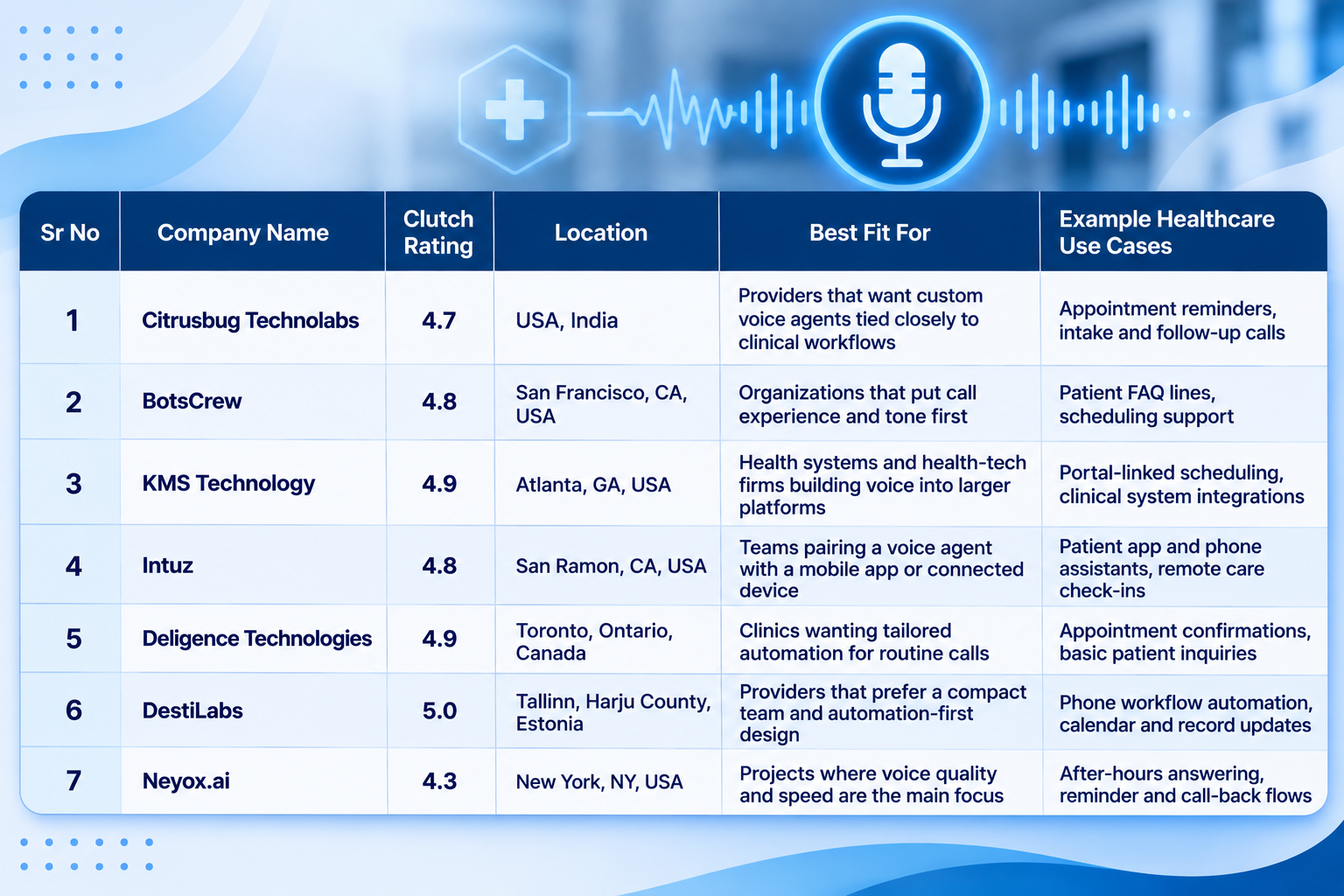
Side-by-Side Comparison of the Top 7 Companies
Use this table for a fast side-by-side view, then read the full profiles that follow.
1. Citrusbug Technolabs
Citrusbug Technolabs builds voice agents that handle the calls healthcare teams struggle to keep up with, from booking and rescheduling visits to answering routine patient questions.
Its engineers connect speech recognition, language models, and scheduling or record systems so a call ends with the task actually done.
Security-minded cloud design protects sensitive patient conversations, and AI-assisted development keeps delivery moving.
Providers comparing voice AI agent development companies often shortlist it for hands-on collaboration and healthcare-focused engineering.
Why Choose Citrusbug for Healthcare Voice AI Agents?
Citrusbug is a practical choice when a voice agent must fit real clinical workflows.
The team can begin with one well-defined task, such as appointment reminders, and extend the agent to intake and follow-up calls once it performs well.
Healthcare experience across its wider portfolio means privacy requirements and clinical terms do not need long explanations. Regular check-ins let your staff shape how the agent sounds and when it hands a call to a person.
Clutch Rating- 4.7
Founded Year- 2013
Location- USA, India
2. BotsCrew
BotsCrew approaches voice agents as conversation design problems first. For healthcare, it studies how patients actually phrase requests, then shapes call flows and knowledge so the agent sounds natural and gets to the point.
Its background in chatbots and generative AI lets it build voice assistants that pair scripted steps with flexible answers, which helps when a call touches sensitive topics.
Why Choose BotsCrew for Healthcare Voice AI Agents?
BotsCrew suits providers that care deeply about how a call feels to a patient. The conversation-first process helps agents sound calm and clear rather than robotic.
Mixing scripted flows with generative answers gives you tight control over what the agent may say about care or billing. It is a good fit if you prefer a specialist in conversational AI over a general software shop.
Clutch Rating- 4.8
Founded Year- 2016
Location- San Francisco, CA, USA
3. KMS Technology
KMS Technology brings engineering scale and a long-running healthcare practice to voice AI work. Its teams build the platforms underneath the agent, including integrations with scheduling tools, patient portals, and clinical systems.
Quality engineering is a strength here, so voice flows are tested against realistic call scenarios, accents, and interruptions before they reach patients.
Why Choose KMS Technology for Healthcare Voice AI Agents?
KMS Technology fits health systems and health-tech companies that need a voice agent built into a larger platform.
Healthcare domain knowledge helps the team understand how data should move between calls and clinical software.
Its testing discipline reduces the risk of failures once real patients start calling. Organizations with complex IT environments often value that structure.
Clutch Rating- 4.9
Founded Year- 2009
Location- Atlanta, GA, USA
4. Intuz
Intuz designs and builds AI-powered products across mobile, cloud, and connected systems, and voice agents slot naturally into that range.
For healthcare, that can mean a phone assistant linked to a patient app, so calls, messages, and the app share one view of the patient.
Its engineers handle the full path from voice interface to back-end integration, which keeps the agent from becoming a stand-alone tool that nobody trusts.
Why Choose Intuz for Healthcare Voice AI Agents?
Intuz works well when the voice agent needs to live alongside a mobile app or connected device. One team covers app, cloud, and AI work, so patients get a consistent experience across channels.
The company can take a pilot through to production without switching vendors. Providers building a broader digital front door tend to appreciate that continuity.
Clutch Rating- 4.8
Founded Year- 2008
Location- San Ramon, CA, USA
5. Deligence Technologies
Deligence Technologies develops custom software and AI solutions, and its voice work centers on automating routine, repeatable calls, such as appointment confirmations and basic patient inquiries.
The team tailors each agent to a clinic's schedules, services, and tone, so callers hear information that matches how that practice actually runs.
Why Choose Deligence Technologies for Healthcare Voice AI Agents?
Deligence is a sensible pick for clinics and mid-sized providers that want a tailored voice agent without a heavy engagement.
The team focuses on automating the calls that consume the most front-desk time. Custom development means the agent reflects your actual services and policies. It is well suited to a clearly scoped first project.
Clutch Rating- 4.9
Founded Year- 2014
Location- Toronto, Ontario, Canada
6. DestiLabs
DestiLabs builds AI-driven software with an emphasis on automation, which makes voice agents a natural extension of its work.
In healthcare settings, it can help turn repetitive phone tasks into automated, trackable workflows.
Compact project teams keep communication direct, and solutions are designed to connect with tools a practice already uses, such as calendars and patient databases.
Why Choose DestiLabs for Healthcare Voice AI Agents?
DestiLabs suits providers that want close collaboration with a smaller specialist team.
The automation-first mindset helps identify which calls to hand to the agent and which to keep with staff. Direct communication keeps decisions quick during development. It works well for focused projects with a clear workflow to automate.
Clutch Rating- 5.0
Founded Year- 2022
Location- Tallinn, Harju County, Estonia
7. Neyox.ai
Neyox.ai focuses on voice AI agents themselves, building phone assistants that can answer, route, and follow up on calls. For healthcare, that means handling scheduling, reminders, and common patient questions around the clock.
As a voice-first company, its product thinking centers on call quality, response speed, and smooth handoffs to human staff.
Why Choose Neyox.ai for Healthcare Voice AI Agents?
Neyox.ai is worth considering when voice is the core of your project, not an add-on. A specialist focus means more attention to latency, interruptions, and natural turn-taking in calls.
It can be a quick route to a working phone agent for well-defined tasks. Because it is a newer, focused company, ask for live demos and healthcare references before committing.
Clutch Rating- 4.3
Founded Year- 2025
Location- New York, NY, USA
HIPAA and Data Privacy Requirements for Healthcare Voice Agents
Once you have a shortlist, compliance is the next filter. Healthcare voice agents handle some of the most sensitive data there is, and a capable partner should be able to explain how the build meets the rules that apply to you. This section is general guidance rather than legal advice, so confirm your exact obligations with your own counsel.
Protecting Patient Information on Calls
In the US, voice agents that handle protected health information typically fall under HIPAA. That means safeguards such as encryption, access controls, and audit logs, covering not only live calls but also recordings and transcripts.
Consent, Recording, and Retention
Call recording rules vary by state and country, and some places require callers to know they are speaking with an automated system. Set clear policies for what is recorded, how long it is kept, and who can access it.
Vendor Agreements and Security Controls
Any vendor that touches patient data, including speech and language model providers behind the agent, should be covered by appropriate agreements, such as a business associate agreement where HIPAA applies. Ask for security documentation and an overview of which third-party services handle call data.
Safe Handoff to Clinical Staff
Voice agents should never give medical advice or judge how serious a symptom is. Build in rules that send urgent or unclear situations to qualified staff immediately and log every handoff. Once compliance is clear, the next question is budget.
Voice AI Agent Development Cost and Timeline for Healthcare
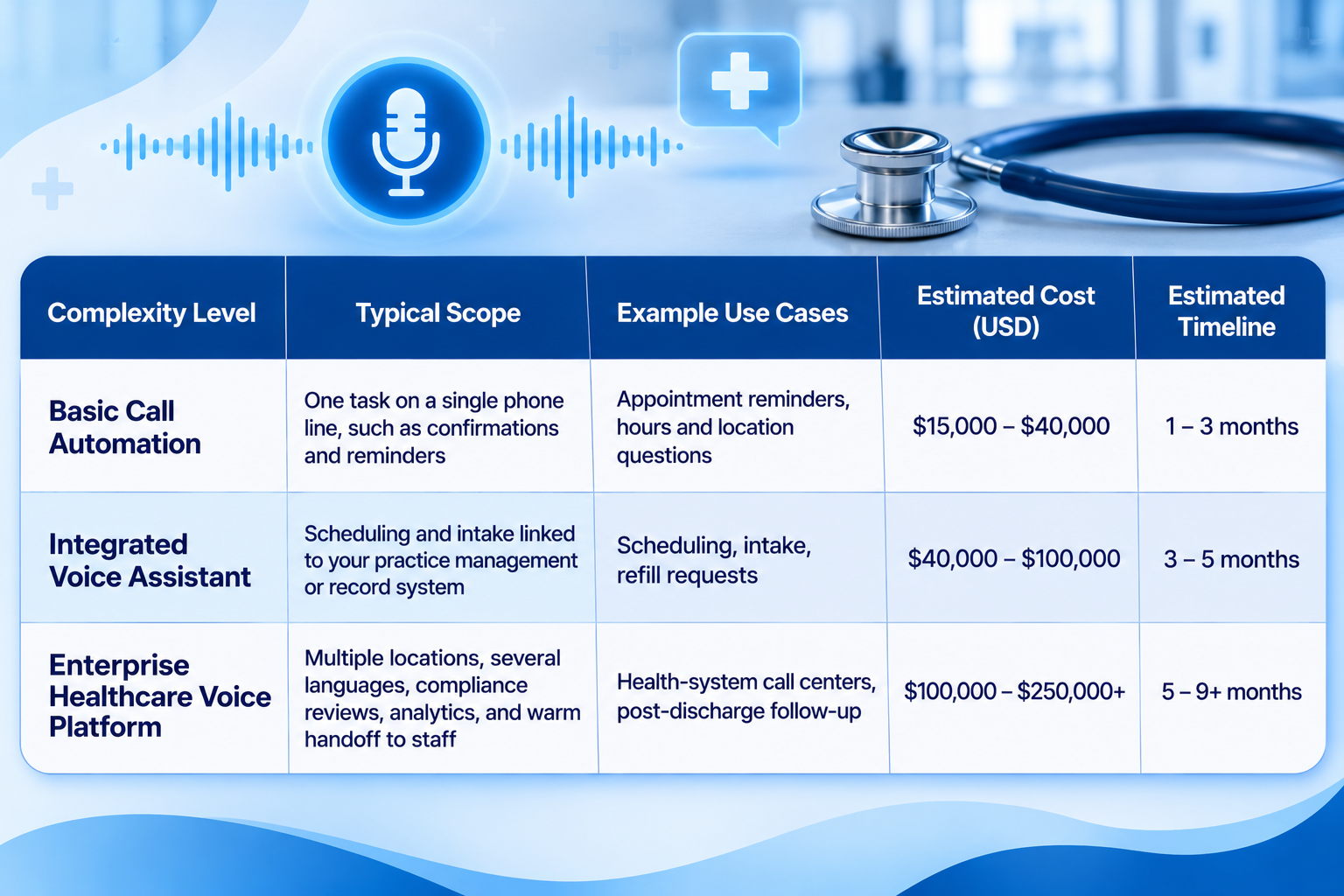
Cost and timeline depend more on scope than on any single technology choice, though healthcare projects usually need extra testing and security work.
The table below gives rough, indicative ranges for three common levels of complexity. Real quotes vary by vendor, region, and requirements, so use these figures only as a starting point for budgeting.
What Drives the Cost
- Call volume and the number of phone lines or locations.
- Depth of integrations with scheduling, records, and billing systems.
- Languages and accents the agent must understand.
- Voice quality and response-speed requirements.
- Security and compliance requirements.
- Level of testing, monitoring, and human handoff features.
Typical Timeline Phases
- Discovery and call-flow mapping usually takes two to four weeks.
- Voice and conversation design runs in parallel with early development.
- Building, integration, and internal testing take the largest share of the schedule.
- A pilot on a limited set of calls helps catch gaps before full launch.
- Monitoring and tuning continue after release.
Ways to Keep Spending in Check
Start with one high-volume call type, reuse proven components for standard features, and expand only after the first agent shows results. With scope and budget clearer, the final step is choosing carefully, which is what the checklist below covers.
What to Check Before Hiring a Voice AI Agent Development Partner
Before you sign with any of the voice AI agent development companies, put the same questions to every finalist. Each point below explains what to ask, what a strong answer sounds like, and what should make you pause.
Feedback From Past Healthcare Clients
Ask what previous healthcare clients say about communication, delivery, and support, and request a reference you can call yourself. A strong vendor names clients and shares consistent feedback. Be cautious if they avoid references or offer only hand-picked quotes.
Proven Healthcare Experience
Ask which healthcare calls the team has automated before, such as scheduling, intake, or refill requests. A good answer describes specific workflows and what changed afterward. Generic chatbot or call-center examples suggest the team is learning healthcare on your project.
Voice Quality on Real Calls
Listen to the agent on live calls, not only scripted demos. Natural pacing, quick replies, and graceful handling of interruptions are what patients will notice first. Phone the demo agent yourself, interrupt it, mumble a request, and ask something it should not answer.
Privacy and HIPAA Safeguards
Ask how calls, recordings, and transcripts are protected, and whether the vendor will sign a business associate agreement. Clear answers cover encryption, access control, and retention rules. Vague statements such as “we take security seriously” are a warning sign.
Integration With Your Existing Systems
Ask which scheduling and record systems the team has connected to before, and how each integration was tested. Specific system names and testing steps are reassuring. A vendor that says anything is possible without examples has probably not done it.
Safety and Human Handoff
Ask what happens when a caller describes an urgent symptom. The agent should pass the call to staff immediately and log the handoff. Be wary of any setup that lets the agent judge symptoms on its own.
Testing Before Launch
Ask how accuracy will be measured before go-live. Strong teams run test calls built from real scenarios and track completion and handoff rates. If there are no measurable goals, you will struggle to judge success later. Starting with a small pilot on one call type also helps you check quality before expanding.
Support After Launch
Ask who monitors and updates the agent once it is live, and how quickly problems get fixed. Look for defined monitoring, regular updates, and clear response times. A vendor that treats go-live as the end of the relationship will leave you handling issues alone.
A vendor that answers each of these with specifics, and welcomes your tests, usually earns more trust than one that leads with speed or price.
Final Takeaways: Pick the Voice AI Partner That Fits Your Care Setting
The best pick among voice AI agent development companies depends on your care setting, your systems, and how much of your call volume you want to automate.
A single clinic, a multi-location group, and a health system each need different strengths, and the seven teams above range from voice specialists to large engineering firms with healthcare roots.
Write down the calls you want to automate, the systems the agent must connect to, and your launch window. Then listen to live demos from a few firms and ask for healthcare references. If you want a partner that handles voice AI agent development with speed and care, Citrusbug Technolabs is ready to help.