

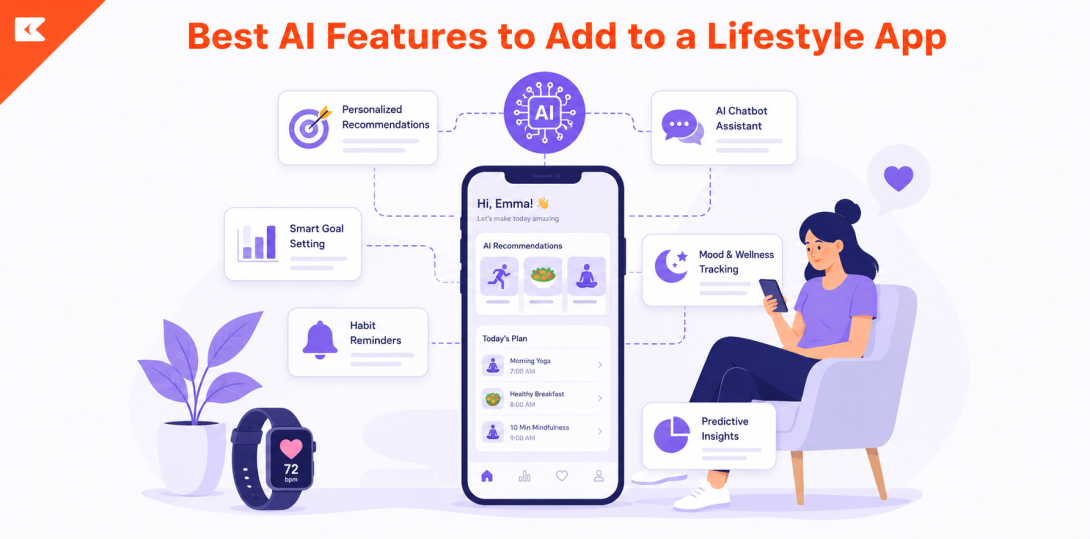
A lifestyle app succeeds or fails based on how well it understands its users, and artificial intelligence is now the fastest way to build that understanding.
From personalized recommendations to predictive wellness insights, AI features turn a static utility into a daily habit. This guide breaks down the twelve best AI features worth adding to a lifestyle app, along with the technology and business impact behind each one.
Why AI Is Becoming Essential for Lifestyle Apps
Lifestyle apps compete in a crowded market where generic features no longer hold attention. Users expect their fitness, nutrition, and wellness apps to adapt to individual routines rather than offering one-size-fits-all content.
Machine learning and natural language processing now make this adaptability achievable at scale, letting apps learn from behavioral data and respond in real time.
Beyond user experience, AI features directly influence business metrics retention, session length, and premium conversions all improve when the app feels tailored.
For teams working with a lifestyle app development company, AI is no longer a differentiator; it is the baseline users expect from any modern application.
How to Identify the Right AI Features for Your Lifestyle App
Understand Your Target Audience
Before selecting AI features, map out who actually uses the lifestyle app their age group, daily habits, and pain points. A fitness-focused audience values goal tracking and form correction, while a wellness audience prioritizes mood tracking and calm-inducing nudges.
Audience research prevents feature bloat and ensures every AI investment addresses a real behavioral need rather than a passing trend.
Align AI Features with Business Goals
AI features should map directly to measurable outcomes higher daily active users, longer session times, or increased premium subscription conversions.
A recommendation engine that boosts content discovery serves retention goals, while a chatbot reduces support costs.
Reviewing how proven lifestyle app development companies sequence their AI roadmaps can help teams rank features by expected business impact before development begins.
Prioritize Features That Deliver Everyday Value
The most successful AI features solve small, recurring problems rather than showcasing technology for its own sake. A smart notification that nudges a user to hydrate at the right moment delivers more daily value than a flashy but rarely used feature. Prioritization should favor consistency and habit formation over novelty.
12 Best AI Features to Add to a Lifestyle App
1. Personalized Recommendations
Personalized recommendation engines analyze user behavior, preferences, and past interactions to surface the most relevant content, products, or activities.
In a lifestyle app, this could mean suggesting recipes based on dietary history or workout routines matched to fitness level. Personalization increases engagement because users see immediate relevance every time they open the app, reinforcing the daily habit loop.
2. AI Virtual Assistant
An AI virtual assistant acts as a guide inside the lifestyle app, answering questions, setting reminders, and walking users through features conversationally.
Built through AI assistant development services, these assistants reduce friction for new users and keep experienced ones engaged by handling routine tasks, feeling less like a chatbot and more like a personal concierge.
3. Intelligent Goal Setting and Progress Tracking
AI-driven goal setting adapts targets based on a user's actual performance rather than static defaults. If someone consistently exceeds a step count goal, the app should raise the target automatically.
Combined with visual progress tracking, this keeps goals realistic and motivating, which directly supports long-term retention for fitness and wellness lifestyle apps.
4. Predictive Insights and Behaviour Analysis
By analyzing historical usage patterns, AI can predict when a user is likely to disengage and trigger a re-engagement action before churn happens.
Behavior analysis also reveals which features drive the most value, informing product roadmaps. This predictive layer turns raw usage data into proactive, actionable insight for both users and product teams.
5. AI Chatbot for User Support
An AI chatbot handles common support queries instantly, from subscription questions to feature troubleshooting, without waiting for human agents. For lifestyle apps with global user bases, round-the-clock chatbot support reduces churn caused by unresolved issues. Escalation paths to human support should remain available for complex cases the bot cannot resolve.
6. Voice AI Integration
Voice AI lets users log meals, start workouts, or set reminders hands-free, which matters in contexts like cooking or exercising where typing isn't practical.
Integrating voice commands into a lifestyle app removes friction from everyday interactions and appeals to accessibility-focused users. Voice AI features require careful attention to natural language understanding accuracy across accents.
7. Smart Notifications and Nudges
Smart notifications use behavioral data to send reminders at the moment they're most likely to be acted on, rather than on a fixed schedule. A hydration nudge sent during a typical low-activity window performs better than one sent at a random hour. Well-timed nudges increase daily active usage without triggering notification fatigue.
8. AI-Powered Image Recognition
Image recognition allows users to photograph a meal for instant calorie estimation or scan a product barcode for nutritional information. This feature removes manual data entry, which is one of the biggest drop-off points in nutrition and fitness apps. Accurate image recognition depends on well-trained computer vision models and a broad food database.
9. Mood and Sentiment Analysis
Mood and sentiment analysis tracks emotional patterns through check-ins, journal entries, or even voice tone to surface insights users might not notice themselves. Mental wellness apps use this data to recommend breathing exercises or connect users with resources during difficult periods. Sentiment analysis must be handled with strict privacy safeguards given its sensitivity.
10. AI-Powered Content Generation
Generative AI can create personalized workout plans, meal suggestions, or motivational content tailored to each user's goals and history. Rather than relying on a fixed content library, the app generates fresh material on demand, keeping the experience from feeling repetitive. This is particularly valuable for apps with smaller content teams and large user bases.
11. Predictive Health and Wellness Insights
Predictive analytics can flag early signs of fatigue, irregular sleep patterns, or stress buildup based on trends in wearable and app data. Studying how established wellness app development companies surface this data shows that pairing predictions with clear, actionable recommendations is what makes the feature feel proactive rather than passive.
12. Gamification Powered by AI
AI-powered gamification adjusts challenges, rewards, and streaks dynamically based on individual user behavior instead of applying the same rules to everyone. A user close to burnout might receive an easier challenge, while a highly engaged user gets a harder one. This adaptive approach keeps gamification motivating rather than frustrating over time.
AI Features by Lifestyle App Category
Different lifestyle app categories benefit from different AI priorities. Here's how the features above map to specific use cases:
- Fitness Apps: AI-driven form correction, adaptive workout plans, and predictive injury-risk alerts help fitness app development services keep users training safely and consistently.
- Nutrition and Diet Apps: Image-based food logging, personalized meal recommendations, and AI-driven micronutrient tracking reduce the manual effort that usually causes nutrition apps to lose users.
- Mental Wellness Apps: Sentiment analysis, AI-guided meditation pacing, and mood-pattern insights let wellness app development services respond to emotional state rather than offering generic content.
- Productivity Apps: Smart scheduling, AI task prioritization, and predictive focus-time suggestions help productivity-focused lifestyle apps adapt to a user's actual working rhythm.
- Fashion and Beauty Apps: Visual recommendation engines and AI-powered virtual try-on tools let fashion and beauty apps personalize style suggestions based on past purchases and preferences.
- Travel and Lifestyle Apps: AI itinerary generation, predictive pricing insights, and personalized local recommendations make travel-focused lifestyle apps feel like a knowledgeable local guide.
Key Technologies Behind AI-Powered Lifestyle Apps
Machine Learning
Machine learning models identify patterns in user behavior over time, powering everything from recommendation engines to churn prediction. It's the foundational technology behind nearly every adaptive feature in a modern lifestyle app.
Large Language Models (LLMs)
LLMs power conversational features like virtual assistants and content generation, understanding natural language queries and generating human-like responses. They let lifestyle apps handle open-ended user requests without rigid, pre-scripted flows.
Computer Vision
Computer vision enables image recognition features such as meal photo analysis and workout form correction. It converts visual input into structured data the app can act on instantly.
Voice AI
Voice AI combines speech recognition and natural language understanding to let users interact hands-free. It's essential for fitness and cooking-focused features where typing isn't convenient.
Predictive Analytics
Predictive analytics uses historical data to forecast future behavior, from churn risk to health trends. It shifts lifestyle apps from reactive tools to proactive wellness partners.
Recommendation Engines
Recommendation engines rank content, products, or activities by relevance to each individual user. They're the engine behind personalization across nearly every lifestyle app category.
How AI Features Increase User Engagement and Revenue
AI features aren't just a user experience upgrade — they move the metrics that matter most to the business:
- Boosting Daily Active Users (DAUs): Personalized recommendations and well-timed smart notifications give users a reason to open the lifestyle app every day instead of only during setup or occasional check-ins.
- Improving User Retention: Adaptive goal setting and predictive re-engagement nudges catch disengaging users early, addressing the drop-off patterns that typically hurt lifestyle app retention after the first month. A look at some of the best fitness apps shows retention consistently tracks with how proactive the AI layer is.
- Increasing Premium Subscription Conversions: Advanced AI features like predictive insights and AI-generated content plans are natural premium-tier differentiators that give free users a clear reason to upgrade.
- Enhancing Customer Lifetime Value (CLV): Continuous personalization keeps users engaged for longer periods, extending subscription lifespans and increasing the overall revenue each user generates over time.
- Driving In-App Purchases Through Personalization: AI-powered product and content recommendations surface relevant paid add-ons at the right moment, increasing conversion rates without feeling like a hard sell.
Conclusion
Building a successful lifestyle app today depends on how intelligently it adapts to each user, not just how many features it offers. From personalized recommendations to predictive wellness insights, the AI features covered here turn passive tools into daily habits.
Prioritizing the right combination based on audience and business goals, rather than chasing every trend, is what separates a forgettable lifestyle app from one users return to daily.